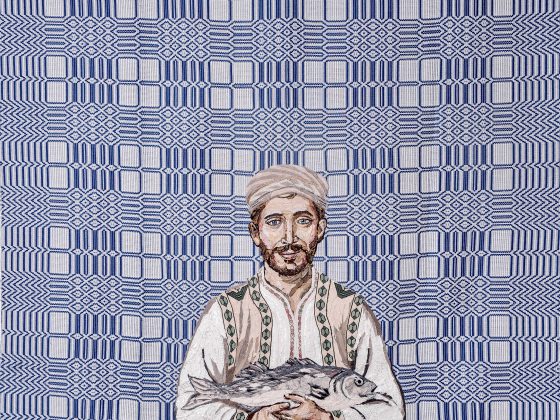
What I love about creating is that there are no limits, no rules, and it allows me to reconnect with my childlike wonder, to play, explore, follow my intuition and see where it leads me. To create with my hands gives me an inner calm that nothing else can. I love learning new things, trying, failing, and trying again. It’s a contagious energy really to create something from nothing. One idea leads to another and another. I get so excited that I can’t wait for the next day.
There’s no guidebook to being a creative, and it takes so much courage to be vulnerable and keep putting yourself out there. Lots of rejection that breeds self-doubt. It takes lots of inner work to stay positive. Over the last 10 years, I’ve learned to trust my gut, avoid situations that drain my energy, and only work with good people. When a «no» arrives, I’ve learned to tell myself, «ok, they are not your people, now go find someone else who is.»
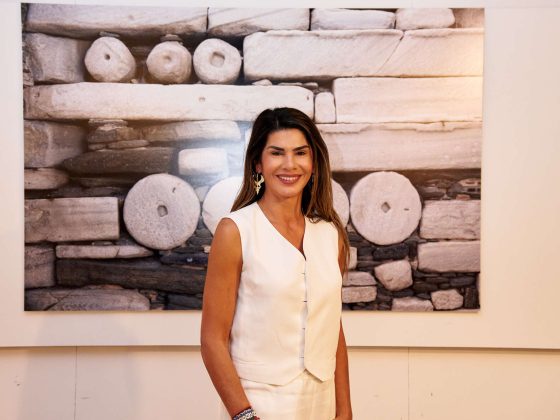
athens__mon_amour was originally created as a recording of an older Athens, an Athens that is slowly fading, with all the insensitive gentrification that is taking place particularly in and around the center.
Athens is a symphony of chaos with a pulse that defiantly refuses to be silenced. It’s a city that wears its imperfections like a badge of honor and its resilience is etched in the faces of its people. And its abundant light so engulfing and welcoming…addictive indeed
There is endless beauty in the melancholy of these decrepit buildings that I encounter. The state that they are in, although heartbreaking, can also inspire one to dream, to imagine the lives once lived, the love played out, the laughter that reverberated within those walls. Light filters through dust-laden windows, turning neglect into something almost sacred.
The amazing creative world of ceramist artist Maria Economides is full of passion and inspiration
I’ve always been into crafts — knitting, woodcarving, painting, clay. From a very young age, I needed to keep my hands busy. At a vulnerable moment in my life, clay changed me; it was as if it was shaping me while I was shaping it. It felt like a dialogue where both of us were discovering ourselves.
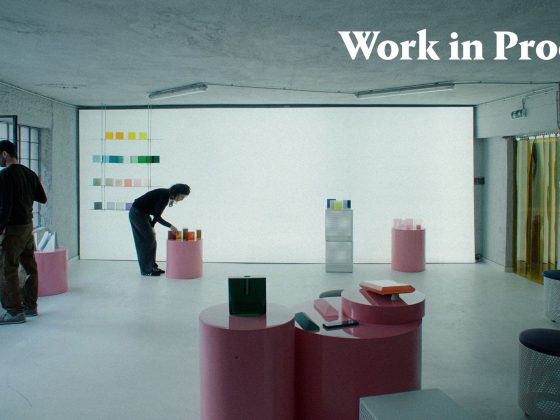
Over time, that relationship deepened. We’ve become one — we understand each other completely. I know when to touch it, when to let it rest, when to trust it. It’s a silent coexistence, a conversation without words. I build all my vessels entirely by hand, using almost no tools. I work slowly, letting the clay guide me toward its form. My pieces are thin and light, made to be held and embraced. They feel like they come from another time, yet they carry a contemporary spirit.
Through my work, I speak about memory, time, and continuity. Each vessel carries a part of me, and when one travels abroad, I feel as if I travel with it. It’s a beautiful way to exist everywhere. The beauty and strength of clay last much longer than we do. And that gives me hope — that through my vessels, a small part of me will remain for a very long time.
I evolved more as an observer than as a “designer.” Fashion gave me a field of action — without having academic knowledge of the subject and without being concerned with the ephemeral. On the contrary, I was interested in the stable, the charged, the repetitive with meaning. Creatively, I learned to stand in the interaction: how the material, the designer, the user and time converse. Creation, for me, is closer to exhibition curation than to design in the traditional sense. I connect things. I choose, I reject, I structure. It is a form of composition that is more like writing than “production”.
If there is a “secret”, perhaps it is the persistence in listening. Not only to the market, but also to the material, the time, the details. I try not to produce “noise”. I want every piece we make to have a reason for being and to be able to stand beyond its time. I am interested in relevance as a place of observation, not as a goal. And I believe that relevant work is that which remains silently in the life of another and continues to mean something after the initial excitement.
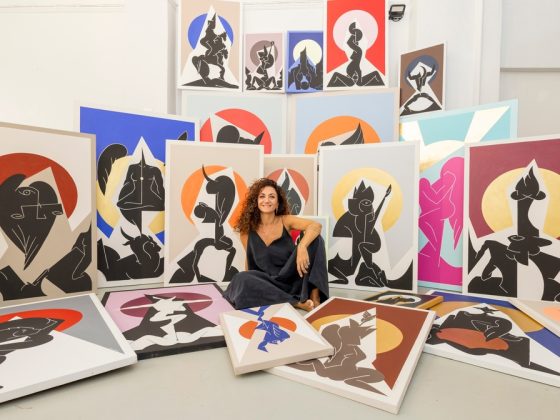
First of all, curiosity, the need to remain creative, alive and useful. The issue of work is very important to me, to create the conditions for me to have something to do. Inspiration or an idea can find me anywhere. A thought, an image, an experience. I note it down in writing or in my mind and process it with a (pre)plan. The important thing is to deal with what we call drawing or painting almost daily.
In my work, the circles, the semicircles, come from modernism and design, from Ben Nicholson and Calder, the furniture of Gio Ponti, the sculptures of Anthony Caro, and the pure forms of the great illustrator and graphic designer, Paul Rand.
I often wonder what makes us return to our roots. Is it the need to remember or the need to continue? Maybe both. Geneteira was born from this question. It did not begin as a project or a professional ambition, but as an inner need to keep alive everything that raised me, my grandmother’s voice, the light of Crete, the stories that were heard around a table. I grew up in Rethymno, in one of the oldest families in the place, where every object had its own story. Our house was full of family heirlooms, jewelry, handicrafts, woodcarvings, and old furniture that had been passed down from generation to generation. This chain of transmission, from grandmother to mother and from mother to me, became the occasion for me to understand what the word “homeland” really means. It is not only the place where we are born, but also the way we continue to exist through our people, their stories, and their memory. When I had my daughter, the need to pass on this heritage to her became even more intense.
Geneteira is, above all, an attempt to keep this memory bright, to make it a living practice in the modern world.
In truth, Greek design has the power to speak to every culture — especially when it draws inspiration from, and extends, our own heritage. If there’s something we must overcome, it’s ourselves — our tendency to constantly incorporate unaltered elements from the design of other countries and creators. Perhaps blending them, rather than swallowing them whole, could be a good and alternative approach.
Greece is the marble, the white, the cypress trees, small fried fish with onion in a taverna, anise, ceramics, round pebbles, rocks, waves, the sky with our own kind of blue, the blackbirds hidden in the arbutus trees, grape spoon sweets, whitewashed flowerbeds, stone walls, homemade bread, buried statues, little lights in the distance, courtyards, olive oil, songs. It’s everything born from the talent, the nature, and the kindness of its people. And it’s a lot.
The world is not only what you see, but also the way you illuminate it within yourself. I was always captivated by the movement of time across things, by decay, by the rhythms of nature, by the body within space. I constantly sought a way to make time visible—not as a snapshot, but as a flow that penetrates the image and gives it life.
My aesthetic evolves organically, although the core of my exploration remains the same. In my early works, through photography, video, and performance, I explored the limits of the self, of identity and corporeality, often through theatricality and irony. Over the years, this language became more internal and more abstract.
Creativity is a state of being. The creator cultivates the ability to listen—to grasp what already exists around and within, before it takes form.
For me, this is creativity: to make space, to allow the unknown to emerge, and to trust yourself enough to follow it.
I truly believe that wherever I have reached—whether it is mediocre, good, or very good is not for me to judge—I reached as a result of the everyday moments of my professional journey. It is not just the degrees; it is not the doors that I was lucky to have opened in my life; it is not the people I met who trusted me; it is not the recognizable positions. It is not the big moments when the spotlight falls on you.
It is the unseen daily efforts, the victories but also—and perhaps more importantly—the defeats, the way we manage both, the consistency, the relentless work, the teams built along the way, the relationships with the people you meet, giving first before expecting to receive, seeing the goal and not losing focus on it, keeping your head down, doing all tasks—both the easier and the less significant—with attention to detail.
There are many more things I could mention, but they all share the same essence, the values of everyday life. The big moments were what fueled the continuation of the effort; they did not bring the next success. After all, big moments usually come with risk, and with the danger of someone feeling invincible and making mistakes.
Evolution is always the result of growth; when you grow and make use of all your abilities, then you move on to the next stage. Art exhibitions in their conventional form require knowledge from the viewer, and very often they impose opinions. Visitors today are well trained, and to capture their attention you need to interrupt the script of their visit. You need to confuse them—and that’s usually what I do.
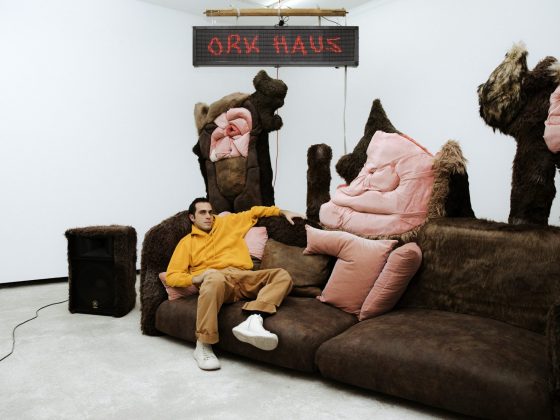
All environments tell stories—you just need to know how to read them. To capture the reader’s attention, I create environments of Typological Complexity. An archaeological excavation inside a communist party building that is also a nightclub, a playground, a discussion space, and a sex club. The stories told by such a space don’t focus on an official narrative, but on the countless micro-narratives that are usually omitted by historians and archaeologists. The Parthenon interests me the way archaeologists first discovered it: one part was a church, another a mosque, but also a munitions depot, a national symbol and a national ruin. The way such opposing interpretations coexist is what we call art.
I use pills and their packaging both for their aesthetic value and because they act as carriers of meaning and associations. The pills with their various colors and shapes, the capsules and blister packs with their transparency and shine, or the aluminum blisters that are small sculptures in themselves, create a multitude of materials and ideas that I use just as another artist might use paints, clay, mosaics, etc. In my chandeliers the transparent capsules become small crystals reflecting light; in my shields the blisters give the impression of an impenetrable metallic surface; in the “wallpaper” made of pharmacy bags the orderly accumulation of plastic becomes a contemporary palimpsest of city imagery. The possibilities are endless.
I believe that over the years, although I continue to work with themes of healing and medicine, my work evolves both on the level of meaning—as I constantly examine different facets of these themes—and on the level of form, materials, and mediums. Medicine and healing are a large “umbrella” with many subtopics related to science, our lifestyle, and contemporary issues, all of which serve as sources of inspiration for me.
Design entered my life when I dropped out of university and began working to support myself as a craftsman in a workshop for special constructions, mainly serving the film industry. Being in contact with craftsmen, designers, art directors, and architects motivated me to “look into it” more seriously and begin my design studies while working.
The experience I gained working on special constructions for cinema and the fact that I had access to a fully equipped workshop with tools and materials, sparked my first creative steps.
What I am truly proud of is the fact that everything I have achieved has been built from scratch — very carefully, with patience and a lot of work. My persistence in creating and expressing myself through design, relying on my own strengths, is what gives me the drive to keep moving forward.
Authenticity is not perfection. It is an inner experience — genuine and unique, despite its flaws and imperfections.
The authentic does not make noise; it prevails quietly. It relies on its own intrinsic nature.
The greatest achievement was being able to express my creativity to its fullest. Carla Sozzani and Condé Nast gave me the freedom to create without constraints, with complete trust. That was pivotal. It allowed me to bring out everything I had carried within me since childhood—the creative spark, my love for fashion, art, and beauty.
I travelled to extraordinary places—New York, Milan, Los Angeles, across America—and loved each of them deeply.
But India is a piece of my heart; I have adored it for years and have dear friends there. And of course, I love Greece profoundly—my homeland.
Fashion was a passion from the time I was little. I had a natural instinct for aesthetics, beauty, and imagery.
I’m not really into “designers.” I’m not interested in the signature on a garment, nor do I have idols. I appreciate talent, of course, but overall I prefer vintage, well-made, distinctive pieces.
I like wearing unique items, often made by me, crafted from old fabrics with character. Wearing my own identity—not someone else’s.
In every era, the role of intellectuals is fundamental. They are the ones who protect and strengthen a society’s ability to think, to feel, and to envision. They give us the tools to understand reality on a deeper level. They transform chaos into narrative and remind us that the essence lies not in what makes noise, but in what reflects—and creates.
I have a special interest in destinies that serve as points of reference, and in how these destinies inscribe themselves in the greater human adventure. These are individuals who, by example, show that to advance one must remain faithful to one’s vision—and above all, dare. I have always been fascinated by what makes a person become who they are. How their myth is formed. And I refer not only to myth as a model to emulate, but also as narrative. For a fundamental element of the human spirit is storytelling. We understand life through the recounting of events, situations, and experiences. This is what inspires and mobilizes us, what we transform into vision in order to move forward.
I believe that goodwill and a thoughtful approach to a subject inspire a sense of safety and trust in the person you’re speaking with. To engage in meaningful dialogue on any topic, you must truly understand it.
With no prior experience working with thread, I was drawn to it while searching for a material that could offer a warm expression of light. Thread had always seemed to me like a primordial material, usually used in more traditional ways—I admired it in woven textiles, which are true works of art—but I began to see that it could also become a three-dimensional “garment” for illuminating different types of objects.
I started designing and crafting the Reywal pieces with thread. Using thread as a material carries memories of tradition, now reimagined through light. At first, the light was simply encased within its conventional form, but as the work evolved, I discovered that thread offered great freedom. It became a tool for contemporary expression, enabling new themes and visual languages. Starting with a single thread, you begin to create your own world.
Katerina Psoma and her Bla Bla collection connects women in an authentic way
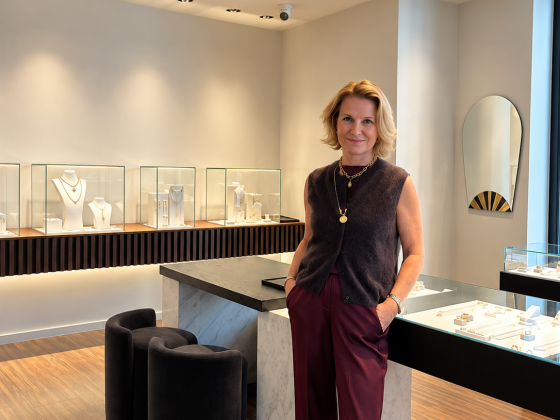
I could never have imagined how fascinating this concept would be. How someone defines themselves through a single word they dare to wear around their neck. It has to do with our identity and how we connect to the outside world. Some women chose their own names, others chose the initials of their children, and then there were words that reflected who they are—like the word “joy.”
That evening was a celebration of uniqueness—how each one of us carries something special and expresses it through a piece of jewelry. It was truly touching to see women who didn’t know each other begin talking, laughing, embracing. It was something truly emotional. Of course, the Wait and See store is a place that naturally brings people together through its unique identity.
When it comes to achievements, I think I am quite strict with myself. I’ve done many things in my life, but I focus on the essentials: being a good mother, a good friend, a good daughter. And leading a team that creates beautiful jewelry. I love that I help women feel stronger and more beautiful in their everyday lives.
Being Greek, especially while living mostly abroad, it’s almost impossible to escape your history, because it always finds a way to follow you. That’s how the story of the amphorae began. I knew that in ancient Greece there was a minority of amphorae that were made of gold. These were used either as funerary or devotional objects by mortals offering them to the gods — to seek favours or simply to show admiration. In this sense, my pretend-to-be-gold amphorae are my own offering to the contemporary “pantheon.”
Greece is at the core of my work. It exists in the form, in the light, and in the reference to the sacred. Ideally, I would like the viewer to feel a sense of familiarity as if they recognise something from the past, yet are simultaneously surprised by its contemporary expression. I would like them to feel calm, harmony, and perhaps even reflect on what we consider precious today. To see Greece as a living source of inspiration rather than a static museum.
Architecture has always been the way I think and create. It taught me how to see form, proportion, light, and the space that surrounds the body. Over time, though, I felt the need for a more immediate, more tactile form of expression something handcrafted, something you can touch and wear.
The first idea was born precisely from that need: to unite the discipline of architecture with the organic nature of the body. Jewelry became, for me, a form of micro-architecture, a structure that carries emotion, history, and identity within it. That is where everything began, as a subtle shift that gradually evolved into an entire journey.
My jewelry naturally evolved into small sculptural forms, as I have become increasingly interested in their relationship with the face and the movement of the body. Eccentricity and unconventionality are not goals in themselves, but rather outcomes of this exploration. I am moving toward pieces with a stronger presence works that function as statements while maintaining structural clarity.
Being part of London’s artistic ecosystem has shown me the unseen labour behind exhibitions; the long studio hours, curatorial processes, logistical coordination, and emotional investment involved in bringing art to the public.
What impressed me most is how fluid the field is: artists become curators, illustrators discover they can write, and creatives transition across roles they never imagined. This interconnectivity revealed that the art world is not linear and helped me realise that beyond creating art, I am naturally drawn to research and the market side of the arts.
Illustration is what I have found best represents me and the ideas I want to communicate, although painting and printmaking remain my foundations, and is possible for me to turn to these mediums again in the future, for now I find illustration mixed with watercolours and pen drawings to be what I love most doing. I think it also has to do with easier access and ability to work from anywhere without having a studio, allowing me to capture my ideas instantly.
Over a decade ago, my sister and I combined our studies and love for Greece, storytelling, and art to launch our passion project Portes. Initially, we started with the goal of bringing an authentic piece of Greece back to the Greek-American community. Since then, our Portes family has grown globally, inspiring people well beyond the community we first wished to address. This is something I am immensely proud of and gives me the motivation to continue discovering such wonderful people and exchanging inspirational stories with them.
Greece’s natural beauty has forever inspired its inhabitants and those who passed through. From shaping clay drawn from the earth into art and everyday objects, to developing an inquisitive seafaring culture guided by the sea, nature has continuously fueled creativity and innovation.
Creativity has always been within me. I feel it’s in my DNA, in the way I grew up and in the freedom I had from a very young age to feel and express it—without “shoulds” and without a predefined direction. That freedom was crucial, because it allowed me to develop my imagination and perspective naturally, without fear. For many years, this creative energy was expressed through my work in communication, where I learned how to organize inspiration and give it structure. At some point, however, I felt clearly that what had always existed within me was asking to come to the forefront.
Art didn’t appear suddenly in my life. Rather, through my choices and experiences, it gradually moved into a leading role. From a tool, it became a personal language. Over time, it was shaped through lived experience, travel, my connection to Greece, and the need to express something true, bright, and meaningful.
Today, art is a natural continuation of who I have always been: a way of existing, communicating, and evolving—while remaining faithful to the freedom and emotion that defined me from the very beginning.
The exhibition “Be earth no more” by Myrto Papadopoulou in Arch Workshop, Arch Athens
My journey in ceramics was not linear but organic, much like the material itself. My studies were followed by periods of intense searching, experimentation, and hands-on practice, along with collaborations and exhibitions that helped me better understand my position within the contemporary art landscape. Every step—even moments of doubt—brought me closer to developing my own visual language.
The first idea emerged from a need for contact with something tangible and grounded. Ceramics allowed me to combine thought with the body. Over time, this initial attraction evolved into a conscious choice: I began to see clay not only as a material, but as a carrier of memory, time, and emotion. My practice matured through constant experimentation and an acceptance of uncertainty.
Over the years, I’ve moved away from excess and closer to essence. Today, I believe design gains value when it is conscious, sustainable, and emotionally honest. An object should enter into dialogue with its user and be able to withstand time.
Anyone creative and artistically minded around me helps me, even subconsciously, to open my mind and dismantle conservatism, limits, and barriers that I often place on myself.
Anthologist was an instinctive response to a missing layer in design. The space where my obsession over atmosphere converged with my lifelong love of objects, artisans, and the small details. In other words: I noticed the gaps, and I did what I always do. I stepped right into them.
Given my background in travel, I’ve spent my life around makers, ateliers, workshops, and markets. My mother would drag me down back alleys in the Caribbean to find an artisan and I carried that sensibility through to my adult life. Over time, I realized I’d built a network of artisans and objects that deserved a more intentional home. Anthologist was simply the natural next step.
What I respond to is material intelligence, pieces that are well made and have a solid rooting in their culture. I’m often drawn to irregularity, too. It keeps us honest about life.
Anthologist feels like an extension of everything my parents taught me: the importance of handwork, the power of collecting with intention, the belief that objects carry stories across generations.