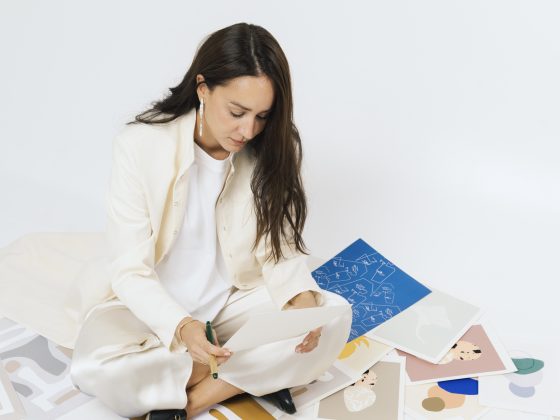
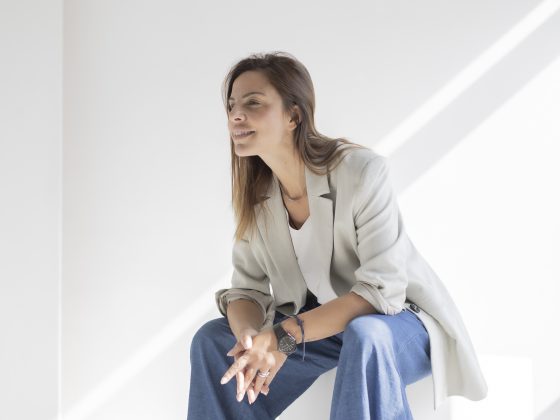
All started with a sense of “uncoordinated fullness” for Vasiliki Zafiria Ypsilantis. She had many different interests: development planning, event organization, place design, supporting local communities, functional aesthetics, space, the materials of her region. She wanted to unite them into something that would be unlike anything that already existed. Mantility was born as an experiment — how a piece of silk can tell a story, generate thought, activate dialogue between creators and users. Along the way, the journey acquired rhythm, people, and scope. It evolved as a research laboratory on matter, memory, and contemporary identity — in the form of silk scarves.
How did you evolve in relation to fashion and creation?
I evolved more as an observer than as a “designer.” Fashion gave me a field of action — without having academic knowledge of the subject and without being concerned with the ephemeral. On the contrary, I was interested in the stable, the charged, the repetitive with meaning. Creatively, I learned to stand in the interaction: how the material, the designer, the user and time converse. Creation, for me, is closer to exhibition curation than to design in the traditional sense. I connect things. I choose, I reject, I structure. It is a form of composition that is more like writing than “production”.
How easy is it to create in Greek fashion?
The difficulty is not in inspiration; Greece fills you with images, shapes, intensity. The challenge is in production, in organization, in duration. The fashion space in Greece remains fragmented, with few fixed structures. On the contrary, independent design operates more flexibly. There, islands of resistance, of creative survival, are created. When you work on a small scale, with respect for materials and craftsmanship, you can create space for meaningful things. It’s not easy — but it’s possible, and it has depth.
❝ For me, design is a tool for thinking — and that thinking can translate into many things. I'm as interested in the material as I am in the content. And everything we design, I want to carry a story, a quiet reflection on how we live, how we choose, how we remember. ❞
The highlights of your career and the store in Kavala
There are many highlights — but the most important are the moments of understanding. When I felt that what we do is not just “nice”, but important to some people. The store in Kavala functions almost like a social workshop: it is a showroom, a library, a gallery, an experimental space, a meeting point. There I see how the idea is translated into practice. How a visitor from the Netherlands, a lady from the neighborhood or a child on a school trip connect with a painting, in completely different ways. That is, I think, the biggest “highlight”.
Tell us about this year’s collection, what is special about it.
We do not operate with the term “collection” in the traditional sense of the fashion calendar. Every year we collaborate with 5 to 10 independent designers, choosing to produce new limited-edition scarves based on the dynamics of each one: the idea, the line, the point of contact with the public. Diversity is central to our approach — different styles, influences and narratives coexist under a common curatorial umbrella, aiming to create not “an aesthetic”, but a dialogue of views on silk.
What is the secret of your success that makes your work relevant?
If there is a “secret”, perhaps it is the persistence in listening. Not only to the market, but also to the material, the time, the details. I try not to produce “noise”. I want every piece we make to have a reason for being and to be able to stand beyond its time. I am interested in relevance as a place of observation, not as a goal. And I believe that relevant work is that which remains silently in the life of another and continues to mean something after the initial excitement.
❝ The most interesting element is the unexpected use: people wearing our scarves not just as accessories, but as carriers of identity, memory, or intention. Their use activates a kind of “personal performance” — sometimes they function almost like amulets.❞
Tell us about the collaborations that have been milestones in your journey and your most recent one
Some collaborations act as catalysts. They are not necessarily the “biggest” ones, but the ones that open up new paths — creatively, institutionally, humanly. The first such collaboration that comes to mind was with Ms. Missirian and the MOHA Institute. Together we set up an impressive exhibition at the Imaret Hotel, in the midst of COVID — an almost impossible situation. That collaboration brought us into contact with a new audience, gave us visibility, and opened channels that are still working. A second special experience was our collaboration with BREATHE and the creation of “Scarf of Hope.” It was a project with an aesthetic and social impact, culminating in the emotional moment when we saw our scarves at the closing ceremony of the Olympic Games, worn by the Greek Olympians. Contributing to an initiative with such social significance — and at the same time seeing your work participate in a historical moment — is a thrill that cannot be duplicated. As the most recent, I would single out our collaboration with the Athens and Epidaurus Festival and the creative agency Beetroot Design for the anniversary scarves of the Festival’s 70th anniversary. Each of these collaborations had its own rhythm, its own challenges, and its own impact — and each time, I learned something new about how aesthetics can be transformed into a tool for dialogue.
What is Perasma, how did you relate to it, and what exactly did you create?
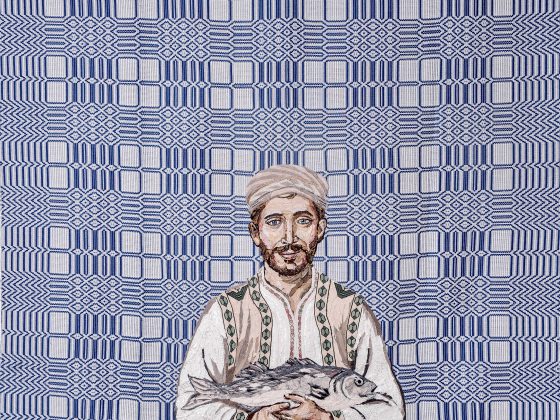
Perasma is an international artistic platform and at the same time a highly structured meeting ground between contemporary creators, local communities, and international networks. It was designed by Burcu, Gizem, and their team as a multidimensional environment for the production of culture. We were asked to produce and curate objects and scarves. During the seven days of the installation of “Hagiati” as the exhibition shop calls it, Leros became a landscape of concentration for us: we came into contact with works by leading and emerging artists, such as William Kentridge, Eugenia Vereli and Joline Kwakkenbos, we spoke with fashion consultants such as Robert Rabensteiner, we presented our work to international journalists such as Ricardo from Vogue Italia, we reconnected with friends who know the place in depth, such as Fotis Vallatos and we were introduced to the localities of Leros thanks to people such as Nikos Fokas, Ioanna Asmeniadou and Mario Monzini. As part of Perasma, Epàrchîa Design Boîte presented a curated collection of objects: ceramics, porcelain and jewelry. 15 different silk scarves were designed especially for the Leros Project by Ioannis Tsigas, and were produced in limited editions. In addition, We have launched a new collaboration with Dutch artist Joline Kwakkenbos, who has created a unique design for us on the silk canvas we provided her. This work will be released as a collector’s scarf, in a limited edition of 100 numbered copies. We see this collaboration as a natural continuation of the dialogue between material, art and the artisanal transfer of experience.
What is your favorite scarf ever
The truth is that all the scarves in the collection become my favorites when worn at the “right” moment. The relationship is dynamic, not static. And perhaps this variability is the most interesting element: that an object can acquire new meaning over time, without changing at all.
What do you get from those who wear your scarves and what is your ultimate goal
The most interesting element is the unexpected use: people who wear our scarves not just as accessories, but as carriers of identity, memory or intention. Their use activates a kind of “personal performance” — sometimes they function almost like amulets. In this context, the scarf is not just a material object; it is a projection surface, a carrier of emotional and aesthetic information. My ultimate goal is to create objects that produce meaning. Not in the sense of a symbol, but in the sense of an active point of contact. To connect the user with the object, not only through the image, but through use, touch, repetition. If anything remains, it should be the relationship that is created. Essentially, I want us to be consistent with the tagline of MANTILITY: “The Mentality of Silk”.
What else do you design besides scarves
MANTILITY started with the scarf, but personally I never wanted it to be limited to that. For me, design is a tool for thinking — and this thinking can be translated into many things: a handmade soap, a ceramic vessel, a painting, a glass of wine. I like to work interdisciplinary — mainly with conceptual coherence and then with commercial feasibility. I am as interested in the material as the content. And everything we design, I want to carry a story, a quiet reflection on how we live, how we choose, how we remember.
Give us your own definition of beauty
Beauty, for me, is not an aesthetic result; it is a perceptual function. It is the moment when form, materiality, and intention are coordinated, without any need for explanation. We do not all perceive it the same way, because it activates internal memories, cultural perceptions, and physical experiences. In essence, it is a form of harmony — not necessarily symmetry — between what you see, what you touch, and what you feel. When an object or an image functions consistently toward its purpose and essence, then beauty emerges. Not as decoration, but as a phenomenon of understanding.
❝ We launched a new collaboration with Dutch artist Joline Kwakkenbos, who created a unique design for us on the silk canvas we provided her. This work was released as a collector's scarf, in a limited edition of 100 numbered copies.❞
What are your next steps
What concerns me most at this time is the relationship between growth and cohesion. I want MANTILITY to continue to evolve without overflowing. We are planning a selective physical presence in Athens — not just to “be there,” but to create a space for experience, not consumption. At the same time, we are building international partnerships with institutions and creators who share the same way of thinking, without losing the quality of the small. We are interested in reconsidering the role of objects today — what they serve, what they mean, where they lead. The next steps will not necessarily be big. They will be more conscious.
The best advice you have ever been given…
“Don’t promise anything with your work that you can’t support with your life.” This phrase accompanies me. It reminds me that the profession is not cut off from ethics. That aesthetics without values is decorative. And that, ultimately, the way we produce, collaborate and communicate says much more than the product.
The dream project you dream of
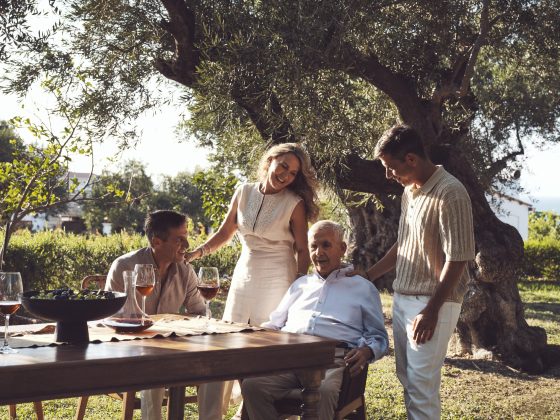
Since I was little I have said that I want to create an “artists’ village”. Now I simply mention it in modern terms. A small residency-workshop on an island or in Kavala — for artists, poets, designers, writers. A house near the water, with a garden, books and a large common table. Clichéd but authentically Greek. Not as a “hospitality space”, but as a place of inner reconstruction. To be able to work quietly, to share thoughts, to try. To have time without stress, silence without loneliness, collaboration without pressure. And in the evening — dance. Not as a release, but as an expression. Dance as an extension of thought within the body, as a ritual of everyday life. A small community of essence, reminding us that creation is first and foremost an experiential experience.
Note from the Founder
I am often asked what MANTILITY is. A brand? A collection of scarves? A gallery on silk? And every time the answer changes — not because the essence changes, but because MANTILITY is on the move. It is a framework that is shaped by the people who encounter it: the designers, the collaborators, the visitors to the store, those who wear the scarves and are “left with” something. I believe in the power of small things that are made with thought. In the importance of matter when it has intention. In slow, studied creation. The one that leaves space, but is not indefinite; that withstands time, because it was not made to be “consumed”, but to be integrated into life. If there is one thing I wish for the future, it is that we can work less “to produce” better and “to exist” more in what we make.