You have had a remarkable career and established yourself as a talented architect and designer who continually impresses us with the spaces you create. Which moments or milestones do you consider the most defining and important in this fascinating journey? Tell us about your story and how you became involved in architecture and design.
Well, it has been a work in progress. I have to say, my journey has been anything but linear. I have been extremely lucky in my life, but I have never arrived where I was going in a straight line. Over time, I have come to realise that these roundabout experiences have shaped who I am and how my work differs from others in the field.
I originally studied computational structural engineering at the National Technical University of Athens (Metsovio Polytechnio). My thesis focused on computational form-finding and coding methods that enable the design of minimal structures using the finite element method. This type of study later proved closely aligned with my architectural education at the University of Pennsylvania, where I studied alongside computational deconstructivists such as Thom Mayne and Tom Wiscombe.
Having studied civil engineering in Athens gave me a significant advantage over my peers. I was able to accelerate my architectural studies and involve myself in final-year courses while still in my first year. That experience gave me an edge in internship applications and ultimately led to a position with Matthias Hollwich, where I worked on the design of a winning competition proposal for the MoMA PS1 pavilion. This work caught the attention of a recruiter from the studio of Elizabeth Diller and earned me a place at the design table.
Liz Diller has been both a mentor and, in many ways, family to me. The studio’s focus on design, conceptual thinking, and intellectual discourse is unmatched. It felt like an advanced educational environment while technically being professional practice. This was very different from engineering school, or even my studies at Penn, which were more digitally driven. At DS+R, the emphasis was on critical thinking, programmatic and performative architecture, and architecture’s intersection with art and civic life.
The upheaval of the pandemic led me to launch Manhattan Projects New York (MPNYC), a studio that, while not strictly based in New York, strives to produce work inspired by my formative years there. More recently, I have divided my time between New York, London, and Athens. Geography is less important to me than ensuring I work with the right group of clients, people interested in exploring and challenging architecture in a more adventurous way.
What is your philosophy in the way you approach a space? How do you feel your design evolves, and how do you yourself evolve through this process?
The studio is dedicated to enduring architecture in an era of compulsive novelty. Rather than adhering to a singular aesthetic that risks locking buildings into a disposable cultural moment, MPNYC merges techniques, styles, and references from different periods and disciplines. The result is a deliberately ambiguous body of work, neither classical nor contemporary, local nor global, artisanal nor engineered, minimal nor ornamental.
Rather than being defined by a particular aesthetic, the work is driven by process. Each project begins with a core idea drawn from idiosyncratic external references and unexpected triggers, which are then filtered and shaped through a minimalist, modern sensibility.
Is there a methodology in the way a new project develops, and how easy is it to make decisions during the design process?
I feel that I always have to trust the process. When a project begins, I can usually identify very quickly “the what” , what it will be about and the core idea it will orbit around. What I don’t know at the beginning is “the how”, how it will ultimately be executed; that comes with time. I try to listen carefully to the constraints as they arise within each project, to go with the flow, and to look for inevitabilities.
I strongly believe in doing more with less, not in a Miesian sense, but in the belief that you need to understand what a project is truly about and commit fully to that central idea, almost against popular belief, I like to put all my eggs in one basket and being “lazy” with ideas: using fewer ideas, but making them stronger.
What types of projects are included in your range of explorations, and which ones do you prefer?
I don’t choose the type of project, I look for the right clients, the ones with whom I can build the right relationship so that, together, we can discover what the project wants to become. Right now, my main focus is a residential project with a truly unique client. The process feels deeply synchronized, and together we are searching for singular answers to domestic questions.
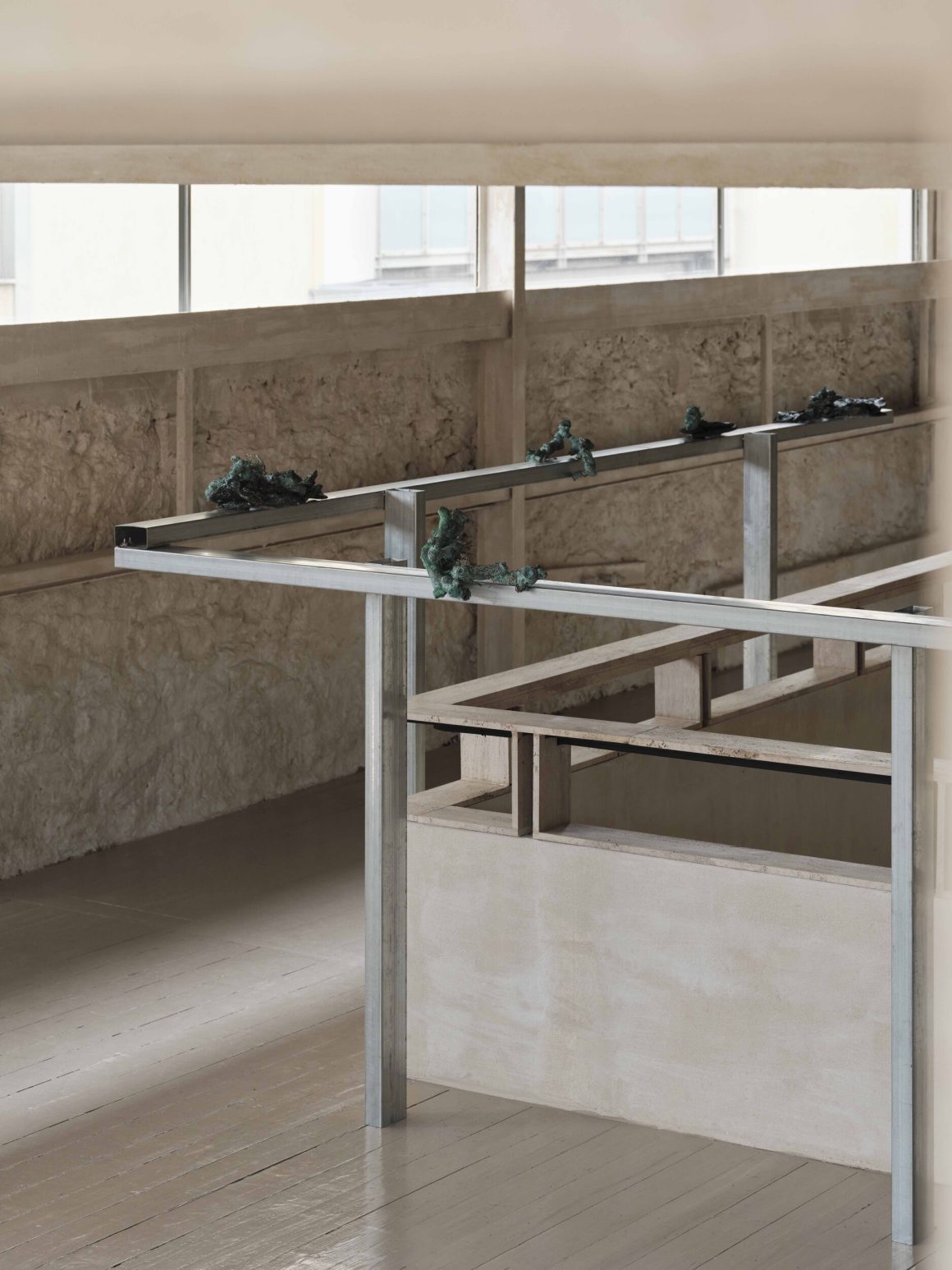
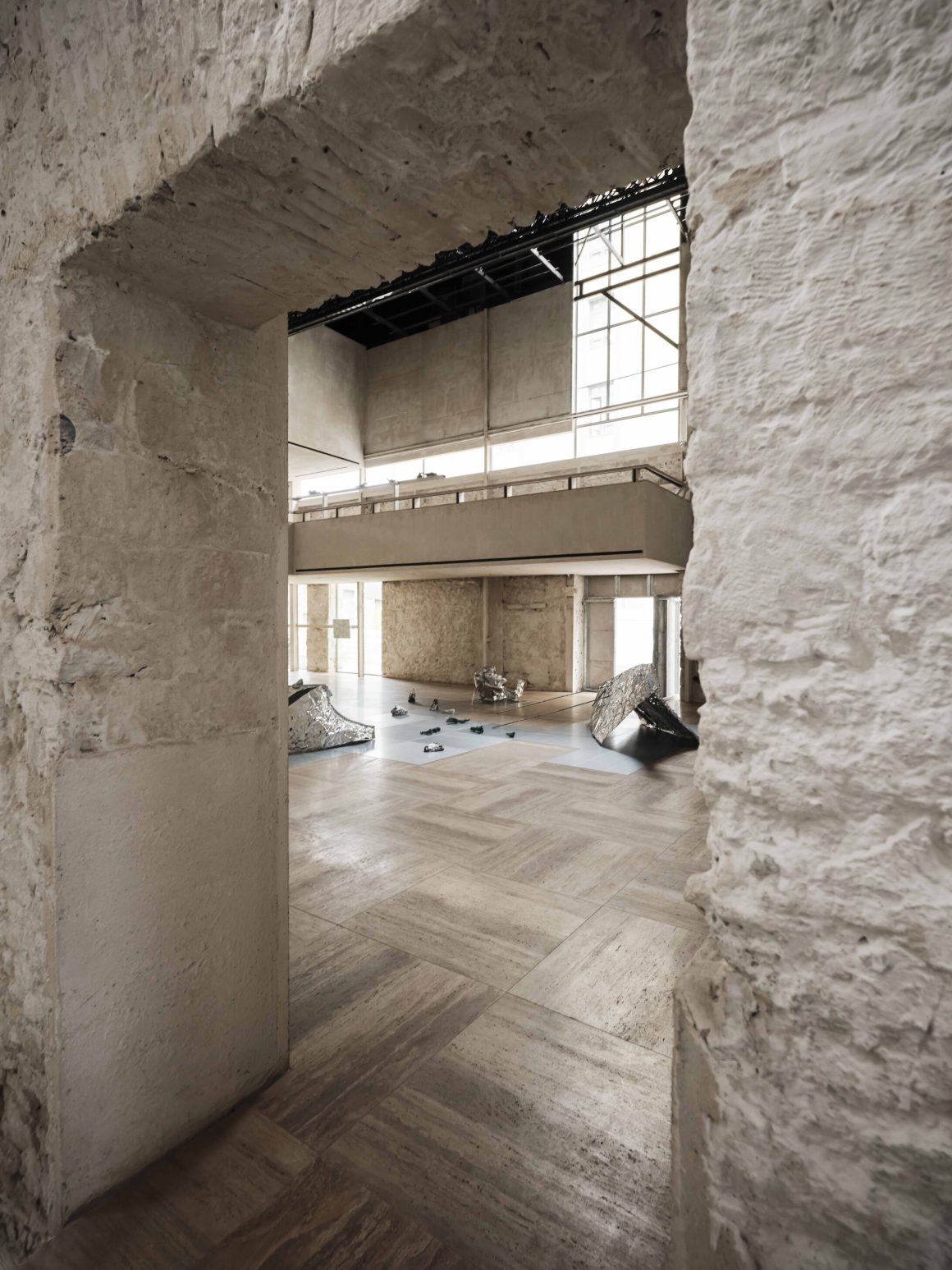
Another project that feels especially close to my way of thinking is Castor Place. I was commissioned through MPNYC to transform a former 19th-century storage warehouse into a multi-use venue capable of hosting lectures, exhibitions, workshops, concerts, dance, and theatre performances. Castor Place takes its name from Kastoros Street, itself derived from Castor, one of the Dioscuri twins of Ancient Greek mythology. This lineage introduced an underlying narrative of duality and parallel states that became central to the project. For me, transformation here was never about erasure, but about a conscious doubling, allowing old and new to exist in calibrated tension.
When I first encountered the building, it bore the marks of haphazard interventions. The original 1850s masonry shell, defined by thick load-bearing walls worn by time, had been compromised by a 1990s conversion into a dark, inward-facing nightclub, which imposed a two-storey metal extension onto the structure.
The challenge became one of reconciliation: how to bring these disparate layers together through a method grounded in clarity, adaptability, and light. My reading of the venue’s potential was informed by a familiar theoretical precedent, Cedric Price’s Fun Palace, often described as a “Swiss Army knife for the arts,” where indeterminacy and user-driven transformation superseded fixed form. I later encountered a similar ethos in projects such as The Shed, which I engaged with during my time with Elizabeth Diller, where architecture operates as an enabling framework rather than a static object.
I conceived Castor Place in much the same spirit: as a blank canvas. Modular staging, flexible lighting, and an open floor plan allow the venue to shape-shift seamlessly across different uses. By stripping away unnecessary layers and reopening blocked windows and doors, the building now operates as an open, welcoming space capable of continuous reconfiguration.
My design strategy operates in an in-between condition. Rather than erase the building’s history, I approached it through what I think of as a form of surgical archaeology, a process of articulating, rather than concealing, its accumulated layers. The 1990s addition was reinterpreted as a metallic monolithic volume hovering above the original masonry. A slender clerestory window visually separates the two eras, creating the impression of levitation above the original cornice and culminating in a dramatic nine-metre-tall vertical opening. This cathedral-like window floods the interior with natural light while revealing an interior height unique to the block.
The deteriorated metal façade was refurbished to improve acoustic and water insulation before being finished with a liquid metal coating embedded with aluminium microfibres. I wanted the surface to behave almost like a responsive skin, protecting from sun exposure while producing a shifting reflectivity that mirrors the changing sky above Piraeus.
Below, the porous stone base was restored following the removal of protective plaster. Vintage brick was introduced to reconstruct the canopy and intentionally left unmortared to preserve the visible discontinuity between past and present. The result is a calibrated contrast of materials that allows the building’s temporal layers to remain fully legible.
Inside, the strategy shifts toward unification. To bring coherence to the expansive space, I applied a thin coat of simple stucco, a traditional, coarser filler now largely absent from modern mortars. Freed from the fatigue of fake perfection, the intervention embraces the honesty of authentic materials.
This architectural “whitewashing” transforms damaged surfaces, structural bracing, metal panels, and brick infill into a continuous tonal field, creating an abstracted, almost model-like quality. Paradoxically, the unifying layer accentuates the disparate textures beneath it: the many “surgeries” Castor Place has undergone over the decades emerge in sharper relief.
The interior volume was further restructured through balconies that provide multiple vantage points, overhead trusses, and a suspended Gumtree lighting system integrated along the roof to support flexible programming and shifting modes of occupation. The space transforms continuously, adapting to each event without imposing a fixed identity.
Existing trusses, once external structural elements, were conserved and reframed as readymade decorative objects, intentionally interrupting views through the windows as a tangible reminder of the building’s accumulated past.
In such a competitive field, what do you consider the most important qualities of your work that make you stand out?
I feel my work really comes from personal fixations and interests. I try to avoid looking too much at what others are doing, and I avoid too much research or mood boards. I like ideas to develop in a more personal headspace, to shape them through a kind of subconscious design energy that has been formed by past experiences. Of course, there are references, and I am constantly looking at things. I just never want a one-to-one connection. I like to absorb new things continuously and let them sink into the back of my mind, where they can resurface when the time is right and their form feels ripe.
How do you manage to combine the contemporary with the old, when needed, in such a masterful way?
First of all, thank you for noticing, it makes me smile. For me, the old is precious. You cannot make “old”. But you can reframe it and recontextualise it, intensify it, and let it guide you.
I hate the idea of restoration. The old is old, it carries its patina, its scars, its own sense of time. For me, it is more about gluing things back together in an almost architectural “kintsugi” way, revealing those scars rather than hiding them.
Tell us about your recent projects and whether the final result met your expectations.
Again, Castor Place has been really popular with the press recently. But the truth is, when you spend so much time trying to express your priorities and inner thoughts through your work, it is incredibly satisfying to see people actually understand your intentions.
Whether it comes from magazine editors, fellow artists, academics, or local passersby of all ages, people somehow see it and feel it. That is what feels so exhilarating to me, the idea that you can communicate something truthful and have it resonate with others. It gives you a sense of belonging, of oneness, a kind of “I see you, we are all in this together” moment.
What comes next in your plans?
Lots of things! But I’m particularly excited about opening our office space in Athens. It will be on the same block as Castor Place and is conceived as a space that can oscillate between an office, a showroom, and a gallery. We are really looking forward to hosting collaborations, mainly around material innovation and design, but also across other creative fields.
We also have a small show in the works, hopefully to inaugurate the space… but I can’t tell you about it yet, because then I would have to shoot you. Hahah.
What do you love doing most, and what have experience and maturity brought you in your work?
I really enjoy the ideation and the formation that happens on site. When a project is unfolding, I love being in space and working directly from there. It’s probably not sustainable in the long run, but I really feed off that energy. I also feel it is incredibly formative to stay as close as possible to the construction process. You learn so much, not only from the technical realities of the project itself, but mainly from the people involved and the way other creatives solve problems.
Are new technologies an important tool in your work, and what kinds of pitfalls do they involve?
I don’t know. I’m very immersed in everything technological, but I still feel these things are just tools, they are not the work itself. You have to bend them to your will. At the same time, tools have always informed both process and outcome, so I don’t think things are inherently good or evil.
In a strange way, I feel the sloppier you use the tools, the better the results can become. There is something problematic about superficial perfection. The mistakes, the character of the human hand, somehow begin to feel elevated. Old crafts, slower processes, simpler materials and techniques, they carry a kind of depth that feels increasingly precious.
How do you generally approach and work with color?
One at a time. I like monomateriality and tend to use colour in a singular way for each project. I do not like falling into the tropes of complementary colours or matching things in an overly aesthetic way. I prefer to use colour more immersively, less as decoration and more as a way of creating a certain aura or mood.
What is your favorite project, and what would be a dream project for you?
I’m working on my dream projects. The truth is, you can make almost any project a dream project. The nightmare usually comes from issues of communication and alignment.
An architect has to be a bit of a therapist. You have to be able to do three things well: control the client, control the client, and control the client. Hahah.
What is your connection to Greece, and what do you hold closest to your heart?
Greece has given me the opportunity to work on some amazing projects. Many of my clients there are well-travelled, refined, and educated, and they have trusted my ideas and recognised the value I bring. Even though budgets in Greece are generally lower, both in terms of fees and construction, your money can go much further, and good craftsmanship is still relatively accessible and affordable.
How different is your design approach when it comes to a project in Greece?
I don’t treat Greek projects differently. Greece should be, and is increasingly becoming, more international and metropolitan. I approach every project as a Manhattan Project, in the sense that each one is unique, one of a kind, and something I devote myself to completely.
I’m not sure if you are familiar with the expression “my Manhattan Project” or “one’s Manhattan Project,” but I use it in the colloquial sense: a deeply personal, obsessive undertaking, the thing you become completely consumed by, pour immense energy into, and treat as uniquely important or potentially transformative. A passion project, in a way, something that demands total commitment and problem-solving.
So for me, every project becomes my Manhattan Project, something singular that deserves full devotion.
New York vs Athens — what do you love, and what not?
Well, New York is the only place where I truly feel at home, where I feel a real sense of belonging. Athens has always been more connected to my past, and in some ways, also an escape. However, there has been a lot of energy in Athens recently, a real sense of growth and possibility. It is also much easier to experiment and try new things there from a financial perspective.
I feel London sits somewhere in the middle, if it has to enter the chat.
What is it that makes Athens special for you?
Nostalgia mixed with hope. It is a weird feeling, where happy memories from the past and hopes for a better future can somehow coexist. It feels like we have a second chance, another shot to make something really great of our country and move forward while learning from the shortcomings and failures of others.
What do you consider the most important achievements you have accomplished and keep closest to your heart?
Managing to move to New York on my own, attending an Ivy League university without being a legacy admission, and always trying to do professionally what I truly feel is right. I rarely compromise, and I try to turn everything that comes my way into an opportunity.
A story you will never forget
I don’t know, there are so many. Sometimes, I feel our lives are somewhat predetermined, and we simply have to move through them while trying to become the best version of ourselves. I’m not suggesting we go through life passively, on the contrary, I feel that if one can do something, one must do it, in a somewhat Zarathustra-like way. It is just that I have often felt some sort of invisible guidance in my life. I have experienced many serendipitous moments along the way.
When you enter a space, what is the first thing you notice?
The light and the architectural integrity. I focus on the primitive aspects of a space, the things that truly matter and define its essential qualities.
Three places you love returning to, and why?
New York, London and Athens. My three homes.
Έχεις σχεδιάσει κάποια αντικείμενα ή custom made έπιπλα για συγκεκριμένους χώρους
We almost always design custom pieces for our clients or source antiques. We never buy generic furniture, it is one of my pet peeves.
Your own definition of beauty
Honesty, clarity, and restraint, those are probably the three things I value most.
What do you consider authentic?
Unapologetic attitudes. When you are not afraid to be who you really are and to develop yourself outside the boxes society has created for us. Sometimes those boxes can even come from more progressive or liberal spaces.
I find it very attractive when people question everything and step outside of herd mentality in search of their own truth.
What would you design for TheAuthentics.gr?
Probably a long pause. We live in such an overstimulated world that I find myself increasingly interested in creating moments of clarity, spaces that remove noise and allow people to search for their authentic truth.