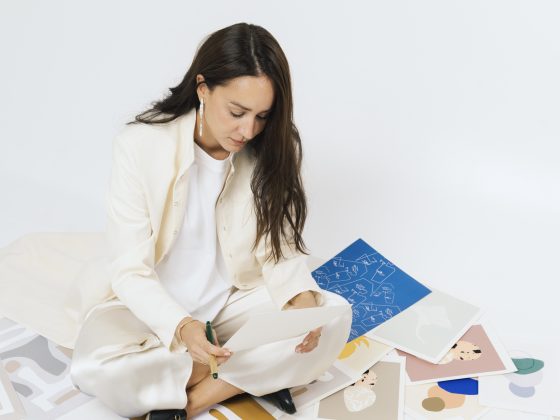
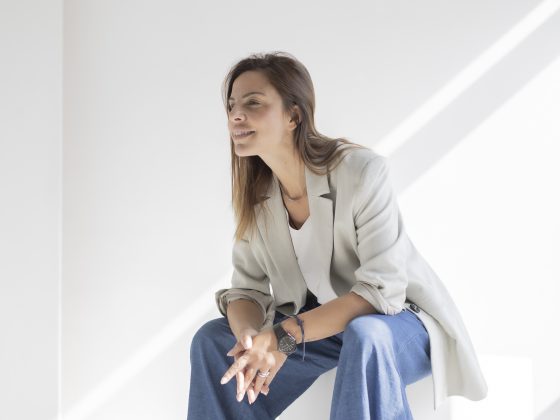
Starting from a completely different field, what shaped you into an inspired creator and what have been the highlights of this journey?
Reywal is a series of handcrafted lighting objects and artistic light installations made from thread, metal, and light. My journey began with a need to tell my story through light—moving against the trajectory my life had taken up until then. Creativity always stems from an inner necessity, and so the steps unfolded naturally and with enthusiastic momentum. Coming from a different professional background, designing and creating objects out of light felt both exhilarating and surprisingly familiar.
Reywal now moves in two directions: a commercial one, where custom-made lighting pieces are created for professional or private spaces, and an artistic one.
In the artistic realm, my work exists between light and matter. Every Reywal piece is an art object in which light is not simply functional—it becomes narrative and expressive. Each work is crafted entirely by hand using thread, a material linked to the weaving tradition, and it takes on a three-dimensional form that surrounds and diffuses light without restricting it.
Some highlights have certainly been the Satori exhibition at Gallerie Marneri in 2018, where I made my first professional appearance. A significant milestone that followed was the creation of my first large scale works, shapes reminiscent of columns in geometric harmony, like contemporary light totems inspired by Greek tradition. These were placed in Phaea Resorts and opened the door to a series of collaborations with major hotel groups. Reywal pieces are now found in different concepts, such as the Floating Leaves installation at the W Costa Navarino, thread-formed leaves suspended from the ceiling like a green canopy, and in the Niko Seaside Resort – McGallery. Further collaborations followed, including Oda Gallery in Milan, culminating in my partnership with the Benaki Museum Shop.
What about the story of discovering your creative direction in crafting handmade objects, how the first idea was born and how it evolved over time.
With no prior experience working with thread, I was drawn to it while searching for a material that could offer a warm expression of light. Thread had always seemed to me like a primordial material, usually used in more traditional ways—I admired it in woven textiles, which are true works of art—but I began to see that it could also become a three-dimensional “garment” for illuminating different types of objects.
I started designing and crafting the Reywal pieces with thread. Using thread as a material carries memories of tradition, now reimagined through light. At first, the light was simply encased within its conventional form, but as the work evolved, I discovered that thread offered great freedom. It became a tool for contemporary expression, enabling new themes and visual languages.
Starting with a single thread, you begin to create your own world.
In what way do you feel your aesthetic continues to evolve?
My goal is to give shape and form to an idea, and the medium I use is thread. In tradition, thread was never just fabric, it was connected to a craft of storytelling passed down through the fiber itself. Here, in a way, light is used to narrate that connection. Each work leads me to the next, and often the next idea appears from the very beginning of a project conversation. Every creation embodies our aesthetic approach; each piece is not just a light, but carries fragments of memory and personal perspective.
Which achievements do you feel have been the most significant?
First and foremost, the collaboration with the Benaki Museum Shop for the 200-year anniversary of the Greek Revolution. In 2021, the commemorative Reywal light objects depicting the “Tsolias” and “Bouboulina” in life-size form, inspired by the heroes of the Revolution, were placed in the museum shop as part of the institution’s bicentennial events.
For me, these works were not simply an artistic challenge. They carried immense symbolic weight, and the experience pushed me to grapple with the notions of tradition, identity, memory, and the transformation of a national symbol into an artistic light object. It was the first time my work became a creative dialogue between tradition and the present, marking a starting point for my artistic vision.
In 2024, the Reywal Totem “Pithos”, inspired by the large Minoan storage vessels found at the archaeological site of Tylissos in Crete, marked an important milestone for me. It offered the opportunity to explore the connection between Minoan tradition and contemporary aesthetics, using thread and light as expressive media. Through this process, the lighting object became a vessel of cultural memory, carrying elements of the past into a contemporary artistic interpretation. This work is part of the Contemporary Minoans collection for the cultural organization Branding Heritage and was included in the organization’s 3D digital museum, in collaboration with the Foundation for Research and Technology, with the support of the Ministry of Culture.
In 2024, another significant moment was my collaboration with Helmepa and the creation of the interactive installation “Making Waves” for the Posidonia 2024 exhibition. It is a large-scale light installation (5m long and 2m high) representing waves, created from threads made of recycled plastic bottles recovered from the sea floor. The work invited visitors to awaken and participate by choosing a personal promise about how they would protect the environment and placing it onto the installation itself. This project allowed me to reframe my practice as a tool for awareness and engagement. There, light became a medium of awakening and activism artivism. It was the first time my work had to stand simultaneously in an artistic and environmental field. “Making Waves” was important for me because it pushed me to consider how my work can become a tool of participation, change, and commitment.
And of course, there is my recent Audience Award for my work “Lighting echoes; from Prehistory to Tradition”, the piece that stood out for visitors at Jelo6 project, an artistic event that took place at the Old Town Hall of Nicosia from 12–16 November 2025. The event was dedicated to sculptural objects, ceramic practices, and contemporary jewelry, and will soon travel to Athens to be presented at the Benaki Museum from 13–17 May 2026.
Your latest work moves beyond lighting and enters the realm of sculpture. What stories do your anthropomorphic handmade sculptures tell? How did this new direction emerge, and what did your exhibition in Cyprus include?
Through my works of thread and light, I try to “shed light” on the way I perceive things. In a sense, I try to introduce myself and illuminate what I want to express. This is what I attempted as well in my participation in the Jelo6 project.
The Jelo6 project is an artistic event held in Cyprus under the auspices of the Municipality of Nicosia, with the main exhibition at the Old Town Hall and the parallel exhibition “Tradition Re-imagined” at the Severis Museum (CVAR – Severis Foundation). Together, they created an experiential dialogue between art, applied arts, and the cultural heritage of the region. I had the great honor of being one of the distinguished invited artists by curator Niki Stylianou and presenting several of my works across the two exhibitions. Upon receiving the invitation, I immediately wanted to learn more about Cyprus, its culture and symbols, so that I could connect the works I would present with the identity of the place and with my own creative approach.
My central work, “Lighting echoes; from Prehistory to Tradition,” connects the prehistoric cruciform figurine of Pomos, from the Chalcolithic period, discovered in the Paphos district, with the traditional women’s costume of Paphos. It was an attempt to narrate these two temporal states, “before” and “now”, within a single form. The abstract seated figurine, a symbol of fertility and a key artifact of Cypriot cultural heritage, with its open arms, evokes a ritual dance. On the reverse side, a standing woman dressed in the Paphian costume, vraka, colorful skirt, vest, and headscarf, dances and embodies living tradition: the “rituals” of today. The two female figures, one from prehistory and one from the island’s more recent past, meet in the same posture with open arms, celebrating life in a gesture of welcome. Using simple materials, iron, threads, and light, one figure appears as an extension of the other, with light becoming an artistic language that symbolically illuminates the passage from prehistory to the present, from the minimal to the ornate, where forms and memories coexist within the same artwork.
In the parallel exhibition “Tradition Re-imagined” at the Severis Museum (CVAR – Severis Foundation), I participated with the work “Woman with Headscarf.” In this piece, I attempted to transform tradition into a contemporary symbol of light and protection—where the thread remembers. Metal, light, and threads shape the face of a woman covered with two layers of head covering: the inner cap and the outer veil or koukoula.
The work draws inspiration from the traditional Cypriot headscarf as seen in the museum’s artifacts, translating its memory into a modern symbolic language. Here, the headscarf becomes a symbol of light—a portrait of a woman carrying the time and memory of her community.
What do you receive from the audience in relation to your work, and how does it help you evolve?
What I receive from the audience plays a decisive role in my evolution. My recent Audience Award for Best Artwork at the Jelo6 Project was a powerful affirmation, like a “green light” encouraging me to keep moving forward. I feel deeply honored, especially because the award came directly from the public. The audience is spontaneous, honest, demanding, an incorruptible judge, it observes, evaluates, and recognizes. In reality, it guides every creator. It may seem like I work alone, but the evolution of my work is very much the result of a continuous interplay with them.
What new things are in your immediate plans?
Alongside several commercial projects that are currently underway, the Jelo6 Project—which will be presented at the Benaki Museum this coming May (13–17.5) is another important link that leads me further into my artistic practice. These are works with a distinctly artistic character, through which I express myself most fully and to which I want to give even more emphasis in the coming period.
What are the non-negotiable values in your work?
Light has always been my guiding criterion. My vision is to connect the lighting object with the art object, to create handmade artistic lighting pieces from thread, bringing art and light together through the medium of yarn. Therefore, the non-negotiable elements in my work are light, thread, and of course, the fact that everything is handmade.
How has your design philosophy evolved over time, and what do you believe has particular value today?
In design, creativity is the key to giving a new dimension to the idea of lighting, to move beyond the conventional object. It led me to the conviction that lighting can be expressed artistically through an object that emits light as a form of art. For me, creativity means seeing things differently, taking an idea and shaping it into reality using your own materials and means, creating something that carries a personal imprint.
Creativity in design brings the unexpected, the unfamiliar, the spark that makes you think, that helps you escape the predictable and discover new ways of seeing. In contemporary design, creativity is, for me, a form of freedom, one that encourages personal interpretation.
What would you like to create, your dream project?
To be honest, every project I take on feels like a dream project before it’s even made.
The creators you hold close to your heart, and why you choose them
The anonymous craftsmen of the Cyclades from the Early Cycladic period, who made the Cycladic figurines. I choose them because thousands of years ago they created one of the purest, most minimalist, and modern sculptural languages, a language that influenced many 20th-century artists and proves that design is timeless.
The last thing you bought, and why
A small replica of the Pomos figurine from the Archaeological Museum of Nicosia during the exhibition in Cyprus, to remind me how far back inspiration can go.
Something you read recently and loved
“We pass through everything as thread passes through a weaving; giving form and shape to images we ourselves do not yet know.”
(Rainer Maria Rilke, “Duino Elegies” – Seventh Elegy)
An object you would never want to part with
Cards with children’s drawings and wishes.
The artist you love and would like to own a work by
Mark Rothko.
In another life, you would be…
A premium, upgraded version of myself, free from my flaws!
Three places you love returning to
My home
My studio
The sea
Is art and creativity a path for connection and becoming better?
For me, art has a unique power: it can create communities. Not only among those who experience it, but also among those who make it. It becomes a point of reference, sparking collaborations and shared experiences, even when we perceive them differently. That alone is a form of connection.
A work of art exists in space, but it gains even greater intensity when placed next to another. Even if the works are different perhaps especially when they are different a dynamic emerges between them that could never arise from each one alone. It’s as if a conversation begins to unfold. Sometimes they complement each other; other times they stand in contrast. But in every case, something new is generated. And that is a gift, because it pulls you slightly out of your own world and allows you to see your work from a different perspective. It creates space for the unexpected.
So yes, I truly believe that art connects us—and makes us better.
The museum and artwork that stole your heart
The Joan Miró Museum in Barcelona, specifically the piece Femme.
Give us your own definition of beauty
Beauty is whatever makes you want to stay somewhere just a little bit longer.
What do you consider authentic today?
Anything that withstands time without altering its character in order to follow trends.
If you were to design something for The Authentics.gr, what would it be?
I would create a piece made of handcrafted luminous rings, each one in a different shape, size, texture, and color.
Every ring would stand on its own, just like the individual stories featured on The Authentics.gr.
And at the same time, they would all connect into a larger structure: a colorful, harmonious whole, an artwork composed of distinct narratives that come together to form one shared, authentic story.