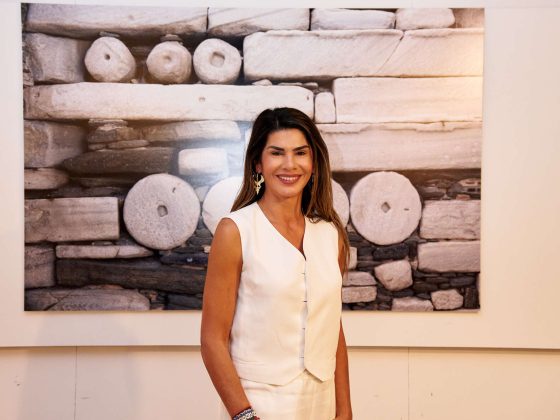
Maria Economides is a ceramic artist born in Thessaloniki, whose work explores the emotional depth of human experience through hand-built vessels. Initially trained in business administration to manage her family’s timber trade, she discovered her passion for ceramics after moving to Athens in 2018, following eight years in Shanghai. Her pieces, inspired by the concept of vessels as containers of emotions and memories, combine ancient techniques like terra sigillata with contemporary innovations, such as high firing and intricate clay coloring.
What about the highlights of your journey — what are the most important steps that brought you to where you are today?
Hard work — a lot of it. An obsession with work, really. I’ve always worked endlessly, with passion and countless hours, never counting fatigue. Consistency, patience, and love for what I do are what have brought me here.
I come from Thessaloniki, from a family that worked with materials — wood, earth, matter. Maybe that’s why the need to make things with my hands was always there, it just took time to find its voice. After my years in Asia, when I returned to Greece, I felt the need to dive into something real — and clay became my medium. Since then, I’ve been traveling through it.
My years in China were a precious chapter in my life. I wasn’t working with clay back then — I had moved there for family reasons and was raising my children. But it was a time full of images, experiences, and strong contrasts.
What always fascinated me was how the old and the new coexist there — the traditional way of life next to the completely modern. You can see someone working with their hands, just as people did centuries ago, and a few steps away a futuristic building. That balance deeply influenced the way I see creation.
What’s the story behind discovering your creative path in ceramics — how did the first idea begin, and how has it evolved over time?
I’ve always been into crafts — knitting, woodcarving, painting, clay. From a very young age, I needed to keep my hands busy. At a vulnerable moment in my life, clay changed me; it was as if it was shaping me while I was shaping it. It felt like a dialogue where both of us were discovering ourselves.
Over time, that relationship deepened. We’ve become one — we understand each other completely. I know when to touch it, when to let it rest, when to trust it. It’s a silent coexistence, a conversation without words. I build all my vessels entirely by hand, using almost no tools. I work slowly, letting the clay guide me toward its form. My pieces are thin and light, made to be held and embraced. They feel like they come from another time, yet they carry a contemporary spirit.
Through my work, I speak about memory, time, and continuity. Each vessel carries a part of me, and when one travels abroad, I feel as if I travel with it. It’s a beautiful way to exist everywhere. The beauty and strength of clay last much longer than we do. And that gives me hope — that through my vessels, a small part of me will remain for a very long time.
In what way do you feel your aesthetic evolves?
I experience everything intensely. I love to travel, to discover new things, and to be inspired by experiences and people. I don’t know if my aesthetic consciously evolves, but my emotions certainly do — and that’s what shapes my work.
What do you feel are your greatest achievements?
I’m not sure I can talk about “achievements.” Many beautiful things have happened in my life and my work, and I feel grateful for them. Perhaps the most important is that I can make a living doing something I truly love.
Who and what helps you move forward in life?
Definitely my family, and especially my children. In the early years after they were born, I was always by their side — I never left them for a moment. Now that they’ve grown, I feel their reward: they support me, admire me, and completely understand the demands of my work.
Your participation in Art Athina and your collaboration with Virginie at Taxidi
My collaboration with Virginie and Taxidi in Tinos began two years ago. This year, we were together at Art Athina, and I’m very happy about that. Virginie has her own unique vision and aesthetic. Together we can talk endlessly and create beautiful things with a shared sense of purpose.
❝Through my work, I speak about memory, time, and continuity. Each vessel carries a part of me, and when one travels abroad, I feel as if I travel with it. It’s a beautiful way to exist everywhere.❞
Having a strong presence in exhibitions abroad, what do you receive from the international audience compared to Greece?
The international audience truly loves ceramic vessels. I think abroad people grasp their meaning more deeply — they see something far beyond a simple “vase.” For me, a vessel is not a decorative object; it’s a dialogue between past and present, a container that holds memory, time, and emotion. Each piece is both sculpture and remembrance — a tribute to the past, seen through a contemporary lens.
What has extroversion offered you, and how does it affect your work?
My work is completely intertwined with my personality. I’m extroverted and social, but at the same time deeply introspective and observant. It makes me happy when people tell me my vessels resemble me — the way I hold them, soft and crumpled, full of imperfections and sensitivity.
What does your new collection narrate, and what are your immediate plans?
In my new collection, I explore new forms and colors using materials I brought back from my recent residency in Jingdezhen, China. It was an experience that profoundly influenced me. My upcoming plans include more travels, participation in international fairs, and of course, long hours of studio work.
What motivates and inspires you to evolve creatively? Tell us a story.
My motivation comes from my connection to the material — my obsession with clay and my inability to stop working. Inspiration always comes from emotion. When I touch the clay, I feel I can express what I cannot put into words. That’s what keeps me growing and exploring.
What are the non-negotiable values in your work?
Truth and authenticity. I can’t create anything that doesn’t have a soul. Every piece must be honest, carrying the energy of the moment and my own presence.
How has your design philosophy evolved over time, and what do you believe holds real value today?
What has value for me is meaning. I’m not interested in the “perfect” form but in the one that speaks with simplicity and honesty. In today’s world of overproduction, what truly matters is the handmade — the human touch.
What would be your dream project?
A monumental contemporary pithari (ancient Greek storage jar) in the center of Athens — a symbolic work about memory, time, and the city’s connection to its roots.
Which designers do you admire and why?
I’ve always admired those who work with their hands — who create with clarity and sincerity. I’m drawn to minimal creators who let the material speak for itself, who allow space and light to breathe through the object.
❝ The beauty and strength of clay last much longer than we do. And that gives me hope — that through my vessels, a small part of me will remain for a very long time.❞
Are we what we choose?
Both yes and no. Having traveled a lot, lived eight years in Asia, and met people from so many different cultures, I’ve realized we’re not only what we choose — we’re also what we learn along the way, what transforms us. What matters is having the wisdom to embrace every choice.
What was the last thing you bought, and why did you choose it?
A Qipao dress from my trip to China. I chose it because I deeply love the country — it carries memories, people, and experiences that shaped me.
The best book you’ve read lately
I haven’t had much time to read in recent years, but I’ve always been inspired by Edgar Allan Poe’s stories — dark, human, full of symbolism.
An object you could never part with
My black eyeliner. It’s something small, personal, almost ritualistic.
The artist you love and would like to own a work by
I would love to have a ceramic vessel by Toshiko Takaezu. I feel she manages to capture silence and spirituality through form.
In another life, who would you like to be?
In another life, I would still want to be myself.
Three places you love to return to, and why
Thailand — because it heals my body and my mind.
China — because it feels like my second home.
Thessaloniki — because it’s where I grew up and where my roots and parents are.
Is art — and creation in general — a path to becoming better human beings?
Absolutely. Art makes us more sensitive, open, and empathetic. Through creation, we learn to listen, to feel, and to understand the world more deeply.
Tell us a story you’ll never forget
I have countless stories from my travels in Asia. One of them is from Jingdezhen: I remember seeing people pushing carts full of ceramics through narrow alleys, just as they’ve done for centuries. It felt like the entire history of ceramics came alive before my eyes — a moment of pure connection with the past.
The museum and the artwork that stole your heart
During my recent trip to China, the Royal Kiln Museum in Jingdezhen truly moved me. Built over the ruins of the ancient imperial kilns and designed by architect Zhu Pei, its curved structures resemble old chimneys — a place where past and present coexist beautifully.
Give us your own definition of beauty
For me, everything is beautiful. Beauty exists in everything — it just depends on how you choose to see it.
Have you ever designed anything beyond ceramics for a home collection? If not, what would you create?
Not yet, but I love furniture. I’d probably create a table — simple, strong, and earthy.
What do you consider authentic today?
Being yourself. Creating and living without imitation or pretense.