My path has always been a journey between Athens and New York. I studied Painting at the Athens School of Fine Arts, in the studio of Dimitris Mytaras, and continued with an MFA at New York University, where a whole world of experimentation opened up for me: video, performance, photography, technology, large-scale installations. I found myself in an environment that demanded constant reinvention—new technologies, new media, new ways of thinking about the image. Yet within this multimedia practice, my aesthetic remained rooted in the principles of painting: gesture, light, composition, and the time embedded in the surface.
This dual direction—the classical training in painting and the world of new media—shaped a way of working in which the image is never static, but a field of transition, a space the viewer is invited to traverse.
My first creative perspective was born from something very simple: observation. The world is not only what you see, but also the way you illuminate it within yourself. I was always captivated by the movement of time across things, by decay, by the rhythms of nature, by the body within space. I constantly sought a way to make time visible—not as a snapshot, but as a flow that penetrates the image and gives it life.
My aesthetic evolves organically, although the core of my exploration remains the same. In my early works, through photography, video, and performance, I explored the limits of the self, of identity and corporeality, often through theatricality and irony. Over the years, this language became more internal and more abstract.
**Today in painting, especially in my large-scale scrolls, my aesthetic has shifted to something more rhythmic, more meditative—**a space where movement, time, and gaze “travel.” Gesture becomes flowing time, and silence becomes density—not emptiness. The image functions like a field of breath, like an evolving landscape that you do not simply look at but cross. You enter the work’s own time.
Essentially, the shift from performance to painting is not a rupture; it is a continuous cycle. In the large-scale works, painting expands and occupies space in the same way performance occupied public space—as a living presence that activates it.
The most important milestones are not only the exhibitions and collaborations, but the moments when my work opened new paths for me, revealing new ways of seeing.
From my early performances in New York, like Parking, or Bouncing Balls in Bucharest, to Boiling Spells in Athens, many of these works emerged almost by chance, like small revelations. They started from a simple gesture, an object, a situation in space, and suddenly unfolded into an entire field of meanings I had not foreseen. These moments—when the work leads you instead of you leading it—are, for me, true achievements.
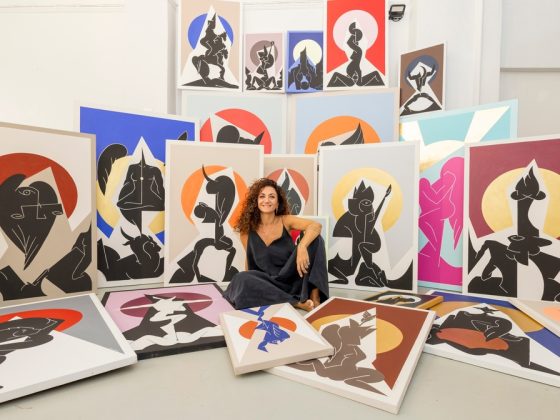
More recently, I consider the series of large scroll-paintings equally important. There I felt I found a coherent language, where time, movement, and gesture unite in an image that does not describe time but generates it.
The people who help me move forward are those who see before I do what I am about to create. Friends, mentors, companions. And those who tell me the truth, even when they know it may not be easy for me.
My years of working with photography, staging scenes in which I was the protagonist, were a way of exploring identity and the role of the woman.
I created small “rituals” in which I became part of the work. Each photograph was like a set where I questioned and subverted the coded role of women. It was a dialogue with the idea of public and private image.
Balancing between photography and visual art, there was never really a “transition.” Painting pre-existed. It was always there—in the composition, the color, the use of light.
It became a continuation. I simply allowed the body to leave the frame, and the movement of the hand, of the water, of the color entered. Painting became another form of performance.
The exhibition “WOMEN. Dialogues of Greek women creators through time” at the Museum of Contemporary Art of Crete presents works by women artists from the 19th century to today, drawn from the Alpha Bank Collection.
In “Supermarket,” the supermarket space becomes a stage where past and present meet. Within a contemporary, everyday, consumer environment, the female figure is placed as a timeless axis—steady, calm, almost ritualistic.
The work highlights the continuously changing roles of women across time and space.
I use classical iconographic representations of the woman—from cinema, painting, and advertising—and transfer them into a contemporary public environment, creating images where past and present merge into a unified narrative that reveals the timeless female presence.
The experience of exhibiting in New York is different, because the city has a way of squeezing you and at the same time opening space for you. It is a city that forces you to stand honestly in front of your work, to see it within its own intensity and sincerity.
People approach art with an open mind, a desire to feel, to converse, to question, with an intellectual curiosity. Everywhere there is the sense that something is beginning, something is shifting.
My enormous works were not a challenge—they were a necessity. The scale emerged from the way I move when I paint. The movements dictated the dimension.
I feel that I am inviting the audience to enter the space—to walk, to breathe, to get lost, to find rhythm. The works are not images. They are pathways.
For me, creativity is not a process that begins with an idea and ends with a result.
It is a state of being. The creator cultivates the ability to listen—to grasp what already exists around and within, before it takes form.
In my work, the piece often precedes intention. The large sheets of paper on the floor, the movements, the fluidity of water and pigment create a field where the inner world is not “depicted” but manifested.
It is a conversation with something formless, before it becomes word. I allow it to appear.
For me, this is creativity: to make space, to allow the unknown to emerge, and to trust yourself enough to follow it.
❝ With the scroll-paintings, I felt that I found a coherent language, where time, movement, and gesture come together in an image that does not describe time, but generates it.❞
The designers of my heart
Isamu Noguchi, for the poetic simplicity of his forms.
Charlotte Perriand, for her human-centered way of understanding design.
Tadao Ando, for the light, the shadows, the empty and the full, and the silent power of his spaces.
The last thing I bought was a large white sheet of paper, 1.5 x 10 meters—because I needed space.
The best books I’ve read recently The Poetics of Space by Gaston Bachelard and The Creative Act: A Way of Being by Rick Rubin.
An object I would never want to part with The green ’69 Beetle—my grandmother’s car and the first one I ever drove. It carries memories, stories, and a sense of continuity across generations. Every time I get inside, it feels like a small journey through time.
The artist whose work I would like to own David Hockney.
In another life, I would perhaps want to be water. A sea or a river. Something that transforms constantly, yet remains the same in its essence.
Three places I love returning to
1. The coastal route from Kavouri to Glyfada. It is the landscape I return to in order to reconnect with the “inner time” of my work. The movement of the water, the constantly shifting light, the sense of the path, the rhythm of walking—all of these return to my paintings as traces, shifts, transformations. It is a daily ritual.
2. New York. The place of intensity, energy, speed. I always return because it helps me see myself and my work from a distance—in another microclimate.
3. The studio. The place of interiority. There, time changes form: it becomes cyclical, returning, repeating, stretching, opening, allowing the work to breathe and reveal itself at its own rhythm. The studio for me is an inner landscape, a space of initiation, where painting is not an outcome but a process—a path that continuously begins again.
It is my most constant return—the source from which everything starts.
I will never forget a walk in the jungle when I was in Trinidad. Suddenly, an aboriginal man appeared from within a tree and—rather than frightening us—guided us through an incredible path. He taught us how to move inside the jungle by mimicking its animals: to swim like fish against the river current, to jump from rock to rock like frogs, to climb up the waterfall.
This experience—of transforming, becoming part of the landscape, moving with its rhythm—has left a deep imprint on my work.
The artwork that stole my heart was the Winged Victory of Samothrace—a Hellenistic masterpiece of the 2nd century BC, at the Louvre. From any angle you view it, and for as long as you observe it, it seems to be in the precise moment right before taking flight. The marble holds within it a breath of movement, a lightness that resists the centuries—like watching time hold its breath.
Beauty is the moment when something surpasses you.
For a home collection, I would be interested in creating a series of fabric “landscapes.”
I consider authentic anything that does not try to impress.
For TheAuthentics.gr, I would design a large, translucent scroll that allows light to pass through it.
Venia Bechraki is participating in the exhibition “Women. Greek Female Artists in Conversation Through Time” at the Museum of Contemporary Art of Crete in Rethymno.
Duration: 19.11.2025 – 26.04.2026