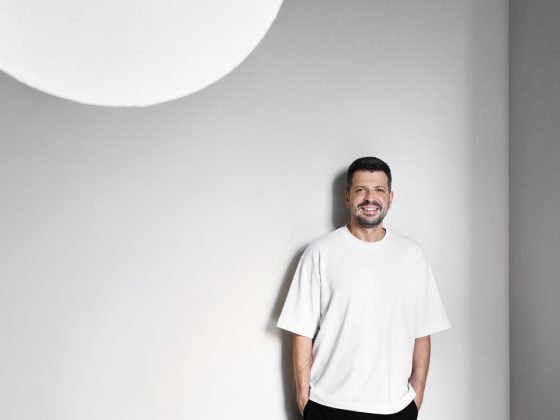
Author, creator of radio documentaries and television programs on art and culture, Yorgos Archimandritis holds a PhD in Comparative Literature from the Sorbonne. He served as Greece’s Cultural Ambassador during the French Presidency of the European Union (2008) and has been honored by the French Republic with the title of Knight of the Order of Arts and Letters (2010), as well as that of Officer of the Order of Arts and Letters (2019), for his contribution to culture in France and worldwide.
In an era where it has become increasingly difficult for one to stand out, you seem to insist that intellectuals still claim a vital place in our lives…
In every era, the role of intellectuals is fundamental. They are the ones who protect and strengthen a society’s ability to think, to feel, and to envision. They give us the tools to understand reality on a deeper level. They transform chaos into narrative and remind us that the essence lies not in what makes noise, but in what reflects—and creates.
Which achievements do you consider the most significant milestones in your career—those that make you proud and feel they brought you to where you stand today?
A person’s journey is a continuous, evolving process. Yet certain pivotal moments undeniably mark it—like milestones along the road. For me, such milestones include my doctoral degree from the Sorbonne, my first radio documentary for French Public Radio, and my first book. Equally important, however, are the people we meet along the way—those who inspire us through their own path and way of life.
Which personalities you’ve encountered in your career would you single out?
A difficult question. Certainly composer Mikis Theodorakis, filmmaker Theo Angelopoulos, actress Jeanne Moreau, actress Irène Jacob, performer Juliette Greco, painter and companion of Pablo Picasso, Françoise Gilot—whose radio biography I recently produced for French Public Radio—dancer Sylvie Guillem, philosopher Pascal Bruckner, playwright Yasmina Reza, and many others. The list is long, and the richness inexhaustible.
Many of your books and radio documentaries are biographical. What draws you to the lives of major figures in art and culture?
I have a special interest in destinies that serve as points of reference, and in how these destinies inscribe themselves in the greater human adventure. These are individuals who, by example, show that to advance one must remain faithful to one’s vision—and above all, dare. I have always been fascinated by what makes a person become who they are. How their myth is formed. And I refer not only to myth as a model to emulate, but also as narrative. For a fundamental element of the human spirit is storytelling. We understand life through the recounting of events, situations, and experiences. This is what inspires and mobilizes us, what we transform into vision in order to move forward.
How has French culture influenced your life, and how do you feel about the distinctions and honorary titles you have received?
These distinctions hold special meaning for me because France is a country that welcomed me generously, embraced me as a citizen, and opened new horizons. The French way of seeing the world continually offers me new stimuli, giving me the opportunity to study subjects that interest me and that reflect both the intellectual concerns of the French and their deep love of the arts and letters. I should also say that, within this framework, I often return to the relationship between Greek and French culture, in order to highlight the fertile and ever-evolving dialogue between them.
I was impressed watching you, in your role as moderator of a public conversation (Hermès – Art Athina), approach your speakers with such mastery — making them feel at ease and allowing their thoughts to unfold effortlessly as they responded to your insightful questions and comments. How easy is this exercise?
I believe that goodwill and a thoughtful approach to a subject inspire a sense of safety and trust in the person you’re speaking with. Building a conversation requires meticulous study and preparation. To engage in meaningful dialogue on any topic, you must truly understand it. Only then can the final recipient — the audience — not only understand but genuinely engage with it.
In the realm of ideas and human expression — whether it’s a public discussion, a book, an essay, or a radio documentary — you are called each time to create a work with a particular economy, structure, and balance. A work that will reach its audience, spark their interest, and move them.
What has your experience been like participating in Art for Tomorrow, and how optimistic do you feel about this compelling initiative?
I have participated in Art for Tomorrow since its very first edition in 2015, hosting public conversations with international figures in the arts and culture — among them the former French Minister of Culture and current President of the Institut du Monde Arabe in Paris, Jack Lang; visual artist Jeff Koons; contemporary art collector Dakis Joannou; gallerist Thaddaeus Ropac; and many others.
As a member of the Leadership Council of the Democracy and Culture Foundation, which organizes Art for Tomorrow, I’m delighted to see the program grow richer every year, highlighting the social role of art. Within this framework, and in collaboration with the Moleskine Foundation, the Democracy and Culture Foundation established in 2025 the Creativity for Social Change Award, honoring artists who are active agents of social impact.
What about podcasts — the latest trend. What do you like and dislike about them?
For me, podcasts are not a trend, as I have been creating audio works for French Public Radio since the early 2000s. What you describe as a trend is simply a sign of the democratization of audio creation, as more and more people can now attempt to work in this field.
Of course, owning a microphone does not make one a creator — just as a camera, a computer, or a paintbrush does not automatically make one a filmmaker, writer, or painter. You must delve into the craft you wish to pursue, with seriousness and discipline.
What are your plans for the future?
These days I am completing a radio documentary of historical interest, which will be broadcast on French radio on December 21 (France Culture). Its subject is the “Odyssey” of the Mataroa, the New Zealand ship that in 1945, at the initiative of the French Institute, transported around 150 Greek scientists, artists, and intellectuals from Piraeus to Italy, enabling them to reach Paris via Switzerland, so they could study and advance in their respective fields.
I am also preparing a new book that will be published in France in April 2026, a new series of radio documentaries, two major anniversary events on Greek themes at the Sorbonne University, and many other projects we can talk about another time.