The highlights of your journey that shaped your path
If I look at my journey as a whole, I don’t see it as a straight line but as a series of conscious turns. Every important step came at the moment I dared to change direction, even when I didn’t have a clear picture of the next destination.
The first solid foundation was built through my work in advertising, as a creative director. There, I learned to think strategically, to give form and voice to ideas, and to understand the power of image and message. The decision to leave this framework and devote myself fully to art was one of the boldest turns of my life—and a defining one.
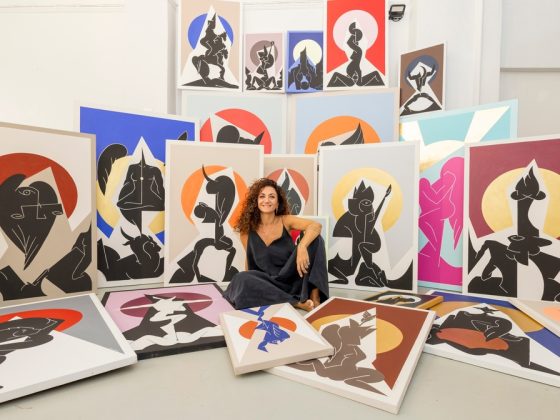
From there, a journey began with exhibitions in Greece and abroad, from New York and Los Angeles to Monaco, as well as works and projects that connect Greek identity with a contemporary, pop visual language. A significant milestone was All You Need Is Greece, which evolved from an idea into a book, exhibitions, and an entire identity, as well as the work I created at the summit of Mount Olympus—an experience of a lifetime that combined art, nature, and personal transcendence.
For me, however, highlights are not only the milestones or the places, but moments of inner transcendence: when I believed in an idea and followed it through to the end, when I took risks, when I refused to compromise on what felt true. All of this, step by step, brought me to today—to a place where I feel clearer than ever about who I am, what I want to express through my art, and how I want to continue.
How did art enter your life, and what is the story behind discovering your creative perspective? How was it born and how did it evolve over time?
Creativity has always been within me. I feel it’s in my DNA, in the way I grew up and in the freedom I had from a very young age to feel and express it—without “shoulds” and without a predefined direction. That freedom was crucial, because it allowed me to develop my imagination and perspective naturally, without fear. For many years, this creative energy was expressed through my work in communication, where I learned how to organize inspiration and give it structure. At some point, however, I felt clearly that what had always existed within me was asking to come to the forefront.
Art didn’t appear suddenly in my life. Rather, through my choices and experiences, it gradually moved into a leading role. From a tool, it became a personal language. Over time, it was shaped through lived experience, travel, my connection to Greece, and the need to express something true, bright, and meaningful.
Today, art is a natural continuation of who I have always been: a way of existing, communicating, and evolving—while remaining faithful to the freedom and emotion that defined me from the very beginning.
Through which processes was your aesthetic formed, and what helps you evolve?
My aesthetic evolves in the same way that I evolve as a person. It doesn’t change abruptly, nor does it follow trends. It matures, deepens, and becomes more meaningful. Each period of my life leaves its imprint on the way I work, on the colors, symbols, and materials I choose. At the same time, I remain open to the new. I enjoy experimenting, trying new forms and mediums—not to change my identity, but to evolve it. For me, aesthetics are not static; they are a living dialogue between instinct, experience, and the present moment.
What do you feel are your most important achievements?
When I think about my most important achievements, I don’t see them as isolated successes, but as an overall attitude toward life. I feel that my greatest achievement is that I dared. I dared to take risks, to believe in ideas without knowing where they would lead—without financial security, without guarantees or safety nets.
Looking at my journey from a distance, I feel proud because everything I have achieved was built through hard work, persistence, and consistency. There were moments of uncertainty and fear, but I didn’t give up. I kept working, believing, and moving forward, even when the outcome wasn’t visible.
At the same time, I consider it an equally important achievement that I managed to be present as a mother. To build a meaningful relationship, communication, and sharing with my daughter, while at the same time following a demanding and uncertain path. This balance holds tremendous value for me. If there is one thing that fulfills me more than anything else, it is that I stayed true to myself—that I took risks, believed, and kept going, even when everything felt uncertain. And that, ultimately, is the achievement I carry most deeply within me.
What and which people around you help you move forward?
What truly helps me move forward are the people who see me for who I am—people who are not afraid to speak to me with honesty, even when it’s not easy, because they want me to grow and become better.
I am fortunate to have long-lasting, strong friendships built on complete acceptance, support, and love. These are the people who stand by me during difficult moments, reminding me of who I am and where I’m headed. They support me, help me get back on my feet, and keep moving forward. The same value applies to my collaborators, with whom I have built relationships of trust and longevity. I know I can rely on them—that they understand me as a person and believe in me and my work. These relationships give me stability and the strength to move forward.
What did you prepare for the Start Artworks exhibition in Thessaloniki, and how did your collaboration with Christina Manolaki take shape?
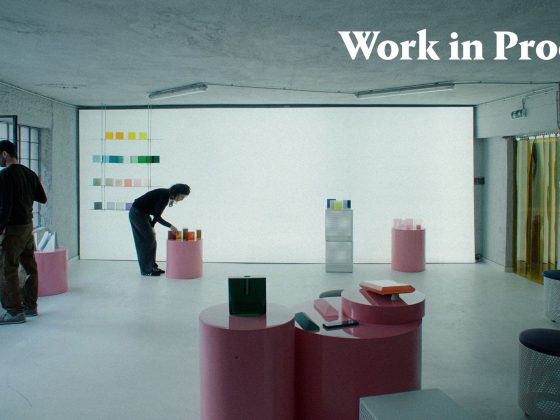
The exhibition at Start Artworks in Thessaloniki was completed just before the holidays, and it was a very meaningful experience for me. I presented Super Hearts, a pop-up project dedicated to love as a force, at a time when I feel empathy is more necessary than ever. Through works featuring light, mirrors, ceramics, and limited editions, the heart functioned as a symbol of empowerment, connection, and hope, aiming for the viewer to see themselves reflected within the artwork.
My collaboration with Christina is very valuable to me, because from the very beginning it was based on trust and complete creative freedom. She allowed me to be myself, to experiment with new materials, and to follow my instinct. It was an exhibition filled with strong energy, light, and a positive message—a reminder that love can function as a driving force.
Three places you love to return to, and why
If we exclude Greece—which is my ultimate love and always my point of reference—the one place I return to again and again is New York. I love walking through its streets, observing its rhythm, and feeling that constant sense of evolution it carries. It’s a city that never stops moving, and that is incredibly inspiring to me.
I enjoy experiencing it mostly on my own, so I can have the quiet and space to truly absorb it—to observe people, energy, and details. From this city, I draw inspiration from everything.
In general, I love traveling and there are many places I’ve grown fond of, but if I had to choose just one, apart from Greece, it would definitely be New York.
Is art and creativity in general a path toward becoming better people?
Yes, I deeply believe so. Art and creativity bring us closer to ourselves and, through that, closer to others. They help us cultivate empathy, to observe, to listen, and to feel more meaningfully.
They don’t necessarily make us “better” in the sense of perfection, but more conscious. And when we are more conscious, we carry more understanding, more responsibility, and more love in the way we exist in the world.
Tell us a story you will never forget
A story I will never forget is connected to All You Need Is Greece, before the book was even published. When I was about halfway through creating the project, the Greek National Tourism Organization launched a campaign titled All You Want Is Greece—with just one word difference. For me, it was a shock. I felt the ground disappear beneath my feet. I felt that all my work had been canceled out in a single moment, and I wondered how I could prove that I wasn’t copying, how I could stand up against such a large organization.
For two days, everything felt dark. And then something pivotal happened: instead of giving up, I rolled up my sleeves and decided I wanted to find a solution. I didn’t want to abandon something I had believed in and worked on for so long. Through friends, I got in touch with Angela Gerekou, who was then the president of the GNTO. She had no knowledge of my project. But when she saw it, she reassured me immediately. She told me that my work was beautiful and meaningful, and that I didn’t need to view it competitively, but rather as something that shared the same message. We spoke about how meaningful it ultimately is to move forward together.
If I had given up during those two days, nothing that followed would have happened. All You Need Is Greece traveled, evolved, and played a decisive role in my subsequent path and presence—and it continues to do so to this day. This experience taught me how important it is how we interpret what happens to us, and how critical it is not to stop at the first difficulty. To fall, to allow ourselves to feel the pain, but then to get back up and continue—believing in what we do.
Give us your own definition of beauty
Beauty begins within our soul. It is the truth with which we exist—the way we love, the way we feel, and the way we stand in the world.
What else would you like to design?
Almost everything. To the point where I sometimes feel a slight sadness that there aren’t enough hours in the day to do everything I think of. I never run out of ideas, which is both a blessing and a curse.
What do you consider authentic today?
Authentic, to me, is being yourself without effort. Living, creating, and expressing yourself as you truly are—not as what seems easier or more acceptable.
If you were to design something for TheAuthentics.gr, what would it be?
A) An immersive experience around the concept of authenticity. I would create a circular space—an Authentics Capsule—made entirely of mirrors, inside and out, all around, above, and below. Upon entering, the person would see only themselves. Inside, there would be low, meditative music and a voice guiding the visitor to breathe and silently answer questions about themselves. Not to be judged, but to come into contact with how authentic they are and what that means to them.
B) At the same time, I imagine a cover-as-artwork: a large mirror, about two meters high and 1.5 meters wide, with the title The Authentics in neon. Whoever stands in front of it becomes the cover itself. Around the mirror, people would be able to write their names, making the work collective, alive, and constantly evolving.
In both cases, the work wouldn’t show you something—it would bring you face to face with yourself. That, for me, is the essence of The Authentics.