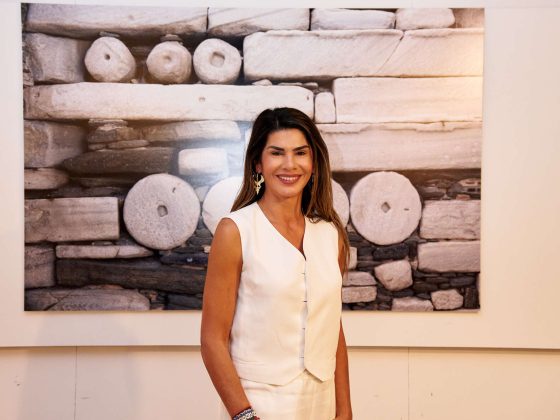
Ioanna Dretta, with a series of weighty titles and positions of power and responsibility, is above all a modern woman who looks you straight in the eyes with a crystal-clear gaze and leaves the impression that whatever she takes on, she will see it through in the best possible way. Nothing is accidental, after all, since today she serves as President of the National Archaeological Museum, CEO of Reds of the Ellaktor Group, and President of Marketing Greece.
With a very interesting trajectory, you have emerged as a model of professional consistency and dedication. Which steps do you consider the most significant in shaping your path?
I truly believe that wherever I have reached—whether it is mediocre, good, or very good is not for me to judge—I reached as a result of the everyday moments of my professional journey. It is not just the degrees; it is not the doors that I was lucky to have opened in my life; it is not the people I met who trusted me; it is not the recognizable positions. It is not the big moments when the spotlight falls on you.
It is the unseen daily efforts, the victories but also—and perhaps more importantly—the defeats, the way we manage both, the consistency, the relentless work, the teams built along the way, the relationships with the people you meet, giving first before expecting to receive, seeing the goal and not losing focus on it, keeping your head down, doing all tasks—both the easier and the less significant—with attention to detail.
There are many more things I could mention, but they all share the same essence, the values of everyday life. The big moments were what fueled the continuation of the effort; they did not bring the next success. After all, big moments usually come with risk, and with the danger of someone feeling invincible and making mistakes.
Knowing that you devote yourself with passion and discipline to each of your roles, how do you manage to balance such important and diverse responsibilities? Is there something you keep for yourself that helps you maintain your creativity at such high and multiple levels?
Indeed, the many and varied roles are not easy; they require constant planning and time management, cohesive and loyal teams, mental flexibility, and quick, well-informed decisions. At the same time, these many and varied roles feed into one another, with originality of thought, creativity, and a wide range of diverse experiences. Therefore, there is indeed a cost associated with them, but at the same time, if one takes the risk and everything goes well, one role practically benefits from the other.
Now, the question of how one keeps creativity at consistently high levels requires separate effort and mental work. The mind needs rest; it needs small breaks during the day to clear itself; it needs more time for that now and then, perhaps on weekends. Each person has their own way: meditation, nature, sports, art, or good company, a pleasant conversation, laughter with friends, or a good book. All these are necessary for high performance in the professional arena. I deeply believe that a professional path is connected more to character than to hard skills.
There are always exceptions, of course, but I am a supporter of the view that we must take care of our personal development, as human beings first and naturally as professionals, through self-improvement and the cultivation of our traits—especially in demanding, high-responsibility, high-stress positions, and in roles that come with power and require safeguards so that one remains faithful to their values.
❝ In my view, “Art will save us”. It's a way for the mind to rest and recharge. For me, Art is a release for my mind from the demanding molds of daily life and work.❞
Having recently taken on the role of Chair of the Board of the National Archaeological Museum—at this pivotal moment when its impressive expansion is being planned—what is your grand vision for what’s ahead, and how important is it for you to be steering the threads of such a crucial development for the country?
It is an enormous honor, as well as a joy, to participate from this position in the effort to expand and renovate the National Archaeological Museum—an undertaking driven by a vast team consisting of the museum’s executives, officials from the Ministry of Culture, Greek and international consultants, among them the globally renowned and acclaimed David Chipperfield studio. It is one of the country’s largest projects, not only in cultural terms but also socially, as it will transform an entire area and the broader Athens landscape.
We are not simply talking about a museum, but about a hub of culture—one that, beyond a completely new museological and museographic approach, will give residents of the city the incentive to make it a point of gathering, learning, and release from the pressures of everyday life. A place within the city, a landmark integrated into its pulse—a museum we won’t visit only when guiding friends around Athens, but one that will become a natural choice for its residents.
Is culture the foundation and starting point for broadening our horizons and achieving a better life? Are the right incentives in place for the new generations to follow this path? And how can we experience our rich heritage in a tangible way as part of our everyday lives?
In my view, “art will save us”—a phrase I often use on social media. It is one of the outlets I mentioned earlier, a way for the mind to rest and recharge. The concept of cultural prescribing is particularly interesting—where health professionals refer patients to cultural activities for physical and mental well-being. Of course, this is not new at all; it has existed in one form or another since ancient times, when theatre served a similar purpose.
But I also believe it is a personal matter—we shouldn’t create rigid boundaries. For me, art is a release for my mind from the demanding molds of daily life and work.
As for the last part of your question, it is a very important observation: cultural heritage cannot be experienced tangibly if it doesn’t enter everyday life in various ways. This relates to state initiatives—policies and actions by museums and archaeological sites—as well as private initiatives across all facets of entrepreneurship: programs for employees, for the broader public, support through Corporate Social Responsibility, activities in schools. The list is endless. One thing is certain: it cannot happen spontaneously. It requires effort.
Among other roles, you also hold a decisive position in the course of Marketing Greece, with the primary goal of promoting Greece and its tourism on the global map. Tell us about the key achievements of this effort and your plans for the future.
Marketing Greece, I can say with certainty, is a unique case of a company in Greece—but also globally. It is a private, non-profit company that raises funds from the private sector while collaborating with the public sector, offering a wide range of high-value services as a result of the investments made in the company since its founding.
Marketing Greece has achieved remarkable successes throughout its years of operation, but most importantly, it has succeeded in becoming an incubator of ideas. It has developed the capacity to build partnerships between the public sector, business, and society that produce measurable results.
At the same time, it has a special team working for its mission—a team with a strong sense of responsibility not only toward the company but toward Greek tourism more broadly. A team that, thanks to the trust of its many supporting sponsors, has the ability to bring to life any project or initiative it envisions. This strength—built through countless hours of effort over the years, with limited resources yet delivering positive social impact—is truly rare.
❝ Creation and creativity are central notions in my life. You create value for society by contributing your thoughts to the public sphere or through your actions. You create value for the people close to you through your attitude toward life.❞
Has Greece achieved what it deserves, and how much further is there to go for it to rise even higher? What do you believe is a strategic area that must be improved for our country to change for the better?
I believe that the public discussion regarding how we define success in tourism and the country’s next steps increasingly links it with the integration of the principles of sustainable development—and I agree with that.
If we want to be practical about how we can get there, I can briefly mention the following goals, among many others:
Public infrastructure in destinations that can support the needs of both residents and visitors.
A more substantial, creative, and carefully curated connection between tourism, culture, and agrifood.
Cooperation among tourism stakeholders, particularly between local authorities and the private sector.
Public dialogue on all issues, allowing everyone involved to make better and more informed decisions.
Let us not forget that the future of global tourism aligns with what our country can offer. Sustainability, in a broader sense, can be the main pillar on which we build our product.
Some say that when you focus on highlighting the good, the negative aspects shrink and fade away. What is your view?
I agree. I try to practice it as much as possible, and I speak often about its power. Recently, I had both the need and the opportunity to apply it in practice. I think it’s like a muscle—everything can be learned. Focusing on the good with a sense of gratitude not only helps you see things differently, but also “guides” developments in a positive direction. Neuroscience has studied this extensively, and there are leading scientists who speak publicly and with scientific evidence about how beneficial it is to focus on the good.
I strongly disagree with gender distinctions in the professional arena, but do you truly believe that a man would perform equally well if he were in your position, with such a demanding and multitasking daily schedule?
There are studies indicating that multitasking is an area where women have an advantage—and I believe, generally speaking, this is true. However, I have seen men with extremely complex schedules, full of varied responsibilities and obligations, who handle them simultaneously with great success.
But yes, I do believe that a man with my academic and professional profile would have achieved more than I have—or would have achieved it with less effort. I am very clear on that.
In any case, to close on a positive note, research shows that teams perform better when they incorporate different—not identical—voices, and by extension, different genders.
What is the most important dimension of life for you? What is it that you love to create?
To live my life meaningfully, truly, authentically. To honor who I am—after all, character reveals itself in difficult moments. In hardship, the quality of a person is revealed; in hardship, you see how empty or harmful someone may be.
Creation and creativity are central notions in my life. You create value at work—for the company, the shareholders, society, the employees. You create value for society by contributing your thoughts to the public sphere or through your actions. You create value for the people close to you through your attitude toward life.
❝ So many things bring me joy—this too is a mindset one can train. The smallest things, the biggest things, and everything in between. And what I want to emphasize is that we must not overlook the small things; we should pay attention to them.❞
What comes next in your immediate plans?
I’m preparing something of my own—something I’ve been dreaming of for a long time. I’m trying to squeeze it in between many obligations. And the reason I’m sharing it, even though it’s still a bit early, is to hold myself accountable so that I don’t abandon the dream—out of fear or compromise. We’ll see. It’s something I truly want, something through which I hope to share everything my profession and life have taught me so far.
If you could invite five people to dinner—even historical figures—who would they be and why?
I’m fascinated by people who break molds and live life on their own terms. Even more so when they do it publicly. I would choose two figures from the struggle of 1821—a period whose complexity deeply captivates me, and which I came to understand more deeply during the bicentennial celebrations. Then two contemporary Greek women and one international personality.
Manto Mavrogenous—despite her tragic end, despite everything she did for the struggle, she died discredited and slandered by her former partner. She did everything backwards for her era; she gave her entire fortune to the cause and made personal choices that were far from easy for her time. Fortunately, history vindicated her.
Georgios Karaiskakis—“angel and devil,” as he called himself—perhaps the most heroic figure of the revolution according to some historians. Born in a cave, died in battle, and carved his story with his own hands.
Angeliki Kottaridi, one of the most astonishing women I have ever met. It is a great honor for me that she is my friend—a person you simply cannot take your eyes off.
Maria Efthymiou, whom I do not know personally, but the way she speaks about Greek history—with simplicity and at the same time deep scientific grounding—moves me. As does everything she does to share her knowledge with the general public.
Finally, as an international personality—perhaps it’s cliché, but I mean it—Michelle Obama. A woman who used, for good, the great power she found herself holding in life.
What brings you joy, and how do you define beauty?
So many things bring me joy—this too is a mindset one can train. The smallest things, the biggest things, and everything in between. And what I want to emphasize is that we must not overlook the small things; we should pay attention to them.
As for beauty—when speaking of people—even when it is deliberate, it must be deliberately effortless. Beauty is also radiance, something that shines outward from within. And something I’ve discovered recently: vulnerability is often a source of radiance. Feeling comfortable with being vulnerable—perhaps because, according to scientists, it is connected with happiness.
What do you consider authentic in today’s world?
The unpretentious—whether polished or not—as long as it serves certain values. I believe authenticity has a positive moral dimension; one cannot, for example, be “authentically rude.”
Having already worked across different fields and reaching a certain maturity in managing them, what do you most love to do? What excites your creativity?
Fortunately, I enjoy many things. For me, it is important to create value—both tangible and intangible—and to contribute to the common good through what I do.
My creativity is sparked in various ways: by purpose, by the people in the team, by diversity, and—let me admit it—by difficulty. Challenging work excites me. Tasks that require—perhaps surprisingly—imagination. I believe imagination is an underrated skill, yet in my view it plays a central role in problem-solving, crisis management, and the handling of people and situations
A dream project you would be passionate about—I hope it’s already on your agenda.
The good thing is that I become passionate about my projects easily. I currently have two fantastic projects that excite me in different ways, and both concern public infrastructure—thus society itself. The Alimos Marina and the National Archaeological Museum.
The upgrade and operation of Alimos Marina, a concession project of the Greek state, is an important development for the Athenian Riviera—a city marina, an extension of the urban fabric that will soon have a completely transformed, highly elevated, I would say welcoming character, grounded in the values of sustainability.
On the other hand, the full renovation and expansion of the National Archaeological Museum—perhaps the city’s most important project.
Photo by Olympia Krasagaki