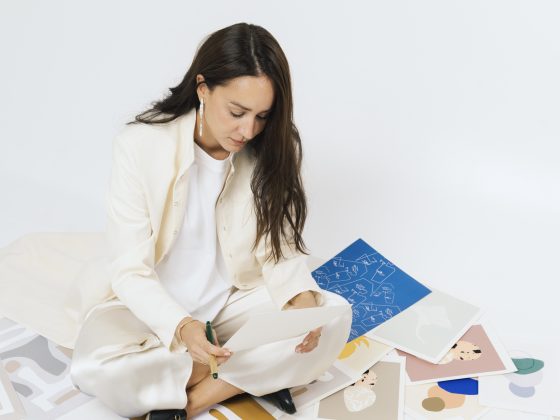
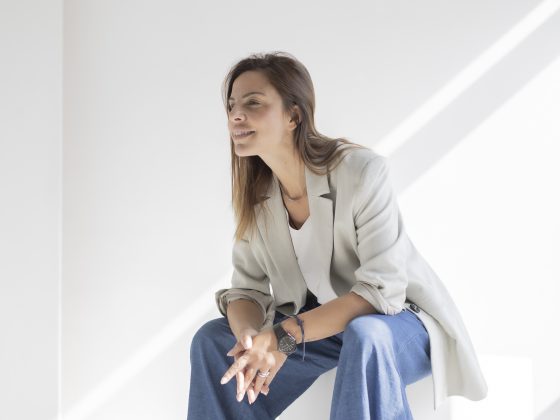
Two exceptional women with common origin, love and passion for their work that evolved into an incredible creative encounter. That of Nikomachi Karakostanoglou and Electra Soutzoglou, which, at the initiative of Art Rug Projects, brought together a visual artist and a historical carpet weaving industry in a conversation between matter and spirit, past and present, the gesture of art and the art of handmade weaving, in an act of translation and transformation.
Visual artist Nikomachi Karakostanoglou initially presents her own side…
Tell us about the story of your meeting and your common decision to proceed with a creative conversation with Electra Soutzoglou.
Electra and I met in 2019. She had just presented her works with Philippos Theodoridis and had already begun her collaboration with Jannis Varelas. She contacted me and I remember during our long meeting a very, very warm approach from both sides. We started talking about how we could create our own carpets and it took us at least two years of meetings apart to determine exactly which works would be suitable to be made into carpets and how this could be achieved. What excited us both very much was the fact that we had a common origin. We are both from Izmir and our families had thread as their subject, Electra’s with carpet making and mine with textiles. We felt that we had a common strength.
Knowing your work with its poetic character and existential implications, how were the common paths found or invented so that the result would be a work of art that justifies you? How were the difficulties overcome?
It was a great invitation because we actually had to translate ink and water, which are my basic materials, into reality in silk. How do you describe the transparency and immateriality of water through matter? We were greatly helped by the vast experience of Electra’s father, who very discreetly guided us to choices that would not make it difficult for us and would help us. Anyway, all this evolved after a long series of tests. From the moment we decided the works, we defined which parts of each were the most difficult to implement and then dozens of samples began to be made, one after the other. The times between them were about two months and then the next, and this in itself, as a process, required a lot of patience. Thus, through successive samples and after a while, we managed to overcome the difficulties and approach what we wanted to describe.
In what way is the Benaki Museum involved and how catalytic was the participation of the amazing Mrs. Matseli in this partnership?
Around 2023 and as the carpets were ready, we started looking for a place to present them. At first, I had in mind an abandoned neoclassical building that had this crumpled intensity of the urban tone, but I was looking for the meaning of the house. While talking to Elias Papailiakis, he suggested that I meet with Ms. Virginia Matseli who, as she said, knows everything. Speaking with her at the beginning, she suggested a pottery in Monastiraki that was about to close, which was ultimately in bad condition and we rejected it. She suggested that we also see their own space at the NH.MA. which had just been approved as a museum. The archives from the Antonopoulos and Mentis spinning mill had arrived, they were leaning on the shelves, while several old machines were also in the space. There was an accumulation of objects and archival material that she had just received, but it was not yet organized. We were excited, we made the decision and started to set up the exhibition architecturally. About a month before the exhibition we entered the space with a team of four people, which in the process grew after the people from the NH.MA., the spinning mill next door, were added. We formed a large team, took everything down from the shelves and began to reorganize the archive in detail and with colors. This in itself was a shocking experience because inside it it was literally like painting with threads.
Do you think there will be a continuation with custom made creations or home items in the future?
I do not perceive carpets as home items as you describe them but as works of art and they are works of art, they are unique. For me it is very interesting that for the first time in my two-dimensional works I invite the viewer to caress them. It is something that usually only happens in my sculptures. Because that is the only way someone can feel them. What has happened, I feel, is that I have changed my material for a moment, from water and ink it has become silk and it has become a translation of a painting that already exists through another material into something else.
What is your definition of beauty
The definition of beauty is something that I would not like to give since it is something that torments me a lot in my work. More so in terms of perfection. If perfect is absolute beauty or that which is full of imperfections and mistakes because it is real. So I do not want to give a definition, to say that beauty is this. Certainly that it is real, it is authentic, it is human and it concerns me a lot.
If you want, give us an idea of the beautiful things that follow in your plans
I have just delivered a very large project, the Room of Strength as it is called at Onassis Hospital in the waiting area. It is a room where patients, doctors, nurses, those who have a reason to be in the hospital, can stand for a while, touch their thoughts and be quiet during their stay. Next week I present the windows of the Hermes boutique for Christmas as a guest artist. The following ones are more distant with new series of sculptural works in white marble.
Electra Soutzoglou of Art Rug Projects refers to her own connection…
You have such an important and unique creative path. What was the point when you met Nikomachi and how did the idea for such an interesting joint collaboration arise?
I approached Nikomachi in 2021, shortly after my return from England, when I had just founded Art Rug Projects. This is an initiative through which contemporary Greek and international artists transfer their works to the carpet — transforming painting into weaving and visual design into a handmade art object. With Nikomachi, who also has roots in Asia Minor, we felt from the very first moment that we shared a common way of thinking and a similar attitude to life. Our collaboration was born effortlessly; I invited her to participate in Art Rug Projects because I was deeply interested in seeing how the fluidity and sensitivity of her work could be rendered through the carpet—how the light, transparencies and poetry of her painting could be transformed into thread.
What does your collaboration involve and how did it evolve? What is the common narrative of your work?
Our collaboration was an exploration; a journey from idea to weaving. We started by studying the elements that recur in her work – light, water, flow – and tried to render them through materials, textures and colors. Our common narrative is the concept of transformation: how something as delicate and changeable as her painting can take on flesh and blood through a carpet, without losing its transparency.
Were there difficulties in the production process and how they were overcome to achieve the desired result?
Every work that involves craftsmanship has its own challenges. Rendering the lightness and transparency of a work by Nikomachi through knots and fibers was not easy. We experimented a lot with the color transitions and the various possibilities that carpet offers as a new material in her work. Any difficulty became part of the process and had this result that one can experience in our exhibition.
In what way did the Benaki Museum helped the partnership and how catalytic was the participation of the wonderful Ms. Matseli?
Ms. Matseli and the Benaki Museum brought an institutional and at the same time sensitive look at how this collaboration could be integrated into the framework of the N.H.M.A. Her support gave us the space to experiment and build something truly unique in a space that carries so much history. It is particularly moving that three generations of women with roots in Asia Minor collaborated and created something so creative.
Why was the N.H.M.A. space chosen for the exhibition and what special things does it offer you?
Our collaboration with Nikomachi constitutes a joint artistic venture but also a meeting of two worlds connected by history, origin, weaving and art. This meeting acquires a particularly emotional charge, as it is presented in a space with an equally deep memory, the Mentis – Antonopoulos Weaving Mill (N.H.M.A.).
A museum and productive space that has been operating as a branch of the Benaki Museum since 2012 with the aim of rescuing old know-how of silk weaving and dyeing arts. The NHMA forms the backdrop of the exhibition and also part of it, incorporating memorable stories into contemporary materials.
Knowing Nikomachi’s work with its poetic character and existential implications, I imagine that you found a way for your part to reflect her energy in each carpet. Does the result justify you?
Nikomachi’s work has an inner calm, a poetic intensity that we wanted to convey as it is. Each carpet carries this energy – a fluid balance between light and silence, movement and water. If you ask me if the result justifies us, I will say yes; because I see in each work her gaze, but also our own shared breath, expertise and experience.
How important is it nowadays to meet people with whom you share a common language and aesthetics. How would you characterize your participation in this very creative partnership?
It is rare and deeply moving to meet people with whom you share a common aesthetic code. Not many explanations are needed; there is a mutual understanding. Our collaboration was an example of this “tuning” — a creative conversation that evolved with trust, respect and a common rhythm and evolved into a valuable friendship.
Is the carpet as an integral part of our tradition something that is being revived in a modern way today?
The carpet is an integral part of our cultural identity, but for years it was marginalized as something “old” and in my opinion “misunderstood”. Today it returns with a new look: as a modern art medium, as a new material for artists, which retains its historical weight but speaks the language of today. This is exactly what we seek with Art Rug Projects — to revive tradition through the prism of modern creation.
Give us your own definition of beauty.
Beauty is an emotion. And beauty lies in authenticity — in the moment when something moves you without needing explanation. It is the simplicity, the honesty, the truth of a work or a relationship.
What do you consider authentic these days?
Dedication. The effort to create something with true intention, without chasing an impression. Authentic is everything that has time, a gesture, a human presence within it. And I believe that the world today, amidst the noise of the ephemeral, needs exactly that: things that are real, not perfect.
The exhibition is hosted in the historic space of the Mentis – Antonopoulos Weaving Mill (N.H.M.A.) of the Benaki Museum until December 5, 2025.
Photography by Nikos Alexopoulos