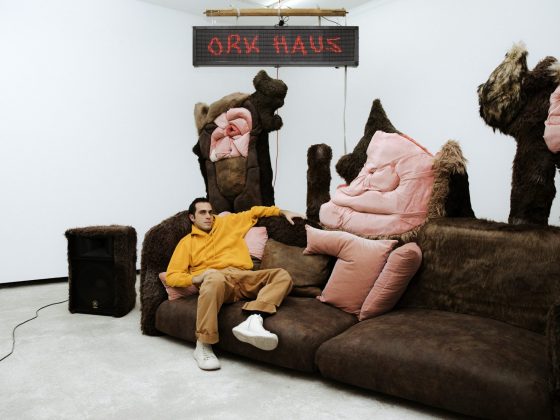
An honest thinker, Aristotelis Barakos based in Athens, creates furniture, lighting, decorative items and other design objects, for both interior and outdoor spaces, that enhance environments visually and emotionally. Born in Munich in 1984 into a family of menswear tailors, he developed a sharp eye for detail early on. Moving to Athens at ten, he absorbed a blend of cultural influences that continue to shape his vision.
First, tell us about the highlights of your journey. What are the most important steps that brought you to where you are today?
I was born and spent the first years of my life in Munich. My parents were classic menswear tailors. Their workshop was essentially inside our home, and I grew up watching them work endless hours, with great detail and dedication, on garments of very high quality made for very special clients.
When I turned nine, we moved permanently to Greece — a huge and defining change for me, as this transition confronted me with a culture very different from the one I was used to.
After finishing school, I was admitted to the Physics Department of the University of Athens, but university life didn’t align with my aspirations, and I decided to discontinue my studies. What ultimately remained from that brief period were friendships that have endured over time, with people I consider a second family.
How did design enter your life, and what is the story behind discovering your creative perspective? How was it born and how did it develop over time?
Design entered my life when I dropped out of university and began working to support myself as a craftsman in a workshop for special constructions, mainly serving the film industry. Being in contact with craftsmen, designers, art directors, and architects motivated me to “look into it” more seriously and begin my design studies while working.
The experience I gained working on special constructions for cinema — and the fact that I had access to a fully equipped workshop with tools and materials — sparked my first creative steps.
Over time, I collaborated with high-tech start-ups on complex design projects that confronted me with development challenges.
When I decided to set up my own studio in 2020, my creativity finally followed my own personal path of expression.
In what way do you feel your aesthetic has evolved?
From the moment I became independent and launched my own brand in 2022, I started creating freely, in the way I want to express myself and present my work. I think that was the turning point that allowed me to develop my own “visual language” — a language that continues to evolve and transform, giving equal importance to form, functionality, and the story behind each creation, which I now want to narrate.
What do you feel are your most important achievements?
What I am truly proud of is the fact that everything I have achieved has been built from scratch — very carefully, with patience and a lot of work. My persistence in creating and expressing myself through design, relying on my own strengths, is what gives me the drive to keep moving forward.
Have you experimented with other forms of art? What else lies within the spectrum of your creative explorations?
No, I haven’t experimented with other forms of art. The truth is that I’m, in a way, obsessed with my work. Every project is a new journey that involves research, getting familiar with a new material, and a lot of communication with a — possibly new — team of people. This whole process occupies both my time and my creative quests as a designer.
What has extroversion offered you in general, and how does it influence your work?
For me, extroversion is not just sociability; it’s a way of opening “windows” to other perspectives. Every conversation, every collaboration, every person I meet carries a piece of information, a small spark. These sparks illuminate — and also compose — the path of my creative journey.
What are your immediate plans?
At the moment, my team and I are working on the creation of an installation in a public space. It is an educational device that will be placed in at least one location in our city. It’s an extremely interesting project that involves quite a bit of technology, but is also highly creative in terms of mechanisms and user experience.
So we are called to design and implement this project in the coming period.
More to be announced soon 🙂
What inspires you to take new steps and evolve your way of creating? Tell us a story.
I’ll refer to the story of how I met Theano Ravazoula-Potamianou, the founder of Aumorfia — an Athens-based leather goods brand — who approached me with the initiative to collaborate and introduced me to the fascinating world of leather, a material I had never worked with extensively before.
During our meeting at the Aumorfia store, the idea for the Hecate collection took shape. Theano’s passion for leather and her vast knowledge of its complex properties intrigued me and fueled the inspiration to develop this collection.
What would you love to create — your dream project?
Still dreaming…
The designers you hold closest to your heart, and why you choose them.
Jasper Morrison — because he proves that the essence lies in simplicity that doesn’t shout.
Are we what we choose?
Of course — we are the imprint of the choices we consciously make. We choose what we keep and what we leave behind. We choose our rhythm, our people, our materials, our battles.
And through these small, daily decisions, our character and our creative identity take shape.
The last thing you bought and why you chose it.
A toy for my daughter, who is 15 months old.
The best book you’ve read recently.
I recently reread The Seven Pillars of Wisdom by T. E. Lawrence. It’s an old, now rare edition that was gifted to me many years ago — essentially the autobiography of Lawrence of Arabia. A man overflowing with passion, strength, and determination. An almost mythical figure who never lost his sensitivity and human side, a personality full of contradictions.
An object you would never want to part with.
A bird-shaped whistle I got during a visit to the workshop of the ceramist Daniel Didier, in Margarites, Crete. Didier combines ceramics with music, creating objects that produce unusual sounds, and his whistle reminds me of the carefree feeling of a beautiful summer day — when my partner, Daniel and I ended up drinking tsikoudia until late in the afternoon.
An artist you love and would like to own a work by.
I would love to own a work by Joan Miró — one of those small pieces on paper he created during the difficult years between the world wars, before his work was widely recognized.
In another life, you would like to be…
Perhaps a woodworker in some remote workshop by the sea — creating objects at a slow, natural pace, free from any pressure of time.
Three places you love to return to, and why.
To my home, where my daughter and my partner are waiting for me — four hands… a huge warm embrace.
To my grandparents’ village in Evia, perched at high altitude, overlooking the endless blue horizon of the Aegean.
To beloved Crete — to its vast, wild land full of flavors and scents, where every time a new surprise awaits, hidden somewhere along the way.
Is art — and creativity in general — a path toward becoming better people?
It’s a fact that both make us think. Where each of us directs that thinking, and whether it makes us better people, is another matter entirely. For me, creation is a way of decompressing and channeling my energy; it calms me and satisfies me at the same time. That alone, I imagine, makes me a little better…
Tell us a story you will never forget.
Every story has its own place in time. A story that feels “unforgettable” in the present can easily be replaced by another — more recent or more emotionally powerful — which feels just as, or even more, important, and therefore becomes “unforgettable” for the moment.
Give us your own definition of beauty.
Beauty is the balance between the unexpected and the familiar.
What else would you like to design?
Something unexpected… that fulfills all my expectations!
What do you consider authentic today?
Authenticity is not perfection. It is an inner experience — genuine and unique, despite its flaws and imperfections.
The authentic does not make noise; it prevails quietly. It relies on its own intrinsic nature.
If you were to design something for TheAuthentics.gr, what would it be?
I would design a ritual-object.
Something the user touches every day — a handle, a small vessel, a gesture-like light fixture. An object that conveys the value of the “good” and the “true” through its simplicity and its material.
Photos: IOANNA TZETZOUMI & GIORGOS VITSAROPOULOS