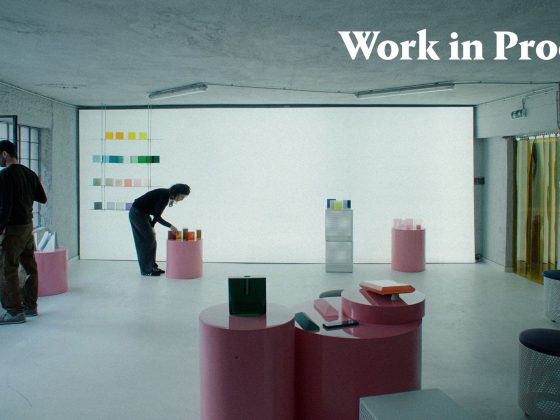
Last day on view of Be earth no more by Myrto Papadopoulou.
Form enters the work of Myrto Papadopoulou through the whirling movements of her hands, gestures rooted in the archetypal motions of the potter. The saying “clay remembers” is affirmed in the textures of her pieces. Some surfaces remain smooth and clear, while others – shaped by twists and urgent motions – echo the harmony of Cycladic vessels. Yet her works pursue their own, unmistakably personal freedom.
Her process layers slip and glazes to create ambiguous, shifting textures. Drawn from mountains, rivers, rain, and the sea floor, her vessels open new imaginative viewpoints. Through this exploration, she uncovers fresh possibilities in texture and form, noticing small details and revealing hidden facets. Her pieces seem to hold both formation and dissolution at once, like clay suspended in the moment before it becomes a finished, signed work.
She holds a BA in Ceramics from Stoke-on-Trent and an MA in Ceramics from Wolverhampton University, UK. With more than eight years of experience in creating ceramic sculptural work, Myrto has established herself as both an artist and an educator. Her practice has been recognised for its distinctive blend of tradition and innovation.
Myrto, tell us about the highlights of your journey. What were the key steps that brought you to where you are today?
My journey in ceramics was not linear but organic, much like the material itself. Important milestones were my studies abroad at Stoke-on-Trent and Wolverhampton University, where I completed my BA and MA, as well as my first lessons in Greece with Maro Kerasioti, which were almost revelatory for me. These were followed by periods of intense searching, experimentation, and hands-on practice, along with collaborations and exhibitions that helped me better understand my position within the contemporary art landscape. Every step—even moments of doubt—brought me closer to developing my own visual language.
The story of discovering a creative path in ceramics—how was the first idea born, and how did it evolve over time?
The first idea emerged from a need for contact with something tangible and grounded. Ceramics allowed me to combine thought with the body. Over time, this initial attraction evolved into a conscious choice: I began to see clay not only as a material, but as a carrier of memory, time, and emotion. My practice matured through constant experimentation and an acceptance of uncertainty.
What did your recent exhibition at Arch Athens include, and what feedback did you receive from the audience?
The exhibition included works that move between the functional and the sculptural, with an emphasis on form, texture, and the quiet intensity of the object. What I received from the audience was a sense of genuine connection—many people responded to the emotional quality of the works and their natural presence. This response confirmed for me that the work can communicate beyond words.
Your works balance a distinct dynamism with sensitivity, guided by unexpected volumes, colors, and unique treatments. What drives your inspiration?
My inspiration comes from contrasts: strength and fragility, control and chance. I’m interested in the moment when a form appears stable but conceals tension. Volumes and colors act as tools through which I express this delicate balance.
Which materials do you love, and how do they guide you? Describe your creative process and how much you enjoy it. Do you discover yourself through it?
Clay is my primary material, and each type leads you in a different direction. I’m especially drawn to natural textures and earthy tones. The process is almost meditative for me: it begins with an intention, but I leave space for the material to speak. Through this process, I discover aspects of myself—it’s an ongoing dialogue.
How much of Greece exists in your work, and what references does it carry?
Greece exists more as a feeling than as a direct reference. There are influences from archaic forms, the Cycladic period, the handmade tradition, and the simplicity that characterizes the Greek landscape—elements that are deeply ingrained in me.
What do you receive from an international audience in relation to your work, and how do things differ in Greece?
International audiences often approach the work with greater familiarity with contemporary ceramics as an art form. In Greece, interest is steadily growing, but ceramics are still often associated primarily with functionality. Both perspectives are valuable and help me continuously reframe my practice.
What does your new collection have to tell, and what are your immediate plans?
The new collection focuses more on form and abstraction. The works emerge through distortions, cracks, and processes of erosion, carrying visible traces of change. There is a shift toward more introspective pieces, with less “noise” and greater intensity. My immediate plans include further exploration of this direction and participation in new exhibitions.
In what way do you feel your aesthetic is evolving?
My aesthetic evolves through experience and the courage to leave behind old certainties. Each work is a step toward greater honesty and clarity. I’m not interested in repetition, but in evolution through meaningful change.
What do you feel are your most important achievements?
For me, the most important achievements are not measured only by exhibitions or collaborations, but by the moment I managed to develop a clear personal voice. Being able to recognize myself in my work and having the consistency to continue evolving it is perhaps my greatest achievement.
What prompts and inspires you to take steps forward and evolve in the way you create? Tell us a story.
Evolution usually comes through doubt. I remember a period when I felt I was repeating myself; that’s when I decided to radically change the way I worked with clay, allowing more elements of chance into the process. This decision, although risky, opened up a new creative path and taught me to trust the process more deeply.
What are the non-negotiable values in your work?
Honesty, respect for the material, and time. I don’t rush the process, and I don’t aim to impress. I want the work to have substance, longevity, and a sense of authenticity.
How has your philosophy of design evolved over time, and what do you believe holds particular value today?
Over the years, I’ve moved away from excess and closer to essence. Today, I believe design gains value when it is conscious, sustainable, and emotionally honest. An object should enter into dialogue with its user and be able to withstand time.
What would you like to create as a dream project?
I would love to create a space or an installation where ceramics function experientially—not only as objects, but as an experience. A project that combines space, light, and material in an almost ritualistic way.
The designers close to your heart, and why you choose them.
I’m moved by designers who work with restraint and depth, who don’t follow trends but build a personal world. I appreciate those who respect the material and leave room for silence within their design.
Are we defined by our choices?
Yes, I believe we are the sum of our choices, especially the ones we make consciously and responsibly. Every choice leaves a trace, just like every imprint in clay.
When you enter a space, what first draws your attention?
The feeling. The light, the shadows, the proportions. I usually observe how the space breathes and whether there is balance between the objects and the void.
The last thing you bought, and why you chose it.
A simple handmade object. I chose it because it had imperfections and character—it felt like it carried a story.
The best book you’ve read recently.
A book I recently read is Against Love by Laura Kipnis, discovered through an exhibition at the National Museum of Contemporary Art (EMST). It made me slow down and observe more. I like books that leave room for thought, without saying everything.
An object you would never want to part with.
An old ceramic vessel of my own. It holds emotional value and is connected to many hours of creation.
An artist you love and would like to own a work by.
An artist who works with material with respect and inner depth. I’m more interested in the energy of the work than the name. In ceramics, there are many artists whose work I admire, such as Eleni Vernadaki, Takeshi Yasuda, Edmund de Waal, Lucie Rie, Akiko Hirai, Takuro Kuwata, Johannes Nagel, Yukiya Izumita, Sandy Brown—and many others whose work I deeply respect.
In another life, what would you like to be?
Something again close to creation and nature—perhaps something that works with the hands and with time.
Three places you love to return to, and why.
The sea, because it grounds me.
A place in nature, because it clears me.
My studio, because that’s where I feel most like myself.
Images by Paris Tavitian