The milestones stand out in your artistic journey so far
I would start with my studies in France, which were my first systematic encounter with how art is perceived in Europe. Then, I would highlight my first interaction with the public—my first solo exhibition. My Uranus series, which still carries me away, and Áfytos, the place where I was artistically born. And finally, The Invisible Ones of the Earth, my exhibition currently running in Athens at the Michael Cacoyannis Foundation. I feel it is my deepest connection to inspiration so far.
When was your love for painting born, and how has it evolved over time?
Painting has always been part of my life—I don’t even remember when it began. I grew up surrounded by colors and brushes, as my mother is a painter. Beyond that, study, thought, inner searching, and above all work—the physical act on the canvas—constantly open new horizons and create new possibilities.
How do you feel your aesthetic has evolved through the years?
Primarily through observation. Continuous observation. Of objects, of people, of nature. I travel a lot and try to see different things—both in art and in the open world.
The most important achievements
If you mean artistically, my exhibition at the Michael Cacoyannis Foundation gives me great fulfillment. It is the result of intense thought and creative work. I also see it as an important step in my inner dialogue. At some point you realize that behind everything there is the human being—and we must not forget that. Climate change, for example, is not only about water and heat. It is also about the human being who is being tested.
What or who helps you keep moving forward?
I am an optimistic person and try to uncover beauty in every moment. That helps me move forward in a world full of difficulties and ugliness. Of course, my family is my closest companion in every important step. And naturally, friends—few but precious, as they say. Sometimes like angels who take me by the hand…
Does your work reference other artists? More broadly, where do you draw inspiration from?
During my student years I was fascinated by artists like Turner, Monet, and Pavlos Vassiliadis. But references come from many directions, often unconsciously. As for inspiration—the more you work, the more new things are born. That happens most of the time. On the other hand, I am one among many, and whatever happens around me socially can trigger intense thoughts and emotions, eventually giving birth to a new body of work—exactly as happened with The Invisible Ones.
How do you work with colors and shapes? Do you follow your instinct or specific techniques?
Color always moves me, and the way each artist handles it. I would say I work more instinctively, trying to create surfaces that satisfy my own aesthetic. Color is the beginning and the end of every act of design for me, in a somewhat impressionistic way. Because I believe that each person’s truth is nothing more than their impression of things.
Is your figurative art a matter of the heart or something that can be learned?
Of course an artist must know drawing and rules, regardless of whether they choose to follow them or not. But the choice must be conscious—not the result of weakness or ignorance. Art undoubtedly needs soul, but that doesn’t mean it doesn’t also require knowledge.
What else is part of your artistic exploration?
I believe an artist must express their own era. Under that lens, I seek the anxieties of my generation—and of course my personal concerns. From a technical perspective, anything is possible, as long as it remains connected to painting.
The story of your latest exhibition. Who are the “Invisible Ones of the Earth”?
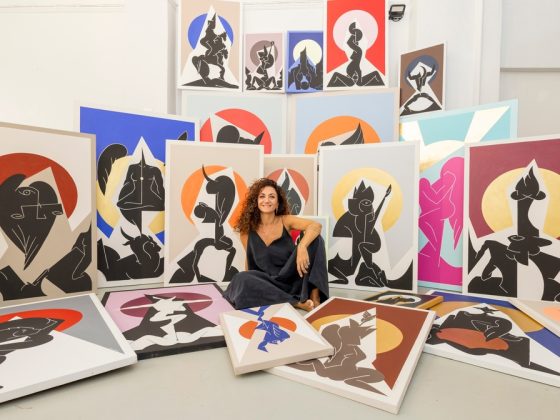
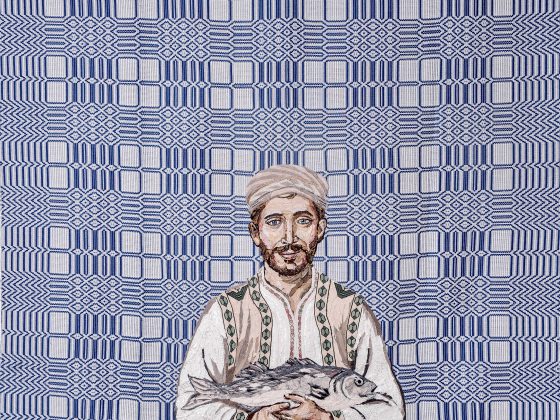
In my exhibition, the Invisible Ones of the Earth are climate or environmental migrants—refugees who are forced to leave their homes due to climate change and move to safer, more hospitable places. Today they are estimated at around 220 million, and according to projections, they may reach 1 billion by 2050. They are called “invisible” because this is a very contemporary phenomenon, and there is still no established framework for receiving them in other countries.
So I wanted to shed a bit of light on the invisible ones of the earth, who may also take other forms: the homeless and the poor, the weak and the vulnerable. The invisible ones of the earth are, in reality, very close to us—they live among us.
What sparks your inspiration and drives you to evolve your creative process? Tell us a story.
In the case of the Invisible Ones, the inspiration came a year and a half ago from my young students, who—during our annual exhibition—worked on the theme of the environment in danger. I held onto that idea, researched it, and let it grow in my mind.
As for the creative process of a painting, in The Invisible Ones, a real image becomes the starting point, around which a fictional universe is built—one that still contains references to reality, sometimes functioning symbolically. From then on, once I begin a painting, the story leads me. It becomes a narrative—a visual narrative. In this project, in every painting, I had my own protagonists, who were usually a human figure.
In your immediate plans
At this moment, I am fully immersed in The Invisible Ones project. I am deeply engaged with how this work will evolve and how it interacts with the audience. I dream of seeing this project travel to places where there is strong interest in its concept—Australia, the US, Portugal, Italy, the Netherlands, Sweden, and beyond.
A dream project
Since—beyond my personal artistic practice—I work a lot with children, a dream project for me would be the creation of a multicultural space, as I imagine it, where children can spend time in an environment full of diverse artistic expressions. I experienced a glimpse of this while setting up my exhibition at the Michael Cacoyannis Foundation: as we were preparing a painting show, actors were rehearsing, schools were visiting, and the whole place was filled with incredible energy and interaction.
Are we the sum of our choices?
I’ll answer directly: yes. We are responsible for our choices — and we must take responsibility for them, not simply drift through life unaware. Of course, there are times when, due to weakness or difficult circumstances, we don’t manage as well as we’d like. Personally, I try to stay true to my choices, even when I know the cost. But I’m at peace with myself — and that is what matters most to me.
What was the last thing you bought, and why did you choose it?
I think it was a small leather shoe keychain that I now carry with my keys. It reminds me of the beautiful steps I’ve already taken — steps I’m grateful for — and of the even better ones still ahead of me.
The best book you’ve read lately?
I’ll mention the book that touched me most recently: On the Lost Train, the testimony of Rina Barzilay–Revach. Reading such experiences always leaves you a better person. And of course, the 15 wonderful short stories written by beloved authors, inspired by 15 works from The Invisible Ones exhibition.
An object you would never want to part with.
My passport. Is that allowed?
An artist you love and would like to own a piece by.
Could I choose Monet? I would love that.
Three places you love returning to — and why.
Home. That’s where my calm is — my refuge and my starting point.
The sea — any sea. I adore the carefree feeling of summer.
And a trip to France is something I always do with love. Some of my most beautiful youthful memories are there.
Is art a path to becoming better people?
I absolutely believe it is. Through creation you constantly experience emotions — small births that touch every part of your inner world. Whether someone engages with art as an artist or simply as a viewer, they always gain something, because it activates not only the mind but also the soul. And both are guided toward paths of values.
A story you will never forget
As years pass, stories become precious memories. One story I will never forget is the experience of becoming a mother for the first time — inexperienced before the magnitude that follows, astonished by the miracle of life. It is the most overwhelming creation.
Your personal definition of beauty
Beauty is harmony. Harmony of shapes, colors, words, and thought.
What do you consider Authentic today?
We’re ending with the hardest question, aren’t we?
Authentic is what is true, pure in intention, uncorrupted, innocent. Like a child’s smile — clear and pure. A truly authentic smile.
The exhibition of Smaro Tzenanidou, The Invisible Ones of the Earth, is on view at the Michael Cacoyannis Foundation in Athens until 7/12.