Tell us about your creative journey and the achievements you hold closest to your heart
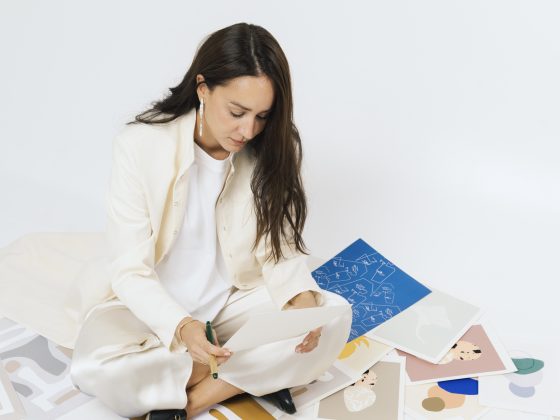
My creative journey began long before I consciously decided to pursue jewelry design. I grew up in my parents’ workshop, in an environment where art and handcraft were not something exceptional, but part of everyday life. It was there that I learned jewelry is not merely a luxury object, but a form of expression — a vehicle for personal style and emotion.
My studies in theatre proved pivotal. I fell in love with freedom of expression and felt a strong need to move beyond the rigid boundaries of traditional goldsmithing, which ultimately led me to theatrical jewelry. I was — and still am — drawn to a contemporary, open approach: creating with whatever captivates me, whatever I encounter and transforms into imagery. Threads, yarns, textiles, feathers, stones, glass, crystals, bronze, silver, gold. Materials that never feel restrictive, but instead serve as starting points for new ideas.
If I were to single out the achievements I hold closest to my heart, the first would undoubtedly be my collaboration with Net-a-Porter. It was the moment I felt that my vision had received international recognition, giving me the momentum every designer needs in their early steps. Equally defining was my collaboration with Christian Louboutin — seeing my designs stand alongside such an iconic name in fashion is something I will always carry with me.
Perhaps the most meaningful achievement of all, however, is that ten years on, I have managed to grow my brand while remaining based in Greece — specifically in Chania — staying true to my principles and aesthetic. The fact that people have embraced this journey and continue to give me space and trust is the greatest source of strength to keep going.
You’ve developed a very distinct signature style that strongly conveys a handcrafted sensibility. How did this come about, and where do you draw inspiration from?
I never set out to create a signature style. It emerged naturally, through doing what I genuinely love. It is essential for me to create my designs myself, with my own hands. When I touch the materials — when I cut, sew, glue, hammer and shape — something shifts creatively. A different sensibility comes into play, one that feels more immediate and honest.
For me, craftsmanship is not an aesthetic choice but a way of thinking. Mistakes, missteps and imperfections are not obstacles; they often become the starting point for new designs and ideas. It’s an endless journey, where creation doesn’t always follow a linear path.
Inspiration exists everywhere. It can come from something entirely unexpected and ordinary — like a piece of fabric falling to the floor, and instead of passing it by, I pause to observe the shape it takes. That has happened. Inspiration can also emerge through travel, such as Morocco, where the culture and bold color combinations opened up new aesthetic horizons for me.
Ultimately, the identity I once wondered whether I would ever find took shape the moment I stopped searching for it consciously and simply began listening to my instinct.
As you mark ten years of a luminous career, which pieces do you consider your most iconic, and how have you loved seeing them worn?
If I had to single out the most emblematic pieces of my ten-year journey, I would begin with those that introduced me to a wider audience. The wool fan earrings, originally crafted from old kilims, were my first true signature piece. A bold design with a strong presence, they effortlessly draw the attention of fashion photographers, regardless of who is wearing them.
This was followed by a more feminine iteration — the silk fan. Through its color, movement and volume, it further solidified my identity. It’s a piece embraced both by people with daring, eccentric style and by those with a more classic sensibility, which I find incredibly important. The pleated fan earrings, among my best sellers to this day, completed this narrative — more structured, more restrained, yet always with a strong character — sealing the image of “the girl with the silk earrings.”
Among the looks that stand out in my memory, one of the most powerful was Lakis Gavalas, wearing a long silk kimono in sunset hues paired with a minimalist straw hat. The yellow fan earrings stood out with sculptural force, turning the entire look into something almost architectural.
I will never forget the shoot for The Edit by Net-a-Porter, where Sarah Paulson wore the red wool fan earrings with a fully pleated, head-to-toe red dress. The image felt almost ancient Greek — like a Caryatid. A moment I will always carry with me.
I also cherish the shoot for British Vogue, where the model wore a white shirt with voluminous sleeves and the red fan earrings on a beach in Goa. In its absolute simplicity, the image felt commanding — like a modern pirate ready to conquer the seas.
And the most luminous moments of this journey?
The most luminous moments are, in truth, the quietest ones. They’re the moments when a friend tells you they overheard two women on the street, and one said to the other,
“Are you wearing Makriyianni?”
simply by noticing the earrings.
They’re the moments when people pause their daily rhythm to call and congratulate you on your work. And when someone, sincerely, tells you they would love to be part of your team.
Moments without spotlights or cameras trained on them — but for me, the most genuinely radiant of all.
What does the next chapter hold—your new collection and your immediate plans?
The next chapter brings travel and the exploration of cultures that resonate closely with my own aesthetic. It involves deeper research into traditional techniques and methods of making that carry memory and generational knowledge. The new collection opens a dialogue with past designs, from which new pieces emerge—ones that radiate the maturity of these ten years. It remains bold, rich in color and energy, but with a greater sense of awareness and intention.
Among my immediate plans is a bridal jewelry collection—pieces for brides that always challenge me to approach design differently. This time, without color, focusing instead on form, texture, and purity. And, of course, the one-of-a-kind designs, where I feel complete creative freedom: pieces that are never repeated and allow the process to remain deeply personal.
What is the best way to style your jewelry?
The best styling for my jewelry is the kind that doesn’t try too hard. It’s simple, unpretentious, and deeply personal. It isn’t driven by excess, imitation, or the anxiety of standing out. It works when the jewelry is worn as an extension of the person who chooses it—with ease and confidence.
Fashion vs. Design: where do they stand, and how do they coexist in your heart?
In my heart, it’s not a battle—it’s an ongoing dialogue. Design is the foundation of everything. It surrounds us; there is no object without design thinking behind it, from the simplest to the most complex. It is structure, function, intention.
Fashion gives design its context. It adds the social, political, emotional, and aesthetic moment in which it exists. It places design in the present, charges it with meaning, and connects it to people and their time.
If I had to choose, I would say I work with design that leaves space for fashion—clear thinking and strong foundations, always open to interpretation, change, and emotion. That’s where something truly alive is born.
Tell us about your collaborations and how they have evolved over time.
My collaborations—both creative and professional—have changed significantly over the years. In the beginning, they were more instinctive, driven by spontaneity and the excitement of exchange. With time, they became more conscious and selective.
A defining lesson along this journey was my collaboration with Christian Louboutin. It was a major school, where I came to understand the importance of method, discipline, and organization behind a meaningful creative partnership. It taught me that freedom of expression doesn’t negate structure; it relies on it.
Today, I’m interested in collaborations that have depth and longevity—ones built on a shared visual language, respect for process, and genuine dialogue. Whether it’s a creative project or a space that hosts my jewelry, what matters to me is consistency and truth. The collaborations that endure are those that evolve with you, not those that simply happen.
What would be a dream project for you?
A dream project would be creating jewelry and accessories for a theatrical production. A space where jewelry doesn’t function as decoration, but as part of the narrative and the character. That’s where everything that defines me comes together: the handmade process, freedom of expression, the body in motion, and the intensity of the stage.
Theatrical jewelry has the power to transcend fleeting fashion and become symbol, role, presence. It’s a world I’ve always loved—and one I hope to return to creatively someday.
Tell us a story you’ll never forget.
When I was a child, I remember telling my mother that one day I would work for Christian Louboutin. I said it while showing her a sketchbook filled with drawings of high heels with elaborate heels, inspired by Art Nouveau aesthetics. It was a passing thought—almost like a dream.
Years later, when we collaborated and my designs appeared on his shoes, that childhood thought had somehow, unexpectedly, come true. And how often does a dream come true, for you to ever forget it?
When you enter a space, what do you notice first—and why?
I’m interested in observing the choices that have been made. Whether there is sincere curation, whether authenticity and character are present, or whether the space is driven purely by image for image’s sake. Through these decisions, I try to understand the people behind the space—how they think, what they value, and how they choose to communicate.
The way a space is composed always reveals far more than what is immediately visible.
The last thing you bought—or would like to buy
Plane tickets to Cairo, specifically to visit the Grand Egyptian Museum. I can’t wait to experience its treasures firsthand and to be immersed in a place where history, art, and culture converge in such a monumental way.
Jewelry designers close to your heart
Solange Azagury-Partridge, Alice Cicolini, and James de Givenchy are among my favorites for the way they approach jewelry without constraints. For their bold designs, unexpected forms, distinctive techniques, and use of unconventional materials. Creators who aren’t afraid of excess, color, or intensity—and who treat jewelry as a field of pure expression.
The exhibition you will never forget
One work I will never forget is the Winged Victory of Samothrace at the Louvre. It is one of the most imposing and emotionally overwhelming works of art I’ve ever encountered. Every time I stand before it, I’m deeply moved.
The sense of movement is almost unsettlingly real—you feel as though the body is about to take flight, to leave the space entirely. The power it radiates is unfathomable. I’m always struck by the fact that it was created with utterly basic tools, and yet the drapery, tension, perspective, and realism are extraordinary. Those folds—so dear to me—feel like living energy across the body.
Each time I face it, it reminds me of something fundamental: when human strength and will align, anything is possible.
Choosing to live in Chania—what do you gain and what do you lose?
By choosing to live in Chania, I gain quality of life. A calm daily rhythm, closeness to the sea and nature, time with loved ones. Living outside the city center, in the countryside, keeps my mind clearer and my thinking more focused. It’s an environment that nurtures inspiration and creation without noise.
On the other hand, you lose—or rather, face challenges—when it comes to opportunities. Developing a brand from the provinces is very different from being in a major city where everything moves faster. Production has its own complexities, and living on an island inevitably slows many processes and makes them more demanding.
Still, I never regret this choice. I’ve learned to respect time—my own and that of things themselves—and to accept that everything happens when it can, not when it’s imposed.
Three places you return to—and why
Three places I return to consistently are the Museum of Cycladic Art, the Benaki Museum, and the Acropolis Museum. Whenever I’m in Athens, visiting them feels almost instinctive.
I see them as cradles of our culture and endless sources of inspiration. When I’m inside a museum, time seems to stop. There’s a sense of calm and stillness that helps clear my mind, away from the constant noise and stimulation of everyday life.
Even when I see the same exhibitions again and again, nothing is ever exactly the same. We evolve through our experiences, and that changes the way we look at things. Each visit is a new reading—through a different lens, with a different perspective and emotional weight.
Your personal definition of beauty
Beauty is often found in imperfections. In what isn’t perfectly symmetrical, but carries life, the human hand, and human presence.
What do you consider authentic today?
Authenticity is character. When something has identity, stands on its own without seeking validation, and isn’t afraid to be what it truly is.
If you were to design something for TheAuthentics.gr, what would it be?
If I were to design something for TheAuthentics.gr, it would be a brooch. A small, understated piece, designed with absolute simplicity. A fragment of metal revealing, at its core, an element of fabric—like a bud in the moment of becoming.
A reference to the most authentic moment of creation: the instant when something begins to take shape, before it reaches its final form. A discreet yet meaningful piece—one that doesn’t seek to impress, but to carry significance.