What about the highlights of your journey?
In recent years, a pivotal moment in my journey was being awarded by the G. & A. Mamidakis Foundation in 2024. As part of the award, I created the installation Long Waves, specifically for the Minos Beach Art Hotel in Agios Nikolaos, Crete—a 27-meter-long work that explores the relationship between humans, the sea, and the environment.
At the same time, my participation in international events such as the Izmir Mediterranean Biennial helped open up a dialogue around my work beyond Greece’s borders.
How did paper-cut design enter your life?
Paper cutting was born during my studies at the School of Fine Arts of Aristotle University of Thessaloniki. While painting, I felt the need to remove material rather than add it. That first “hole” in the work felt like a revelation and gradually shaped my core visual language.
You create your own world with a recognizable technique. Which applications of it do you consider most important?
Large-scale installations are currently the most meaningful application of my technique. Long Waves at Minos Beach Art Hotel in Crete and Void | What Is Missing in Astypalaia are works designed specifically for their sites, where paper functions as both an architectural and experiential element.
In what way do you feel your aesthetic is evolving?
My aesthetic evolves through reduction, repetition, and discipline. Over time, my works have become more minimal, leaving more space for the viewer. I am increasingly drawn to subtraction.
What do you feel are your most important achievements?
That I am able to be fully devoted to my art.
To define my own time, to work calmly on my ideas, and to let my days unfold within the creative process of art.
What does your new collection include, and what new story does it tell?
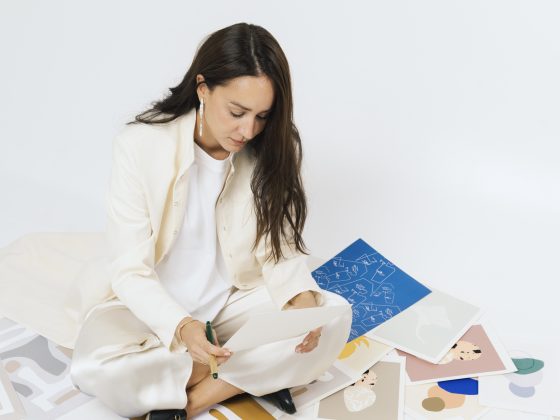
At the moment, with great joy, I have created the limited-edition art series “S’agapó” (I Love You), designed to be accessible to all viewers.
The works are made of lightweight handmade papers, cut by hand with a surgical scalpel, and are available through StratisTavlaridis.com.
Each piece is meant to be shared and to express all those “I love yous” that, for one reason or another, were never said. Through them, everyone can leave their own message and either give or keep a piece of art filled with personal meaning.
Is paper the only material you love?
Paper is not just a material to me—it is my core. It is the way I think and express everything that concerns me.
I mainly work with lightweight handmade papers from Asian countries, which I cut with a surgical scalpel, removing material instead of adding it. Through subtraction, a new world is created.
Do you follow your instinct, or are there techniques that guide you?
My work is based on a combination of instinct and discipline.
Emotion is the starting point, but consistency in execution and the time I devote to the work with my entire being are what complete the artwork and bring it to the viewer.
Have you experimented with other forms of art?
Beyond the visual arts, no.
I enjoy other art forms primarily as a viewer. I deeply appreciate good work in every artistic field when it is done with consistency, knowledge, and professionalism by artists who are fully dedicated to what they do.
What has openness brought you, and how does it affect your work?
Moments with people I never expected. The feeling when someone reaches the point of sharing how they experience your work is indescribable. I carry all this material with me, respectfully, and I make sure that my next works contain a bit of that emotional DNA.
What are your immediate plans?
A strong desire for creation and hard work accompanies me at this time.
I have begun working on my next solo exhibition, which will be presented in April in Athens and is based on the concept of trauma. It is a large-scale installation filled with images and emotions.
All details regarding the venue and dates will be announced soon, and viewers will be able to stay informed through StratisTavlaridis.com or my personal Instagram account @StratisTavlaridis.
What prompts and inspires the evolution of your creative process?
Emotion is usually the starting point. The choreography of the presentation and the interaction that emerges with the audience play a very important role in the form of the work. Gradually, through the production process and dialogue with the material, the work itself reveals the path I should follow.
This past summer, I had the pleasure of presenting my solo exhibition VOID | What Is Missing inside the narrow, curved space of a windmill in Chora, Astypalaia. A six-meter-long work made of handmade paper, cut by hand using the paper-cut technique, unfolded and embraced the viewers, leaving room for visitors to discover not only what is visible, but also what coexists within the phrase written in large letters: “what is missing defines what remains.”
A phrase open to personal interpretation and breathing. This experience allowed me to create an in situ installation inspired by the island of Astypalaia itself and its history, up to the present day.
Are we what we choose?
Clearly, we are our choices, and what we decide determines the path we follow.
The best book you’ve read recently
At times, amid all the noise of everyday life, our sense of proportion gets lost and we become constrained by small, insignificant needs. What calms me and helps me focus on what truly matters are books like Journey to the Solar System by Stamatios Krimigis. Within the vastness of space, I feel my core clear. I go “out of focus” and realize that, in the face of this entire system, we are nothing more than a very, very small existence.
An artist you love and would like to own a work by
I am deeply moved by the work of Edward Hopper. His silence and mysteries leave space for the viewer to find their own stories and emotions, and it’s astonishing to think how many people have lived, felt, and passed through all the places he painted, from then until today.
Three places you love returning to, and why
My studio, because time stops there.
Astypalaia, because time expands there.
And Paris, because time flows in a very different way there compared to other major capitals. All these places contain what I love to do.
Is art a path to becoming better people?
Not necessarily. The best version of oneself revolves around self-observation and self-improvement. Art can help us cultivate areas we may not have previously identified, but without personal effort, observation, and analysis, art alone cannot do much.
It is, however, a pathway to a way of seeing life.
Give us your own definition of beauty
For me, beauty is harmony and balance between the different parts of an object or a moment. It’s when everything fits together and creates an atmosphere—an experience that touches you and fills you.
What do you consider authentic today?
A difficult question, but life has shown me that appearances can be deceiving.
The most authentic things I have found are in people’s eyes—eyes filled with kindness and selflessness.
A rare phenomenon, but it does exist.