At such a young age, it’s admirable that you’ve already accomplished so many significant things. How did you decide to return to Greece after studying in the US? Were your expectations met, and would you recommend it to others?
First of all, thank you very much for the kind words—I always receive them with a certain degree of embarrassment. I returned to Greece in 2018, after nine years abroad, primarily in the US, where I studied at Yale and Columbia and took my first professional steps at the intersection of technology, public policy, and media.
Beyond nostalgia, what truly brought me back was my love for journalism. Claudia Dreifus, my professor and later mentor—a veteran New York Times journalist—recognized my passion and encouraged me to pursue it. At the same time, she advised me to start in a smaller market than hyper-competitive New York, in a place that mattered to me personally and where my work could have real impact. Greece felt like the most immediate and honest choice.
I left behind a very well-paid job in media strategy and returned to practice active journalism, starting at Kathimerini. It has been—and continues to be—a wonderful journey, filled with beautiful moments but also quite a few hard knocks. I don’t regret it. That said, I’m not sure I would recommend it as a universal path, because I’m generally hesitant to give one-size-fits-all advice. Every journey is different, and these decisions are deeply personal. What I do know for certain is that I wouldn’t want to be in the US today.
You spent a year in Istanbul researching historical material. What drew you there, and what conclusions did you reach?
I lived in Istanbul in 2014 as part of a research project on the role of Greek diplomats in the Ottoman Empire, in collaboration with Yale and Boğaziçi University. It was a wonderful year—and a very different Turkey—just after the Gezi Park protests.
What led me there was my interest in history, particularly the presence of Greeks—and especially the Rum community of Constantinople—within the Ottoman Empire. It’s a rich history that isn’t sufficiently illuminated in our collective consciousness, either because of traumatic memories or the way history is taught.
In the archives I studied, an entire world unfolded—one we rarely discuss: Greeks playing decisive roles in trade, the economy, the arts, and even state administration. Some of the first Ottoman diplomats during the Tanzimat reform period were Rum, yet we know almost nothing about them. It was an experience filled with admiration but also melancholy: you could see the traces of a flourishing Greek presence that has now nearly vanished from contemporary Turkey.
What inspired you to write your first book about Pyrros Dimas? Was it a challenge?
The greatest privilege of my career so far has been the opportunity to document the life of Pyrros Dimas. What isn’t inspiring about him? He is the greatest Greek athlete and the most accomplished weightlifter in the history of the sport—the only one with four Olympic medals. And yet, he remains incredibly grounded, “with his feet firmly on the ground,” as he says himself.
What drew me most was how his personal story intersects with modern Greek history: the life of the Greek minority in Hoxha’s Albania, about which we know very little; the experience of migration in the 1990s; the feeling of being a foreigner twice. Few people know, for example, that his passport for Barcelona—where he won his first gold medal in 1992—literally arrived on the day the delegation was leaving.
It’s also a deeply human story: about love and friendship, the Olympic dream, success and loss, the burdens beyond weightlifting—from politics during the years of the crisis to his later career in the US as Technical Director of USA Weightlifting. Pyrros spoke openly about everything, revealing the person behind the myth. I admire and care for him deeply.
Writing my first book was enormously stressful. I felt a heavy sense of responsibility toward him. To finish it, I isolated myself in Leonidio, my hometown, writing twelve hours a day. It was difficult—but today I look back on it and smile.
Wired Greece launches this spring. What do you think it can bring to Greek journalism?
It’s a tremendous honor to bring WIRED to Greece. It’s a historic magazine I’ve loved since my student years. It covers technology, science, innovation, and culture, trying to decode the future with substance but also with engaging, magazine-style storytelling.
We’re launching it under license with Condé Nast, alongside an exceptional team. Our goal is freshness: to shed light on stories about how the world around us is changing—from AI and startups to biotechnology, entertainment, gadgets, and the climate crisis.
We’re building it from scratch, which is both a challenge and an opportunity. We don’t want to simply chase the news—we want to explain it, to provide context. This spring we’ll launch our first print issue, a high-quality website, a strong social presence, and a series of events. The response so far has been incredibly moving and confirms that there is space in Greece today for a medium like this.
There is a crisis of trust in journalism. Does objective journalism exist?
The crisis of trust is global, but in Greece it’s particularly acute. According to the annual Reuters Institute report—where I was a fellow last year—our country consistently ranks last in trust. Only 22% of people say they trust the media.
The problem is also economic. When journalism isn’t financially sustainable, dependencies emerge. That creates a vicious cycle: low trust, and less willingness from the public to pay for news.
Complete objectivity is difficult—perhaps even impossible. What journalists must do, however, is present facts, investigate deeply, and offer multiple perspectives. Above all, they must respect the reader. And in my view, they should avoid “winking” only at those who already agree with them.
What would you say to those who are skeptical about AI and new technologies?
AI has occupied my thinking intensely over the past five years—well before the explosion of generative AI. We’re already seeing applications in medical diagnostics, robotics, and machine learning. We’re at a turning point, and the pace of change will be exponential.
Technology is neutral—no technology is inherently good or bad. Everything depends on how it’s used. The same applies to AI, which brings enormous opportunities as well as serious risks. What’s critical is implementation, regulation, and understanding.
To skeptics, I’d say I completely understand their concerns. Not everything is rosy. But AI is here to stay. Like every major technological leap—from mechanization to the internet—there’s no point in ignoring it. We must understand it, approach it critically, and integrate it in ways that serve society.
In such a difficult, competitive, and demanding profession, is there a survival guide?
You can’t do this difficult—and often bruised—profession unless you truly love it. If there is a “survival guide,” it certainly isn’t a manual. It’s more of a way of life. Passion for journalism is absolutely essential—otherwise you burn out very quickly.
At the same time, I deeply believe in the need to disconnect. Many colleagues—including myself—struggle to stop following the news even while on vacation. The switch doesn’t turn off easily; the itch of current affairs never fully leaves you alone. But to survive, you need pauses, rest, and distance—the space that allows you to see things more clearly. That’s what I try to do, and what I say—half-jokingly—to other “crazy” colleagues like myself.
What advice would you give to someone who wants to pursue journalism?
In the age of AI, information overload, and fleeting headlines flying past us at unbelievable speed, a new need has emerged: people don’t just want news—they want explanation. They want analysis, context, and above all, people they trust to help clear the fog.
That’s why we’re seeing the rise of journalists who speak directly to their audiences, whether through podcasts, video essays, or newsletters—from Ezra Klein to Nate Silver. My advice would be to invest in the skills that will remain deeply human even in the age of AI: deciding what truly matters, humanizing the news, and building trust with your audience. Not just transmitting information, but translating it. And you need courage—it’s a difficult path.
What are your plans for the future? Is there an unfulfilled dream?
Being Director of WIRED Greece is already a lifelong dream. I would feel almost greedy to immediately look for the “next step.” My plan is to devote myself fully to this in the coming years, serving both the brand and the need for high-quality, engaging journalism around technology and science.
Much later—many years from now—there’s also a more personal, completely wild dream. I’d like to travel to Patagonia and make a nature documentary inspired by the work of David Attenborough. We’ll see.
Is there something we don’t know about you?
There certainly is—thankfully. One thing that may surprise people who know me only through journalism and “heavy” topics like geopolitics or technology is that I’m a bit of a nerd. In my free time, I play Dungeons & Dragons with friends, collect Pokémon miniatures, and love fantasy literature—from Ursula Le Guin to George R. R. Martin.
If you could make one wish for 2026, what would it be—and for whom?
I would wish for greater clarity of thought—for all of us. Less noise, less haste, more empathy and reflection before we speak, write, or judge. And if that wish must be addressed somewhere, then first and foremost—to ourselves.
About
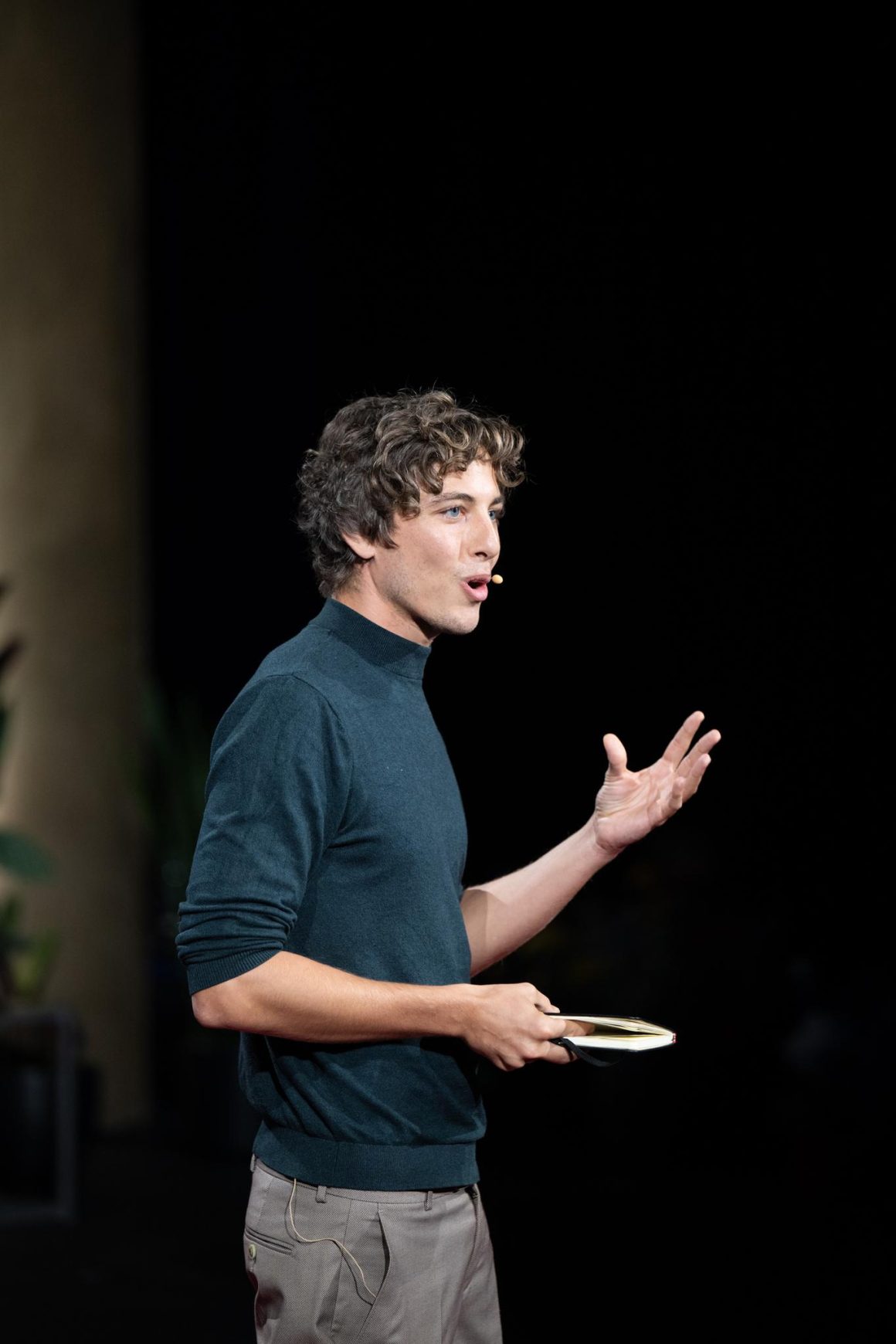
Nikos Efstathiou is a journalist, author, and public speaker from Athens, Greece with a decade of experience in print and digital media. He is currently the Editor in Chief of Wired Greece and just completed his cohort as a journalism fellow at the Reuters Institute for the Study of Journalism in Oxford.
He was previously the Managing Editor at Lifo and a journalist and media strategist for Kathimerini, and his work has appeared on the BBC, NBC News, Al Jazeera, La Libération, and the International NYT in Greece.
His reporting covers a wide range of topics, from geopolitics to technology and from climate change to art. He has interviewed key figures in politics and culture, among them Nobel-prize winner Joseph Stiglitz, Cambridge Analytica whistleblower Christopher Wylie, and Amnesty Int’l SG Kumi Naidoo.
In 2022, he published his first book “Pyrros, on a first name basis” an intimate narrative biography of Pyrros Dimas, the most decorated weighlifter and Greece’s most decorated Olympic athlete, in direct collaboration with him, which became a best-seller in Greece.
He has also worked as the Editorial Director at Rebborn, and a Communications Officer for Who in Greece in 2020-2021, at the peak of the Covid-19 pandemic. He was previously selected as an inaugural Google News Lab Fellow partnering with Witness Media Lab and working on new media and human rights monitoring through citizen journalism.
He has been a presenter at TedxAthens, Greek House Davos, and the NYT Athens Democracy Forum.
He speaks fluent Greek, English and Spanish and is proficient in French and Turkish.