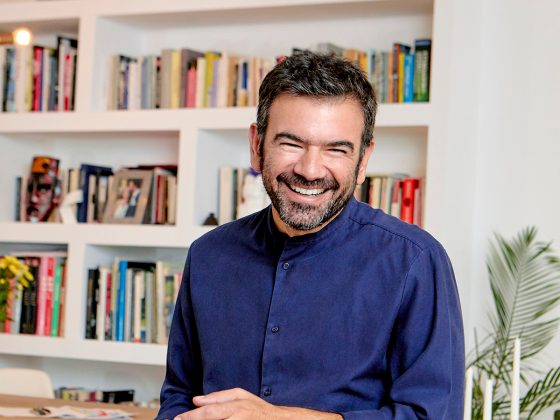
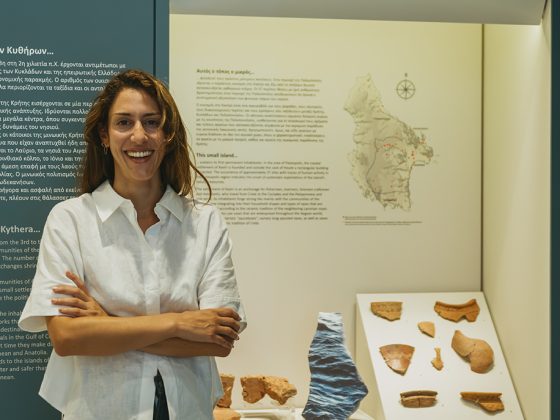
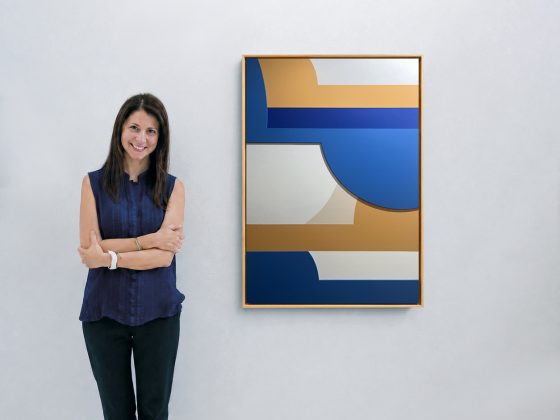
Sealed Earth Gallery, founded by Loukia Thomopoulou, presents a solo exhibition by ceramic artist Maggy Ioannou at Ceramic Brussels, marking the gallery’s first participation in the fair. The presentation features seven works in porcelain and clay, finished with pastel hues and gold details.
Three porcelain mobiles, suspended from the ceiling, fill the booth like galaxies—enchanted chandeliers where chains, hooks, and apotropaic talismans balance delicately, creating three-dimensional, multilayered worlds. Three wall-mounted works and one tabletop sculpture complete the presentation, condensing the same visual language into denser, icon-like compositions.
Maggy, what has your creative journey been so far?
Maggy I. I was studying graphic design when I was offered the opportunity to attend the School of Fine Arts on a scholarship. I hesitated. I completed my studies in graphic design, became a professional illustrator, and later an Art Director. During the 25 years I spent in advertising, I learned a great deal—the value of hard work, the weight of deadlines, and the responsibility toward the work one produces. Yet I always wondered what my creative journey might have been if, at nineteen, I had believed in my abilities just a little more.
Looking back at the “dots of my life,” as Steve Jobs once said, that dilemma was the first dot. From there began a path that eventually led me, years later in 2016, to a conscious life shift toward art.
Another important highlight was in 2018, when I exhibited my work for the first time. That’s when the heartbeat of exposure began—and with it, a meaningful dialogue with the viewer.
A few awards along the way, some positive reviews, and ongoing study and experimentation with my creative language led to opportunities and proposals—such as Loukia’s suggestion that we chase the dream and pursue participation in Ceramic Brussels.
The story of discovering a creative direction in ceramics—how did the first idea emerge and how did it evolve over time?
Loukia T. My own journey developed gradually through a lived, experiential relationship with ceramics and, by extension, through the need to create a framework that truly supports this medium. I began as a maker, working with clay on a personal level, but very quickly I realized that what motivates me is not only the object itself, but the ecosystem around it—the artists, the spaces, the conditions of presentation, and the dialogue with the public.
Today I feel I’m at a point where curating, exhibition production, international presence, and the creation of an institution that promotes contemporary ceramics coexist organically. Every step—from Sealed Earth to the Biennale and international networking—brings me closer to contributing to spaces and opportunities where Greek ceramics can speak in contemporary terms to an international audience.
Maggy I. To be honest, the initial idea was born out of an instinct for self-preservation, when I returned to clay about ten years ago. It was a moment in my life when the inner dilemma was clear: either I would learn to live with my darkness, or I would find a way to externalize it through the channel of art.
So I would say that the creative perspective began as a whisper—a way out.
Once I consciously decided to dedicate myself to creation, I simply took pencil and paper, rolled up my sleeves, and got to work, trying to give three dimensions to my concerns and emotions. Now that my works are becoming increasingly self-referential, I strive to evolve and experiment with my technique so that what I produce communicates my intentions as clearly and fully as possible.
Where did you meet, and how did the idea of your shared journey and participation in Ceramic Brussels begin?
Loukia T. Our meeting happened through the work itself. I had been following Maggy’s work for quite some time, and from the very beginning I felt admiration for the way she handles material and narrative. She is an exceptionally talented artist, with a truly unique mode of expression in ceramics. Her works are distinctive, filled with meanings—sometimes overt, sometimes hidden—and they tell stories that move between personal experience and imagination. That is what won me over.
Her work is like a contemporary fairy tale—a world where the imaginary, the mythical, and the emotional coexist, and it’s impossible to remain unaffected by it.
Sealed Earth’s goal is to step beyond Greece, to meet new audiences, and to highlight contemporary Greek ceramics within an international context. I want to show the remarkable work being done by Greek artists today, in a way that can stand confidently alongside established international presences.
Beginning this journey with Maggy was a choice that allowed us to reach even the most demanding viewer. Her work doesn’t need explanations—it captures you emotionally, almost instinctively. For a first international appearance, I felt it was essential to present work that can stand, converse, and move people beyond borders and language.
Maggy I. It was simply a phone call. A quiet Sunday morning meeting in the studio for coffee, a little over a year ago. It was Loukia’s idea—one of those ideas where you think, “Come on… really? Could it be?”
And from there, everything found its way—through hard work and positive thinking.
What does this fair offer that is new and different?
Loukia T. Ceramic Brussels offers something that was until recently missing from the international scene: an environment exclusively dedicated to ceramics, where the medium is not treated as a subcategory but as an autonomous, contemporary visual language. This alone radically changes how you view, present, and experience the works.
It is a fair with a curatorial approach, focused on materiality and addressed to an informed audience. Over the past three years, it has functioned as a meeting point for a new, international public—collectors, curators, and viewers—who come specifically to discover what ceramics can be today.
What stories does the collection you are presenting tell, and what makes it so distinctive?
Loukia T. The collection tells stories about human behavior, instincts, and our inner contradictions. It is an imaginary world where the mythical and the human coexist, through which Maggy speaks about emotions such as desire, fear, vanity, care, and the need for connection.
It is a collection rich in symbolism: each work can be read as a small, autonomous story, yet together they form a universe with strong scenographic presence. The works hover, converse with one another, and create a sense of ritual and theater.
There is a combination of sensitivity, storytelling, and technical mastery that I believe will capture attention and remain in memory.
Maggy I. The works whisper existential and value-based concerns that resonate across time. Despite humanity’s extraordinary technological achievements, we have not managed to shed poisonous instincts and toxic behaviors that truly prevent us from thinking collectively and evolving spiritually.
What does Sealed Earth Gallery mean to each of you, and how important is it to have people and places that support creativity?
Loukia T. Sealed Earth is much more to me than a gallery. It is a space with deep knowledge of the material—one that understands the process, the concerns, and the anxieties of artists, and does not function merely as a venue for displaying work. It is a living organism, created out of the need for a framework that takes contemporary ceramics seriously, giving it time, space, and visibility, and standing meaningfully alongside artists.
I deeply believe that creativity needs people who see, listen, and support—and places that allow risk, experimentation, and growth. Sealed Earth aspires to be exactly that: a meeting point where creators can present their work without altering their voice, and where the public can engage with it in a meaningful way.
Maggy I. Sealed Earth came to sprinkle ceramics with stardust. In its effort to elevate the image of ceramics and give it the modernity it deserves, it fills a gap and bridges a divide, presenting ceramics as the natural evolution of Greek ceramics of the past.
In doing so, it rightfully places Greece on the map of contemporary visual developments—and artists with big dreams, like myself, alongside it.
How do you feel your aesthetic evolves over time, and what new ambitions capture your interest?
Loukia T. My aesthetic evolves through constant engagement with the international scene. I follow many major international exhibitions, artists, and trends, and through this process I have significantly expanded my network—and, correspondingly, my own aesthetic outlook.
Exposure to different practices and approaches helps me see more clearly where we stand and where we can go. Through this perspective, I identify gaps, genuine originality, and the potential of the contemporary Greek ceramics scene. I am not interested in imitation or easy alignment with trends, but in how we can participate confidently, with our own voice, in an international dialogue.
At the same time, my aesthetic is shaped through curating and creating frameworks. I’m interested in how works coexist in space, how they converse with one another, and how they create experiences for the viewer. For me, evolution lies precisely in this deepening—and in the courage to propose works and artists with meaning and narrative.
What do you feel are your most important achievements so far?
Loukia T. I find it difficult to speak about achievements, because I feel I am in a constant process of learning. If there is something I recognize as important up to this point, it is my consistency and persistence in building things with depth and longevity.
Sealed Earth and the Biennale of Contemporary Keramics did not emerge as goals of success, but as necessities. They represent a journey full of trials, mistakes, adjustments, and continuous restarting. What I consider truly meaningful is that through these paths I continue to learn—from the artists, from the material, from collaborations, and from the audience itself.
My greatest achievement so far is that I remain open, present, and willing to evolve. To listen, to question, and to move forward without certainties, but with respect and curiosity.
Maggy I. I don’t feel that I’ve achieved anything significant yet. I feel like I’m just beginning, and I have many dreams.
What has outward-looking engagement offered you in general, and how does it affect your work?
Loukia T. For me, outward-looking engagement is like traveling. It is a source of knowledge, growth, and self-awareness. It takes you out of the familiar, brings you into contact with different ways of thinking and creating, and helps you see things differently. It opens the mind.
Having a strong presence in exhibitions abroad, what feedback do you receive from an international audience, and how different is the situation in Greece?
Maggy I. Our upcoming exhibition in Brussels, at Ceramic Brussels 2026, will be the first time my work is shown abroad. So yes—I have high expectations, I won’t hide it. Outside our borders, ceramics has an enthusiastic audience, and clay is now considered a powerful creative and communicative medium—one capable of moving people and conveying ideas.
In Greece, unfortunately, ceramic culture is not sufficiently supported by institutions, nor is its trajectory properly documented. Clay is still stereotypically perceived as a material for functional objects. This is such a shame, especially in an era when a work of art can be made even from a banana peel—as long as it communicates something meaningful.
What are the non-negotiable values in your work?
Loukia T. The non-negotiable values in my work are consistency and respect—for the projects I undertake, and for remaining open: listening, learning, and becoming better.
Maggy I. First and foremost, that the work aligns with my own aesthetic. When we create—especially knowing that our work will be judged—it is very easy to fall into the trap of trying to “please.” To be “trendy.” This insecurity can be so intense that sometimes pleasing yourself with your own work comes second.
Are we what we choose?
Loukia T. Yes, to a great extent we are what we choose. Our choices—small and large—reflect our values, our boundaries, and the responsibilities we are willing to take on. Every choice is a statement of how we position ourselves in the world and shapes both our path and the way we exist.
Maggy I. We are also what we do not choose. We are also the compromises we decide to make.
Is art, and creation in general, a path toward becoming better human beings?
Maggy I.
Art opens the small windows of the soul and the mind. It unfolds our sensitivities. Whether it comforts us or angers us, it places us in an existential dialogue with the universe—one that is culturally essential.
Three places you love to return to, and why
Loukia T. The Victoria and Albert Museum. It is perhaps one of my most beloved museums, because of its magnificent, multi-layered collection and the way it presents art through materials. From painting to ceramics, textiles, and everyday objects, everything is treated as a bearer of art and culture. Through this, it becomes clear that art has always been—and remains—part of everyday life. It shows us how art is embedded in living, how it reflects the trends of each era, and how it records the trajectory of human existence through time.
The National Archaeological Museum is a place I want to return to again and again. Beyond my admiration for the collection itself, I feel the deep relationship between humans and material—the need to express themselves through it and to leave a lasting imprint across centuries. I feel admiration, but also a kind of awe at the craftsmanship and the inventive ways people of that era found to express themselves. At the same time, I cannot help but connect it to the present—to the possibilities we have today, our tools and freedoms—while recognizing how decisive the influence of this heritage remains in the way we think, create, and narrate.
A newer place that has found its way into my heart and that I want to return to is the Manufacture Nationale de Sèvres. The guided tour of the production facilities was extremely enlightening—not only in terms of the extraordinary quality and consistency of this historic production, but also regarding the role it has played over time in the history of France itself, which it has served and continues to serve. Every three to four years, they light the historic wood-fired kiln during a major event, and I would very much like to witness that process.
Likewise, the Musée national de Céramique de Sèvres, located right next door, houses an outstanding collection from around the world, revealing deep knowledge and a profound understanding of ceramic history. There I encountered ceramics I had never seen before, objects whose origins I could not immediately identify—and that truly excited me. Yes, it is certainly a place I want to return to.
Maggy I. In Serifos, my DNA awakens. It’s a place that grounds me and brings me closer to my essence—who I am and where I come from.
In Syros, I feel loved. There is a sense of care and acceptance that calms me. My friends are my strength.
In my studio, I feel I can exist and express myself without fear.
A story you will never forget
Maggy I. As a kid, during a freehand drawing class taught by painter Roubina Sarelákou, we had finished our pencil drawings and lined them up on the wall for peer critique.
At the time, I had an arrogant self-confidence—at least when it came to drawing. In my eyes, my sketches were always better than everyone else’s. Until a classmate remarked:
“Maggy doesn’t really show us anything special—her technique is flawless, but the message is zero.”
And he was absolutely right.
I return to those words often and keep them as a guiding principle in my work. Because no matter how “beautiful” something is, it won’t move anyone if it is silent of emotion—if it doesn’t speak to you.
Your personal definition of beauty
Maggy I. Objective beauty exists only in nature—where existence doesn’t try to prove anything, but simply is.
What do you consider authentic today?
Maggy I. Animals. Because they don’t pretend, they don’t construct an image, and they move through the world with sincerity.
About Sealed Earth
Sealed Earth is a gallery exclusively dedicated to contemporary ceramics, founded in Athens in 2020 by Loukia Thomopoulou. Located near the Acropolis and operating beyond its physical space, Sealed Earth has established itself as a pivotal platform for contemporary ceramics in Greece. Bridging craftsmanship, visual art, and design, the gallery foregrounds experimentation and innovation through presentations of both emerging and established artists. Committed to the breadth of expression through clay, Sealed Earth works to position contemporary ceramics in direct dialogue with the international art market. Through exhibitions, residencies, and public programs, it cultivates an ever-expanding network of artists, collectors, and curators—connecting tradition with new vocabularies and local contexts with global discourse.
Ceramic Brussels 2026 is taking place from 21 to 25 January 2026 in Brussels, Belgium and is recognized as the first international contemporary art fair dedicated exclusively to ceramics.
Photography Giorgos Vitsaropoulos