The Fondation Cartier pour l’art contemporain is leaving the building at 261 Boulevard Raspail and moves to 2 Place du Palais-Royal, opposite the Louvre, in a historic building whose interior spaces have been radically redesigned by Jean Nouvel. This new location continues the Fondation Cartier’s mission by offering a flexible and open space, designed to accommodate contemporary creation while preserving the architectural and urban heritage of the building.
The Fondation Cartier building first appeared on the Paris map as part of the extension of Rue de Rivoli, during the first phase of the major works carried out by Baron Haussmann. Built in 1854-1855 as part of the extension of Rue de Rivoli for the first Paris World’s Fair, the building follows the layout of architects Charles Percier and Pierre Fontaine, with its regular stone façade resting on a series of arcades. Five stories high, the building housed the Grand Hôtel du Louvre and the Grands Magasins du Louvre, which remained there for nearly a century, marking the cultural and social life of central Paris. With his transformation, Jean Nouvel highlighted the existing architectural and urban elements, synonymous with the historic modernity of the 19th century.
In December 2013, the Fondation Cartier commissioned the architect to redesign the site to create a new space for contemporary art. “We need to capture the concept of space from above, below, and through the building’s transversal spaces—in short, we need to expand the space,” he immediately projected. From this reflection, the idea of a large interior “machine” was born: vast platforms capable of ascending and descending beneath the glass roofs of the mezzanine. Installing this unique device in a heritage building, already modified several times, proved to be an immense challenge. The building, accessible from its four corners, offers 8,500 m² of open space to the public, including 6,500 m² of exhibition space, spread across the basement, ground floor, and first floor, in a modular architecture that combines the different eras.
Museum Innovation
Five platforms, each measuring 200 to 340 m² and adjustable to different heights, constitute the museum layout inserted at the center of the Fondation Cartier building. Behind the fully preserved façade, this dynamic architecture creates an unexpected combination of volumes, voids, and spaces, thus affirming the modularity of the cultural institution and the central role of innovation in exhibition practices in the Fondation Cartier project.
The interior architectural landscape offers an impressive view: retractable ceilings and mechanized railings transform light and perspectives, offering a constantly renewed experience. With this transformation, Jean Nouvel enhances the architectural and urban elements of the 19th century, while adding tall bay windows that run along the façades. The transparency reinterprets the display windows of yesteryear, offering passersby a complete visual system. The addition of a glass canopy, reminiscent of those formerly installed on the streets of Saint-Honoré and Marengo, reinforces this unique urban unity and brings together the experiences of the street, the historic arcades and the interior spaces.
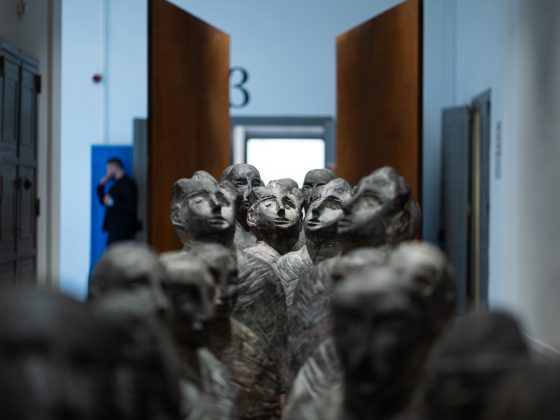
Fondation Cartier’s opening exhibition. Photo by Tom Ravenscroft @dezeen
❝
The Fondation Cartier will likely be the institution that offers the most differentiation in its spaces, the most ways to exhibit, and the most points of view. […] Depending on the chosen configuration, these spaces with variable geometries will be invented and discovered over the course of each project.
❞
Jean Nouvel