Within the lofty walls of a disused factory, QB Atelier carved out a home. The PDS House project weaves itself among fragments of industrial memory and spatial constraints, offering an original reinterpretation of the relationship with the surrounding landscape.
In Lendinara, in the province of Rovigo in Northern Italy, QB Atelier created a house centered around an open-air room, addressing the challenge of integrating it into a pre-existing industrial building. A secret garden brings a vital sense of landscape into the domestic interiors. Built within a masonry “box” that prevents direct views of the city, PDS House is conceived as a sequence of openings and closures that frame sightlines, establishing an ideal connection with the greenery of the public park beyond the entrance wall. Serving as a link between the generous double-height living room and the garden, and between the house and its natural surroundings, is a striking glass wall framed by a timber structure. At the top of this internal façade, the industrial profile echoes the one visible from the street side.
A tall wall faces the square that hosts a public park. Its irregular profile recalls the layered local history of industrial buildings erected at different moments throughout the twentieth century. Next to a vaulted reinforced- concrete structure that presents a generous expanse of glass toward the park, the wall extends into a covered volume capped by a twin gable roof. On this stretch of wall — entirely blank, its top edge capped with a slender strip of flashing — there is only a small black-painted iron door. Crossing that threshold reveals the unexpected: a garden enclosed by high walls, much of them draped in climbing plants.
The garden, conceived as an open-air green room, defines the new residence, which takes its form from one of the old factory buildings. Built with a hybrid structure of timber and steel and contained within the tall perimeter walls, the house echoes the profile of the former industrial architecture. Invisible from the street, it finds in the garden its light and air, giving life to an elegant and generous space. The project is by QB Atelier.
We are in Lendinara, in the province of Rovigo (Northern Italy), on the western side of the city. Here, traces of a once-thriving industrial activity are still visible, though largely abandoned today. The prevailing fabric is now residential, interspersed with generous green spaces. Piazza dello Statuto, where the entrance to the house is located, hosts a lively public park.
Just a few steps away, protected by a boundary wall, lies the historic garden of Ca’ Dolfin-Marchiori.
The theme of landscape directly inspired the project, which distilled elements of the natural environment into the site, thereby inventing the conditions for this unusual new urban residence. The client, owner of the company that once occupied the premises decades ago, had envisioned the complete demolition of the existing structure. QB Atelier instead proposed an unexpected solution— one that reactivated the site’s industrial memory and transformed its constraints into opportunities.
The garden encountered at the entrance, conceived as a large open- air room, was created through the demolition of the factory’s roof and the setback of the building volume now housing the residence. Along two of its sides climb star jasmine plants, their foliage visually extending into the treetops of the adjacent park. The side that frames the entrance is clad in larch wood, while the elevation that connects the garden to the house is defined by a tall, fully glazed façade.
The new construction takes shape as a compact volume within the preserved outline of the existing wall, which has been structurally reinforced. Within this framework, the apartment unfolds across two floors, creating an interplay of volumes that extend into the adjoining building and a small rear courtyard. The entire house reaches toward the garden, where the spacious living area opens across both levels through a glazed wall framed by an exuberant lattice of glulam timber. This expansive internal façade, emphasizing the building’s vertical rhythm, continues seamlessly into the roof structure, underscoring the twin-gabled profile that corresponds to the wall facing the square. From the outside, before passing through the small iron door, the house remains completely hidden from view.
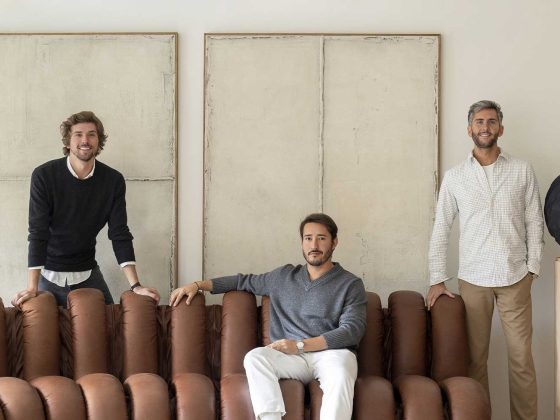
“The project is guided by an idea of landscape that unfolds through a play of closure and openness of view,” said architects Filippo Govoni and Federico Orsini of QB Atelier.
QB Atelier’s design for this house was developed by balancing the desire to preserve and reinterpret industrial memory with the many constraints of the site, the residential character of this part of the city, and its inherent aspiration toward landscape. The measure of this balance defines the project, which takes shape through an idea of architecture that— free from commonplace notions— focuses on the environmental condition. While evoking themes deeply rooted in the urban culture in which QB Atelier’s young founders are immersed, beginning with their Ferrara background, the secret garden here is not so much a representation of a sheltered place or a nostalgic paradise lost, but rather a symbol of a necessary natural environment — one that becomes an architectural device essential to the very condition of contemporary dwelling.