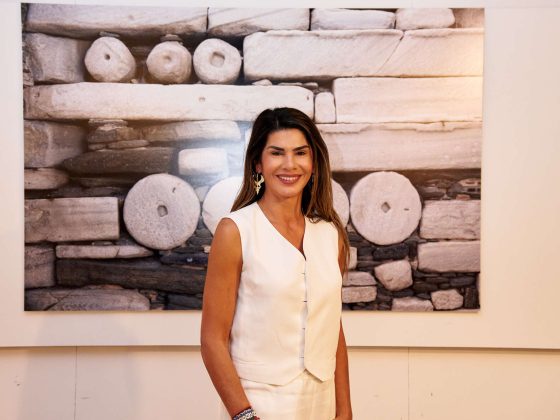
Olga, tell us about your creative journey — how did it begin, what made you completely change direction, and what have been the highlights of your path so far?
My creative journey began when I left behind the path of chemical engineering and decided to pursue photography. It was a decision born out of necessity — the need to express myself through images, to observe the world not by explaining it, but by feeling it.
Over time, I started taking my camera and photographing mostly urban landscapes in Thessaloniki. There was no plan — just an inner impulse to walk, to look, and to capture small moments of silence within the chaos of the city. These photographs, almost personal confessions at first, received an unexpectedly warm response. It felt as if something invisible had been communicated — a shared feeling that didn’t need words.
At the same time, I work as a professional photographer — collaborating with magazines, hotels, companies, and private clients. This side of my work grounds me; it reminds me of the value of consistency and collaboration. Between these two paths — the artistic and the professional — there is a creative tension that keeps me alive. For me, photography is a way of observing, connecting, and translating the world around me into something more personal.
You have a very distinctive personal gaze, and your photographs carry a nostalgic character — romantic and, at the same time, harsh. What is this rooted in, and how would you describe your own way of photographing?
I think the way I photograph is rooted primarily in the way I look at the world. I’ve always been moved by contradiction — the beautiful and the worn, light and shadow, tenderness and distance. Maybe that’s why my photographs have this mixture of romance and harshness; because both coexist within me.
I’m not interested in showing something “beautiful” in the conventional sense, but something true — something that carries a story, a sense of time or loneliness. I often feel that I photograph things that are about to disappear — not to preserve them, but to say goodbye to them.
If I had to describe the way I photograph, I would say it’s intuitive. I don’t begin with an idea or a goal; I begin with a feeling. For me, photography is a way to connect with what I see, to understand it, and ultimately to allow it to reveal itself to me.
❝ I’m not interested in showing something “beautiful” in the conventional sense, but something true — something that carries a story, a sense of time or loneliness. ❞
Every photograph of yours feels as if it tells a story. Which is the story you will remember forever?
I can’t single out just one story or photograph that will remain unforgettable forever. That changes over time — just as I change. Each period of my life brings different images to the forefront, different moments that move me.
Something that once felt deeply personal to me may now look different. It’s not that it loses its meaning; it’s that I have changed, I’ve shifted internally. I believe photography follows that same path — it becomes a mirror of your own evolution.
So, if there is one unforgettable story, it may be the journey itself: how through images I learn, again and again, to see — the world, people, and ultimately, myself.
Is one of your goals to discover beauty? And if so, how do you manage to bring that unique magic into your photographs, even when capturing ordinary landscapes?
Yes, I think one of the main reasons I photograph is to discover beauty — but not the “perfect” or the obvious kind. I’m interested in the beauty hidden in the everyday, the worn, the almost invisible. The kind that exists for a moment and then disappears.
I believe the magic lies less in the landscape and more in the gaze. When you look at something with real presence — not just to capture it, but to understand it — something shifts inside you, and that shift is reflected in the image.
I try to photograph in a way that leaves space for emotion, for chance, for imperfection. I think that’s where this magic is born.
You love photographing landscapes and giving them an otherworldly tone. What is the narrative behind your work, and why do people rarely appear in your photos or seem to come second to the scenery?
I think I’ve always been fascinated by this sense of the “in-between” — when something feels familiar but holds within it a silence, a distance, something slightly otherworldly. Perhaps that is the narrative of my work: an attempt to capture that delicate balance between reality and dream.
People are often absent from my photographs, not because they don’t interest me, but because their presence exists in other ways — in their traces, in the landscapes they’ve shaped, in the marks they leave without knowing. I like this kind of absence that carries stories, as if someone has just stepped out of the frame.
And when a person does appear in my photos, I usually place them at the edge, as if they are part of the landscape too. I don’t want them to dominate; I want them to coexist. Maybe because that’s how I feel as well — like a part of the world, not at its center.
❝ I think I’ve always been fascinated by this sense of the “in-between” — when something feels familiar but holds within it a silence, a distance, something slightly otherworldly. Perhaps that is the narrative of my work: an attempt to capture that delicate balance between reality and dream. ❞
Which photography exhibition illuminated your inspiration, and which of your own exhibitions do you consider the most important? Do you think that a museum exhibition receives greater public response?
I’ve seen many photography exhibitions that have inspired me over the years — mainly those that carried truth and personality, that weren’t trying to impress but to express something internal. Every time I encountered such work, I felt the urge to create again, to look deeper into my own gaze.
Of my own exhibitions, the one that stays with me most intensely is the one I presented at the Stavros Niarchos Foundation, titled Akalipti (“Uncovered Spaces”). It held something very special for me — perhaps because, for the first time, I felt that my photographs truly communicated with people. Visitors stopped, looked, and allowed something to touch them. It was a beautiful, quiet exchange.
As for whether an exhibition in a museum carries greater significance… I don’t think it necessarily does. The value of an exhibition is not defined by the venue but by how many eyes see it — how many souls pause, even for a moment, in front of it. A small, “silent” exhibition can leave a much stronger impression than a dazzling display in a museum. In the end, what matters is the connection — the gaze meeting the gaze.
Who or what do you dream of photographing?
I don’t think there is one specific “who” or “what” I dream of photographing. I’m more moved by the idea of being able each time to photograph something I haven’t yet understood — a new facet of the world or of myself.
Give us your own definition of beauty
I think beauty is not what we see, but how we see. It is that moment when you pause — even briefly — and something inside you becomes quiet. It doesn’t need to be “beautiful” in the external sense; it simply needs to move you, to remind you that you’re alive.
Perhaps this is ultimately the essence of photography for me: finding those small, quiet moments in which the everyday is transformed — not because the subject changes, but because the gaze does.
Is art a way to make our lives better?
Yes, I believe art can make our lives better. Not because it decorates or “sweetens” them, but because it wakes us up. It makes us pause for a moment, feel something, remember who we are.
The interview with Olga Deikou was published in Momus Magazine No. 4, an edition of Momus Museums.
Photography Nikiforos Ntempos