The perfect location
The project is located in Taipei’s Da’an District (in Taiwan), a lively, design-conscious neighborhood where boutique retail, creative dining, and cultural sensibility intersect. “It’s a place where tradition quietly meets modernity, making it an ideal setting for a patisserie that weaves together European elegance with a distinctly local spirit,” the team of Ecru Studio says.
Architectural style
The original space was built in the early 1970s and featured the typical characteristics of a Taiwanese apartment (modest, utilitarian, and architecturally neutral), with no strong historical features. This blank canvas gave the design team the freedom to reimagine the space entirely, using a narrative-driven approach to infuse it with identity, texture, and soul. Four distinct yet connected zones (a pastry showcase, a giftable sweets area, a salon-style seating lounge, and a 9-seat island bar for plated dessert experiences) are brought together into a layered and unexpected space.
Shades of blue
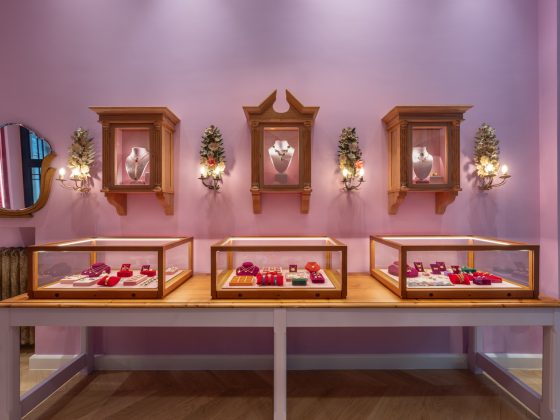
– “As Season entered a new chapter, Chef Hung chose blue as the primary color,” Jin Chen says. “In response, we anchored the fresh pastry and retail zones in varying shades of blue, establishing a calm and elegant tone for the brand’s new visual identity.”
– As guests move deeper into the salon seating and plated dessert area, the design team wanted to evoke the relaxed intimacy and quiet mystique of an 18th-century Parisian salon—with a theatrical touch. To create this shift in atmosphere, the palette was deepened, with the introduction of velvet red, golden yellow, and ochre to heighten the sense of drama.
– Overall, the palette is designed to feel both nostalgic and unexpected. “By combining dusty rose, warm ivory, moss green, and muted gold with the richer, moodier salon hues, we created a layered visual experience that unfolds gradually—like a memory or a quiet performance,” Randy Tu says. “The colors invite guests to slow down, linger, and fully immerse themselves in the space.”
Exploring the tension and harmony between different historical aesthetics
The Ecru Studio team was mostly drawn to the intimacy of 18th-century Parisian salons, and the expressive layering found in Art Deco, Art Nouveau, Rococo, and traditional Asian aesthetics. “These references informed everything from spatial rhythm to material choices—allowing us to blend decorative richness with moments of restraint,” Jin Chen says.
– Ecru Studio incorporated lime wash, lacquer veneer, and lacquer paint to introduce depth, reflection and a touch of quiet luxury. “Every material was chosen not only for its aesthetic resonance, but also for how it would age, interact with light, and support the slow, sensory rhythm we envisioned for the space,” Jin Chen says.
– The designers also looked to Milanese design from the 1940s, which inspired the flooring pattern and contributed to the space’s quiet sophistication.
– In contrast, they felt it was important to weave in subtle Asian elements—“ones that felt forgotten, poetic, and not overly literal”, they say. For example, in the gift zone, the upholstery fabric used for the twin benches features abstract, symbol-based patterns unique to certain Asian textile traditions. “We also referenced antique trim catalogs, vintage dessert packaging, and old textile shops to develop the material and color language,” Jin Chen continues. “Ultimately, the space is a convergence of East and West, old and new, told through fabric, light, and layered storytelling.”
Biggest challenges
– Working within a relatively compact footprint, the designers set out to create four distinct functional zones, each with its own identity yet seamlessly integrated into a cohesive whole.
– The Ecru Studio team explored materials they had never fully worked with before: layers of textiles, floral fabrics, ornamental trims like fringes and piping, and a custom wood floor inspired by 1940s Milan.
– At the same time, they wanted to integrate Asian cultural elements in a way that felt poetic and understated. “We worked with local artist Genggeng to create a hand-painted mural inspired by an ancient Shang Dynasty motif, and incorporated patterned textiles featuring symbolic Asian iconography—mystical signs and totems unique to regional visual traditions,” says Jin Chen.
“These details required a high level of experimentation and precision, but ultimately helped us craft a space that feels emotionally rich and visually unexpected,” says Randy Tu.
Creative freedom and expressiveness
“Designing a commercial space requires a different kind of sensitivity—one that balances brand identity, customer experience, and operational flow,” says Jin Chen. “Unlike residential projects, which are often more restrained by the client’s daily habits and personal comfort, commercial spaces actually allow us greater freedom to explore bold ideas in materials, storytelling, and spatial composition. We can be more expressive with color, scale, and detail—creating an environment that becomes part of the brand’s narrative and emotional memory. Of course, functionality remains non-negotiable. Every circulation path, counter height, lighting angle, and material choice must serve both aesthetic and practical needs. Durability is also essential, especially in hospitality spaces where surfaces are in constant use.”
– “For Season, we approached the design as a kind of sensory theater: a place not just to consume, but to feel,” the design team concludes.
A quiet mantra of restraint
“One moment that stayed with us was during an early meeting with Chef Hung,” remembers Jin Chen. “He spoke about his years studying pastry in France, and how the philosophy he brought back to Taiwan wasn’t about decoration, but about restraint—knowing when to stop. That line became something of a quiet mantra throughout the design process. It reminded us to let certain materials breathe, to hold back when the space was already saying enough. We even made the decision to leave one wall partially bare, so the mural could feel like a fragment of memory rather than a centerpiece. Moments like these reaffirm why we love what we do—when design becomes a shared language between people, memory, and place.”
Layout
The project spans approximately 1,077 square feet / 100 square meters and is arranged on a single level with an open-plan layout.
The space is divided into four distinct yet connected zones: a fresh pastry counter at the entrance, a retail area for giftable sweets, a salon-style seating area, and a central island bar with nine seats designed for enjoying plated dessert courses. The open flow between these zones allows for visual continuity while offering varied spatial experiences from casual takeaway to immersive, in-house dining.
Photos: Dean Hearne