On the fifth floor of a 1930s Rationalist building designed by Giovanni Muzio, the architecture retains that quiet gravitas typical of cultivated Milan: measured proportions, solidity, and an elegance that does not seek attention but commands it. It is here that Moitié Studio—founded by Francesco Gennaro and Giorgia Rossi—has reworked a 150 sqm apartment, transforming it into a sophisticated and layered domestic narrative where memory and contemporaneity finally find common ground.
Before the intervention, the home seemed to hold its breath. A uniform grey enveloped every surface, absorbing rather than reflecting light; the original parquet survived only in fragments, like an interrupted memory, while the entrance—isolated, rigid, paved in dated, characterless marble—broke rather than guided the spatial sequence. Complicating matters further were an obtrusive column at the entry and a beam interrupting the continuity of the large windows overlooking the Garibaldi skyline. Yet some precious details remained: original period doors and a stucco ceiling frame in the living room—traces of a bourgeois, rational Milan that deserved to be listened to, not erased.
“When I first walked in,” recalls Francesco Gennaro, “I immediately understood that this wasn’t about imposing a gesture, but about subtraction: freeing the space, letting light return as the protagonist, and re-establishing a dialogue between the home and the city.”
The clients—a family connected to the finance world with two children—had clear yet essential requests: fewer partitions, more openness, and a light, warm palette capable of giving character with discretion. They also referenced London, a city they had long lived in—not as a literal model, but as an atmosphere, a balance between classicism and lived-in comfort.
In just four months, Moitié Studio worked along that subtle boundary between openness and restraint, memory and new daily life. The project focuses primarily on the entrance–living axis, completely redefined through three micro-architectures that structure the space and transform constraints into opportunities: a large curved volume that welcomes and organizes the entry and living area; an existing structural element—the column—absorbed into the design and transformed into storage; and finally, a reflective volume that closes and expands the space, introducing depth and light. The entire home, with few exceptions, is immersed in a creamy white that amplifies light and creates continuity, while the flooring is unified by restoring and extending the original parquet.
The first strong gesture is a large curved volume clad in Phillip Jeffries silk: it serves both the entrance and living room, concealing storage and the television behind sliding doors edged in brass, and is interrupted by two full-height walnut bookcases. A void filled with objects, books, and traces of life breaks the compactness of the block and balances its presence. Opposite, the conversation area is a manifesto of measured comfort: a Magi chaise longue by Flexform in leather, Augusto sofas by Molteni in moss-colored velvet, an ivory CC-Tapis rug, circular Maxalto coffee tables, and a custom monolithic table in Calacatta gold.
The column, once an obstacle, becomes a protagonist: integrated among the sofas, it houses storage and is decorated with the same stucco motifs as the ceiling, directly referencing the idea of continuity central to Milanese Rationalism. “We are very interested in working by analogy,” explains Giorgia Rossi. “Reinterpreting an existing detail and letting it migrate elsewhere, as the masters of the twentieth century did—capable of creating interiors that were cultured, sophisticated, yet always free from rigidity.”
The dining wall, treated with the same sculptural language, forms the backdrop for the Henry table by Poliform in black ash, customized with a Calacatta Viola top, surrounded by six Wishbone Chairs by Hans Wegner—a subtle homage to his idea of timeless comfort.
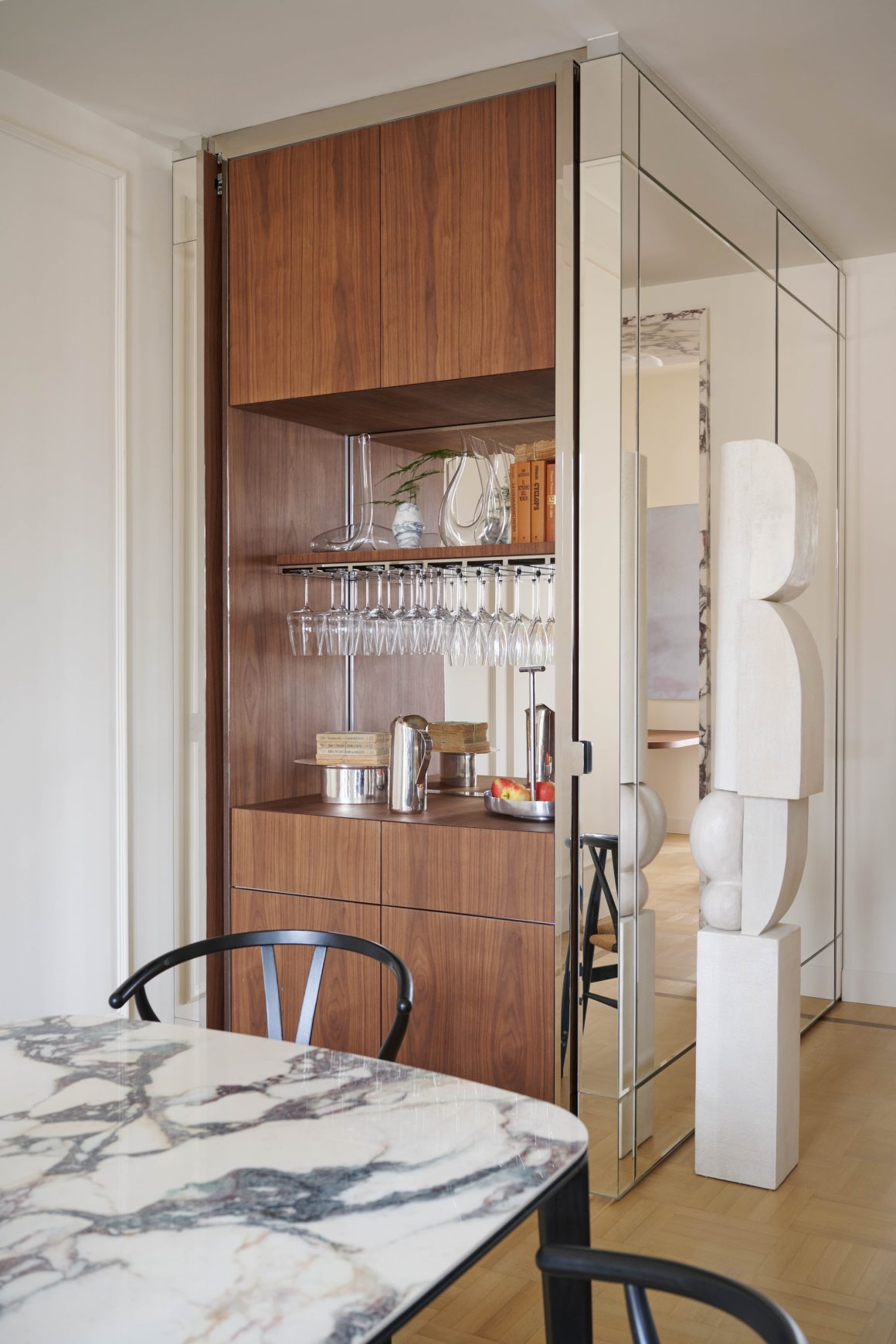
A third volume, clad in extra-clear beveled mirror, reflects sculptures by Paul Bik and an iconic lamp by Achille Castiglioni. It is a scenographic yet measured gesture that conceals a walnut bar, the entrance to the sleeping area, and multiplies light. The corridor leading to the kitchen becomes a space to inhabit, featuring a niche bench upholstered in fine Lizzo fabric, Louis Poulsen wall lights, and the material artwork Green Ink by Paolo Fiore.
The kitchen reveals itself through a true perspectival “telescope,” framed by a Calacatta Viola portal. Entirely custom-designed, it is an intimate space that reinterprets London kitchens in a neoclassical key: a central walnut table with three Armory chairs by Marta Sala, a suspension lamp by Gino Sarfatti for Astep, and a material artwork by Meridiani. The balance recalls certain atmospheres of Edwin Lutyens, filtered through a distinctly contemporary sensibility.
Behind the mirrored door, the sleeping area restores a sense of memory: restored original doors lead to bedrooms and bathrooms. In the master bedroom, the design becomes more intimate. A low bed in a warm, muted fabric engages with a backdrop wall treated like a theatrical set: dark Sandberg wallpaper crossed by a golden pattern that creates depth and protection. Suspended Louis Poulsen lights descend lightly at the sides, freeing surfaces and shaping precise, never intrusive illumination. Textiles by Society Limonta, Dedar, and Schumacher Italia work alongside the restored parquet in a layered composition reminiscent of early twentieth-century English domestic interiors.
The walk-in wardrobe, hidden behind sliding doors in classic boiserie, surprises with warm, enveloping tones: integrated lighting, an Egorug carpet, and a Lavinia pouf by Marta Sala. Opposite the bed, a Maxalto chest of drawers and Parallel Universe artworks by Paolo Fiore complete a space that is both functional and subtly theatrical.
The children’s bedroom opts for lightness: blue striped wallpaper, archetypal furnishings, and space for play. The original door, with a brass handle by Gio Ponti, maintains continuity with the rest of the apartment without imposing an overly defined aesthetic.
The two bathrooms conclude the project as variations on a shared theme. The first, spacious and bright, plays on symmetry and light reflecting on imperial grey marble; the second, smaller one takes the opposite approach: green walls and ceiling, absorbed light, and an intimate, almost secret atmosphere, with custom vertical sconces, mirrored storage, and classic fittings by Cristina.
Every fixed element is custom-designed, every choice carefully calibrated. In this project, Moitié Studio demonstrates a rare maturity: the ability to balance rigor and warmth, memory and vision, Milan and London. Francesco Gennaro and Giorgia Rossi confirm their versatility, creating interiors that do not chase time, but choose to inhabit it.
Lead Architects: Francesco Gennaro & Giorgia Rossi
Photography: Valentina Sommariva