Starting Wednesday, 3 December 2025, the Benaki Museum of Greek Culture presents the exhibition “Clay Landscapes • The Art of the Everyday”, dedicated to the distinguished ceramic artist Eleni Vernadaki, curated by Vassilis Zidianakis / ATOPOS cvc. This “emerging” (popup) exhibition unfolds across the first-floor galleries of the Museum—spaces devoted to everyday life and art in Greece from the 17th to the 19th century—and will run until Sunday, 11 January 2026.
Over the course of her sixty-year artistic career, Eleni Vernadaki (b. 1933) devoted herself to ceramic objects and sculptural clay forms, approaching clay not only as material but also as a medium for artistic inventiveness, meaning, and cultural practice. She also created large-scale wall-mounted ceramic compositions for emblematic public and private buildings, effectively challenging conventional hierarchies between applied and “fine” arts.
The exhibition presents a small yet representative selection of ceramic vessels through which Vernadaki expanded the ceramic canon, both morphologically and technically, while highlighting the importance of art’s dialogue with the wider public. At times austere and Doric, at others rich with bold color, dynamic forms, and tactile surfaces, the vessels featured in the exhibition stand as daring expressions of ceramic modernism—“places” where art and everyday life intersect.
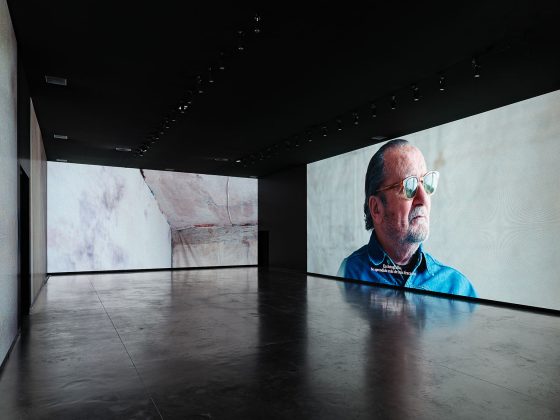
The exhibition also features the work 1095°C, conceived and artistically directed by Vassilis Zidianakis / ATOPOS cvc. It is a two-part motion‐graphics video, whose title reflects the exact temperature at which Eleni Vernadaki fires her ceramic works. The first part, titled 1095°C Out in Space (2016), was created on the occasion of the presentation of her monograph. In it, ceramic forms are detached from their materiality and functionality and reimagined within a fantastical cosmological environment: plates transform into planets, floating teapots disappear into the void, and sculptural satellites travel through interstellar dust made of clay fragments.
The second part, 1095°C Down to Earth (2025), created especially for the present exhibition, reintroduces the ceramic works into a temporally and geologically indeterminate earthly setting—either primordial or futuristic, from which the human presence is absent. Ceramics metamorphose into imaginary botanical species, forming landscapes of uncanny vegetation dominated by a giant creeping dragon that activates mythological and ecological symbolism. The work highlights the fairytale undercurrent in Eleni Vernadaki’s oeuvre, focusing on the relationship between materiality and imaginary cosmogony, crystallized in ceramic form fired at 1095°C.
About Eleni Vernadaki
She studied ceramics at the Hammersmith College of Art and Building in London (1957–1959). She returned to Greece in late 1959 and opened her studio in central Athens (20 Solonos Street), which in 1974 was relocated to Kantza, into a building specifically designed by architect Takis Zenetos. In 1961 she joined “Art Group A’”, formed with the aim of promoting art to a wider public. From 1961 to 2015 she co-directed the Morphological Center of Athens – adc (Athens Design Center), founded with her husband Nikos Papadakis, which became a landmark and dynamic hub for the creation, presentation, and dissemination of works that proposed an inspired coexistence between the handmade artistic object and contemporary life. She is also a founding member of the Association of Contemporary Art (SYST), where she served as General Secretary. She has presented her work in numerous solo and group exhibitions in Greece and abroad.