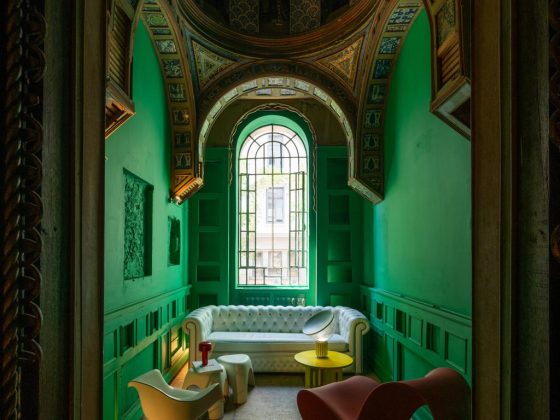
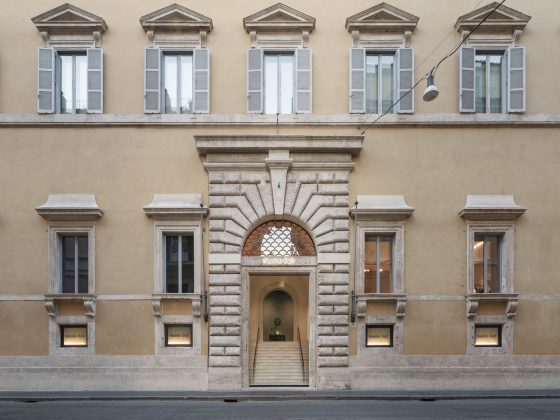
ARCHWorkshop presents Be earth no more by Myrto Papadopoulou, a contemporary ceramic project.
Form enters the work of Myrto Papadopoulou through the whirling movements of her hands, gestures rooted in the archetypal motions of the potter. The saying “clay remembers” is affirmed in the textures of her pieces. Some surfaces remain smooth and clear, while others – shaped by twists and urgent motions – echo the harmony of Cycladic vessels. Yet her works pursue their own, unmistakably personal freedom. Her process layers slip and glazes to create ambiguous, shifting textures. Drawn from mountains, rivers, rain, and the sea floor, her vessels open new imaginative viewpoints. Through this exploration, she uncovers fresh possibilities in texture and form, noticing small details and revealing hidden facets. Her pieces seem to hold both formation and dissolution at once, like clay suspended in the moment before it becomes a finished, signed work.
She holds a BA in Ceramics from Stoke-on-Trent and an MA in Ceramics from Wolverhampton University, UK. With more than eight years of experience in creating ceramic sculptural work, Myrto has established herself as both an artist and an educator. Her practice has been recognised for its distinctive blend of tradition and innovation.
Till 23.12.2025
2. Melas Martinos presents Michael Anastassiades in ‘All Colors Will Agree in the Dark’
In Aristotle’s On Colours, all colours are derived from mixing light with either black or white. He relates them to the four elements: water, air, earth, and fire. Fire and the sun are golden, while air and water are naturally white. The earth is also naturally white, but seems coloured because it is dyed.
“If the sun’s light consisted of but one sort of rays, there would be but one colour in the whole world”. In his book Opticks, Isaac Newton demonstrates that clear white light is composed of seven visible colours.
Goethe challenges Newton’s view, arguing that colour is not a scientific measurement but a subjective experience, perceived differently by each viewer.
RGB I
RGB II
RGB III
A series of bamboo uplighters, a number of poles supporting each other in various compositions. At first glance, they appear as a bundle of poles suddenly dropped and happened upon a random balance. Yet on closer observation, there is structure and order. The ropes at the base prevent the poles from collapsing. Perhaps they are holding the pieces in the very arrangement they achieve each time.
In the first composition, the bamboo poles lean against each other, meeting only at the top. The bottom parts sit about a foot apart. An RGB light projects upward, one colour per pole. The beams overlap: cyan between blue and green, magenta between blue and red, yellow between red and green. At the centre, all three converge to form white, the most elementary colour model made visible. There is perfect alignment to achieve, perfect order as if in a scientific experiment.
In the second composition, it looks like one bamboo pole slipped and found balance between the two others, crossing. Even in a not so orderly composition, there is symmetry and balance. But not in the light beams themselves. A misalignment or a failed experiment makes the red beam project much further out, missing the blue and green, partly overlapping in cyan.
The third composition is so perfectly constructed that it makes you question the light experiment that goes on in the ceiling above. Two pairs form an identical cross between two poles, offset by the distance between the legs. The lower ends of each pair splay outward, while the four tops align in a perfect straight line. Is it another failed experiment—or a different perspective on the same theory?
The room’s ceiling: a choreography of coloured lights—a celebration of light theory, or perhaps a subtle suggestion that white is simply composed of many other colours.
The bamboo is ‘Shiratake’: blazed with fire to draw out its oils. It’s left in its natural state, its surface bearing the meticulous process of being nursed to precision.
Can I go now?
Glad you’re not here
There must be a better way
Sharp outgrowths inaccurately referred to as thorns, prickles serve as the plant’s armour against herbivores. A physical defence mechanism, brightly coloured prickles can also act as a visual warning to predators, indicating that the plant is defended and should be avoided. Natural pigmentation is also there to protect the plants from UV radiation. A series of prickles are selected and scaled into larger proportions. Cast in bronze, they are patinated in unusual colours. The tips are highlighted for their sharpness. Siamese twin thorns side by side, snail-like creatures creeping up the wall. Some remind you of horns or outgrowths.
Early stool
Although simple blocks are often seen as primitive pieces of furniture, the triangular form reduces the footprint and introduces sophistication through its rotational symmetry (of order 3). The introduction of the double cove seat prioritises comfort and beauty over an otherwise basic function. The reduced 60 degree corner, rather than the 90 degrees of a square block, combined with the exaggerated curvature of the top surface, accentuates the sharpness of each corner. The three protruding tips are in dialogue with the thorn pieces displayed on the surrounding walls.
The piece is an evolution of the ancient Egyptian stool, abstracted into a new volume and carved out of a solid basalt block. The choice of material is reminiscent of other historic artefacts from a similar period, made of the same material. The monolithic appearance suggests solidity but also movement through the curved top surface.
Cloud-to-Cloud (CC)
A trio of 1.6m light tubes appear to hang in a random but perfectly balanced composition from the ceiling. The cable used to hang them looks the same as the one that powers them. A series of carefully selected nautical knots secure the glass tubes in place. Though equidistant, the tubes tilt in distinctly different directions, their poise determined by an unusual equilibrium. The composition is an act of improvisation, allowing you to imagine various other possibilities. In certain places the cable appears tangled, through a string of consecutive knots. The excess cables suggest that the piece is still in the process of making.
I was born in May
A tall, thick bamboo pole has been carefully selected, sanded, and painted in a high gloss finish. After the elimination of most of the surface texture, the protruding nodes are the only reminder of the material. The choice of a skin tone colour for the surface is in contrast with all the other bamboo pieces in the exhibition, which are left completely natural. The colour could be almost real if it weren’t for the perfect uniformity of the surface. Three steel cables anchor the bamboo pole onto the floor. The attachments on the piece are through fishing line guides that are secured radially on the upper section of the pole through two black linen bands. The pole is an uplighter that illuminates the room as a beacon or a lighthouse.
Working surface
On the top floor, a low large work surface is used to display a series of related and unrelated objects. Some refer to the exhibits on the lower floors while others are connected as a series, creating their own narrative.
Model for Light structure I
Model for Light structure II
There are also two scaled models of different bamboo light sculptures on identical wooden bases. One is of the bamboo uplighter featured on the floor below. The second suggests a different structure, where three bulbs are supported by a central thinner bamboo pole like a windmill, except that the bulbs are arranged horizontally. One can ask the question, “Does it spin round?”
Vase I
Vase II
The two bamboo vases refer to the light structures of the first floor, in that the joint pieces suggest an unusual natural growth of the species. Made from Zumentake bamboo, the pair is a repeated shape in an upside-down version, where fresh shoots could germinate from the bamboo surface.
Jimbutsuseki 2013, is a carved block of basalt to resemble a miniaturised version of pentadaktylos created from memory, a mountain in the northern part of Cyprus, clearly visible from anywhere in Nicosia. All the edges are rounded off making the piece look like a found river stone, smoothened by the constant flow of water. The name derives from the Japanese philosophy of suiseki, which originated from the 14th century Chinese interest in stone appreciation. Jimbutsuseki is a specific category of suiseki where a stone resembles a body part, in this case the five clearly visible protrusions that relate to the five fingers.
Red round stone
Black round stone (bronze)
Two round stones of different scale: one completely natural, and the smaller as a replica with its surface abstracted in black patina.
Sail is a kite-like structure, an early model of a series of illuminated kites that I developed last year. The elongated triangular sheets of washi paper are framed with the same section of wood that supports the structure.
It is difficult to believe that you and I are operating in the same ocean is a bronze cast of an unusually elongated thorn in highly polished bronze. As its title suggests—a borrowed dolphin code from Canadian submarine communication—it resembles the watercraft half exposed above the water surface.
Good Evening, Shelley and It takes anywhere from 70 to 100 minutes to get dark, are in dialogue. Good evening is a simplified interpretation of the sunset, a half circle of the sinking sun in the horizon formed by just five glowing rays.
This ray arrangement is repeated in Shelley, an oversized black scallop in bronze, displayed upright on the table surface, a dark evening version of the same sunset or perhaps the blue hour that follows, with those last rays as a memory. It takes anywhere from 70 to 100 minutes to get dark is a fossil of the same scallop imprinted on the tip of a grey stone.
“Darkness can weaken the light in its working power”
Till 24 January 2026
3. Kalfayan Galleries presents
Alexis Akrithakis, Karolina Krasouli, Konstantinos Mouchtaridis, Nikos Gabriel Pentzikis
4ensic Drawings
Till 10 January 2026
4. Eleftheria Tseliou Gallery presents Antonakis
Purpose, Desire, Emptiness.
Entering the Mythmaking Studio of Antonakis we find ourselves inside a dollhouse built from studies of rooms, landscapes of fear and authority, where animals, monsters, boys, and emperors wander. Each work is a surface upon which something returns, a scene restaged, inhabited by beings that dwell at the thresholds of body, gender, and identity. We do not know whether it is haunted or archival, a refuge or a nightmare; yet memory and imagination, fear, desire and obsession share the same space, and the stories are rewritten slightly differently each time.
Abstract from Niki Soumpassis’ essay on the exhibition
5. Athanassiadou Gallery presents Hazy Cosmic Jive! by Eirini Linardaki and HOPE (Konstantinos Ntagkas), curated by art historian Eleni Koukou in collaboration with the artists.
The dialogue between the two creators and the coexistence of their works within the exhibition space function multiplicatively, intensifying both the energy and the meanings they generate. Linardaki—who lives and works between Heraklion, Crete, and New York—is an artist with extensive experience in public-space projects and environmental action. HOPE, known for his multifaceted artistic practice—which includes sculpture, collage, performance, and fanzines—presents a new series of ceramic sculptures.
Until 31 January 2026