You approach your art with a disarming honesty, and nature often becomes the framework within which you think and create. How did this come about, and how did your creative journey along this path begin?
I am interested in truth in art. What you perhaps describe as disarming honesty has to do precisely with this need to identify something essential and try to bring it to the surface without burdening it with anything unnecessary. For me, nature possesses this kind of truth, and it inspired me to work with elements such as earth, water, salt, pebbles and celestial bodies.
This began very early in my practice, with the first work I created as an undergraduate, using sand, earth and water. I began experimenting with natural materials and observing what can happen when you intervene only minimally in a material, bringing out something that already exists within it. There is something almost magical about that. With a very small intervention, a quality of the material that you had not noticed before can suddenly emerge. From there, a broader exploration began around understanding the natural world and our place within it.
Over the years, this exploration became a constant thread running through my work. I often begin with a natural material or a process found in nature and, through a particular form of treatment, try to see how far its properties can be taken without losing the original truth of what lies before me. I think what continues to move me most is the transcendent beauty of nature, and how far something as simple and real as water, earth or a pebble can take you.
What do you consider the defining moments in your journey that shaped you as an artist and left their mark on your soul and on the way you create?
There are certain works that, looking back, I can clearly identify as turning points, because each one moved me somewhere else. The first was certainly Desert Breath (1997). It was my first land art project, and the scale of the undertaking was entirely new to me, both in terms of the landscape and the work itself, as well as the time it took to move from conception to completion. We created it as D.A.ST. Arteam, together with Alexandra Stratou and Stella Constantinides, and that close collaboration was itself a powerful experience. I remember being completely absorbed in it for a long period of time, almost cut off from the outside world. I think that sense of dedication, as well as my encounter with the desert, Egypt and a culture beyond the Western framework in which I had grown up, changed me profoundly. The feeling of the earth and sky in the desert has remained with me ever since.
A second pivotal work was The River of Life (2004), which began as an idea during a journey I took by riverboat along the Nile. During that journey, I felt physically that all rivers share, in some way, a common flow, much like our own breath. When, while developing the project, I travelled along the seven largest rivers in the world, documenting the movement of water and the cultures along their banks on video, my perspective began to change as well. Until then, nature had been at the centre of my work. This was when the human element began to enter much more strongly, and my practice took a more anthropocentric direction. Both my experience in Egypt and these journeys reignited my desire to understand the world we live in.
This need later led me to Cut – 7 Dividing Lines (2007). I travelled to different parts of the world where political, religious or national divisions have literally carved themselves into the landscape and the lives of the people who inhabit it. There, I came face to face with a much more violent side of human reality. I was no longer simply observing the landscape, but encountering the people who lived on either side of these lines. It was an experience that profoundly affected the way I perceive the relationship between place and what takes place upon it, and it shifted my work more decisively towards sociopolitical and geopolitical themes.
Later, with On Earth Under the Clouds (2017) in Eleusis, I felt that elements which had previously appeared separately in my work were beginning to coexist. I returned to water, earth and clay, but this time within an intensely industrial landscape, a place where antiquity, industrial history, human migration and contemporary life converge. It was the first time I felt that all these different aspects could exist within the same work without one negating the other.
Threads of Memory (2020) was another step in this direction. I worked inside the abandoned Peiraiki–Patraiki textile factory, engaging with the memory of the industrial site itself, the sounds of the machinery and the stories of people who had worked there. It was also important to me that I could work with a more restrained gesture, one much more directly connected to my body and to what already existed within the space. In a way, this prepared me for Water Traces (2023) in Western Australia. There, I felt that I could trust the methodology I had developed over all those years even more deeply. This meant arriving in a place without a preconceived idea, observing it, listening to its people, and trying to attune myself to it and understand what was already there. In this case, it was the groundwater, the agricultural landscape, human intervention in the land and the knowledge embedded in the place. What I tried to do was bring something to the surface that already existed but was not immediately visible—to allow the invisible to become visible.
Αφάλες may become another such turning point, although only time can truly tell. In the exhibition, I return to elements that have been present in my work from the very beginning, such as water, earth, celestial bodies and the notion of time. But this time I also encounter something far more personal: the memory of my mother, Eleni Potaga, and the sculptural environment in which I grew up. Perhaps that is why I feel that, here, one cycle is somehow coming to a close while another is beginning.


Your work conveys both a sense of futility and a higher purpose in relation to humanity and its relationship with nature. What are you preparing for the exhibition, what inspired it, and how will a piece of your own nature find its place in the heart of Athens?
There is this constant tension in life, alongside the acceptance that we are only here temporarily. Being aware that life does not last forever does not mean that we stop trying or creating. On the contrary, it makes us feel more intensely the value of the time we have. This has always been present in my work, and in Aphales it takes the form of the interplay between light and darkness. The exhibition began with the pure white, naturally smoothed pebbles of Aphales beach in Ithaca, and with the thought of the deep time it takes for a stone to be shaped by water, currents and the influence of the Moon.
Later, when I reread my mother Eleni Potaga’s poem A Marvellous Pebble, I realised that she was essentially speaking about the same journey—the conflict and erosion that eventually lead to form. From there, the exhibition began to take shape, bringing together the pebble, the Moon, salt, water and Breathe (2000), which brings the human being back into this system. For me, however, there is also something deeply personal. I grew up among my mother’s sculptures, and through this work I feel that I am returning to those forms while also reconnecting with a side of her that I only came to understand much later. This is perhaps the most personal element I bring to the exhibition.
The work takes its name from the beach of the same name in Ithaca. What symbolism does it carry?
At first, I didn’t know the name of the beach. What drew me to it were the pure white, naturally sculpted pebbles and the feeling the place itself evoked in me. I began collecting them almost instinctively, and only later discovered that the beach was called Aphales. I was then intrigued by the word’s phonetic association with omphalos, or navel, as well as by the idea of omphaloscopia—a process of introspection, of turning inward.
At the same time, I began to see in the pebbles a formal affinity with the oval sculptural forms of my mother, Eleni Potaga, among which I had grown up. Gradually, all these elements began to come together, and the name of the beach acquired a meaning for me that extended far beyond its original reference to the place itself.
Your new work also serves as a tribute to Eleni Potaga, developing a dialogue with your mother’s work, Muse. How does this dialogue unfold, how challenging and emotionally charged was it for you, and how did this dimension influence your artistic expression?
The exhibition is a tribute to my mother, and it began primarily from a personal need to approach her work again through my own, and in this way enter into a dialogue with her. It is not limited to Muse. The real starting point was the pebbles at Aphales and, shortly afterwards, rereading her poem A Marvellous Pebble. There, I discovered a side of her that I had never seen in quite the same way through her sculpture.
Her sculptures insist on light, whiteness and the beauty of form, while her poetry reveals anxieties, fears and darkness. This was emotionally intense for me, because it helped me retrospectively understand things about her and about the way we communicated with one another. In the installation, I use materials, concepts and forms that were also present in her work, but translate them into my own language, working differently with scale and technology. This project brought me closer to sculptural form again and allowed me to return to something that had begun much earlier in my practice.
What is it about land art that makes it the natural language of your artistic expression?
I came to land art very naturally. From an early age, I was interested in the relationship between human beings and nature, and I always felt the need to be immersed in it—to observe the landscape and try to understand how we exist within it. At the same time, I tend to perceive the world from a broader perspective, almost like a bird’s-eye view, and I am very drawn to scale.
Land art allowed me to bring these two things together: the physical experience of a place and my need to see the larger picture. It was therefore not something I consciously chose as an artistic direction from the outset, but rather the outcome of a search that had been following me from a very early stage.
Beyond nature, time is another central pillar of your work, as it is in this project. How do the cynicism and futility of time manifest themselves in your work?
Time has a cyclical nature and a rhythm that continually returns in my work, much like breathing, the tides or the phases of the Moon. Many of my works are ephemeral, and I don’t feel the need to protect them from change or make them last forever. I am more interested in allowing them to follow their own temporal rhythm and, when they exist within the natural environment, eventually recede before the power of nature.
I accept that everything changes and that, at some point, things cease to exist in the form in which we knew them. I don’t see this as something negative. It is part of the work itself and of the way in which it evolves.


What would you like the viewer to take away from the work, and how does the audience’s experience influence or transform a work, positively or negatively?
What I would mainly like is for the viewer to approach the work as openly as possible, so that they can feel something without my dictating in advance what they should think. I think this is also one of the reasons that led me towards installations and land art. I am interested in the physical presence of the person within the work, their movement through the space and the way they experience it with their body, because then they are no longer simply a passive observer. In some works, this participation is even more direct.
Naturally, the audience’s response interests me and can reveal aspects I had not anticipated, but I do not believe that a work acquires value only if the response is positive. Each person brings their own experience with them, and this inevitably changes the way they perceive the work.
The exhibition is dedicated to Anna Kafetsi, who passed away last July, leaving behind an immense legacy in the field of art, not least as the founding director of EMST. Tell us about this dedication and about your relationship with her.
Anna was a defining figure in my journey. Our relationship began in 1999, when, as commissioner of the Greek Pavilion at the Venice Biennale, she selected me and Evanthia Tsantila, two young women artists at the time, at a moment when this was by no means a given. Anna had the ability to recognise something in an artist’s work at an early stage and, more importantly, to continue following that work consistently over time.
From Venice, we moved in 2000 to the early years of EMST with Communications – Summary 1, in 2004 to Interculturalities, where The River of Life was presented, in 2008 to Transexperiences in Beijing, in 2010 to The Politics of Art, in 2012 to Sound Time and, years later, in 2017 to The Garden Looks Here at the Megaron. It was a creative dialogue that resurfaced at different moments in my life and practice, without ever being lost in between.
What distinguished Anna was her passion for art and her absolute belief that contemporary art deserved to have a meaningful place in Greece. She did not approach curating simply as a succession of exhibitions; she built relationships with artists and returned to their work as it evolved. For me, it was particularly meaningful that she trusted me at such an early stage and that this trust developed into a relationship spanning so many years.
As fate would have it, Aphales, the exhibition she proposed for annexM in collaboration with a new curator, ultimately became the final chapter of this shared journey. The fact that she did not live to see it completed is very difficult for me. This dedication is therefore a thank you—for our relationship, for the opportunities she gave me when I was very young, and for a dialogue that accompanied me through a large part of my life.
Do you believe that art can save the world, or at least the souls of some people?
Art cannot save the world on its own. But it can make us see it differently and become aware of something we may not have seen until that moment. A change in the way we look at things is very important, because sometimes it is precisely what prompts us to think differently and, perhaps, to act.
Give us your own definition of beauty.
Whatever is true is beautiful.
What do you consider authentic today?
For me, authenticity is something that stems from a genuine need. In art, I recognise it when that need is so strong that creating a work becomes almost a condition for breathing. That is when a work carries its own truth, beyond trends or recognition.
Danae Stratou
AFALÉS
8 October 2026 – 31 January 2027
annexM | Athens Concert Hall
Danae Stratou’s new major exhibition exploring the relationship between humans and the natural environment
“The touch of the pure white, perfectly rounded pebbles at Afales became the magical key that would unlock the path towards a dialogue with the sculptor Eleni Potaga, my mother.”
Danae Stratou, 2026
From 8 October 2026 to 31 January 2027, annexM of the Athens Concert Hall presents Afalés, Danae Stratou’s new site-specific exhibition, curated by art historian Alia Tsagkari. The exhibition is the final project proposed and supported by Anna Kafetsi during her tenure as Director of the Centre for Contemporary Art of the Athens Concert Hall (annexM), and is dedicated to her memory as a farewell.
Conceived specifically for the Service Courtyard of the Athens Concert Hall, the exhibition explores the relationship between humans and the natural environment through time, gravity, the flow of water and the lunar cycle, bringing into the exhibition space forces and processes that exceed the human scale and shape the natural landscape. At the same time, the exhibition foregrounds Stratou’s artistic and personal relationship with the work of her mother, sculptor and poet Eleni Potaga. The transition from the cosmic scale to matter and, from there, to the human is articulated through a series of new works created especially for the exhibition, alongside the presentation, for the first time in 25 years, of Breathe (2000), from the permanent collection of the National Museum of Contemporary Art (EMST).
Since the early 1990s, Danae Stratou has developed a consistent international practice that connects sculpture with land art—she is the only Greek artist working within the land-art field—as well as public art and audiovisual environments.
Born in Athens in 1964, Stratou studied sculpture at Central Saint Martins College of Art and Design in London (1983–1988). Her practice encompasses natural and industrial materials, digital and sound technologies, video and photography. Her work focuses on the relationship between humans and the environment, movement, life in contemporary cities, and the social and political tensions of our time. Her major works include Desert Breath (D.A.ST. Arteam, Eastern Sahara, Egypt, 1997), The River of Life (EMST, Athens, 2004), Cut – 7 Dividing Lines (Athens, 2007), On Earth, Under the Clouds (Old Oil Mill, Eleusis, 2017), Concentric (Nirox Sculpture Park, Krugersdorp, South Africa, 2019), Water Traces – Making the Invisible Visible (The Farm Margaret River, Western Australia, 2023), and Virtuous Spiral (G. & A. Mamidakis Foundation Art Prize 2025, Agios Nikolaos, Crete). Her work has been presented, among other venues, at the 48th Venice Biennale (1999), the 1st Valencia Biennale (2001), La Verrière of the Fondation d’entreprise Hermès in Brussels (2010), the Adelaide Festival (2012), the exhibition Critical Dialogues at EMST and M HKA (2016), and the 7th Beijing Biennale of Contemporary Art (2017).
Three years after her most recent site-responsive land-art work in Australia, Stratou returns to Greece with a major new solo exhibition. In Afalés, she returns to natural matter and the forces that transform the landscape, organising the individual works around the movement of water and the lunar cycle. The soundscape combines sounds of water and the sea with excerpts from Eleni Potaga’s poem A Wondrous Pebble, recited by acclaimed actress Reni Pittaki. The recitation of the poem and the sound of waves introduce us to the element of water, foreshadowing a transition that becomes visible through the gravitational influence of the Moon on tidal movement and, through the sea’s long-term action, in the shaping of the pebble.
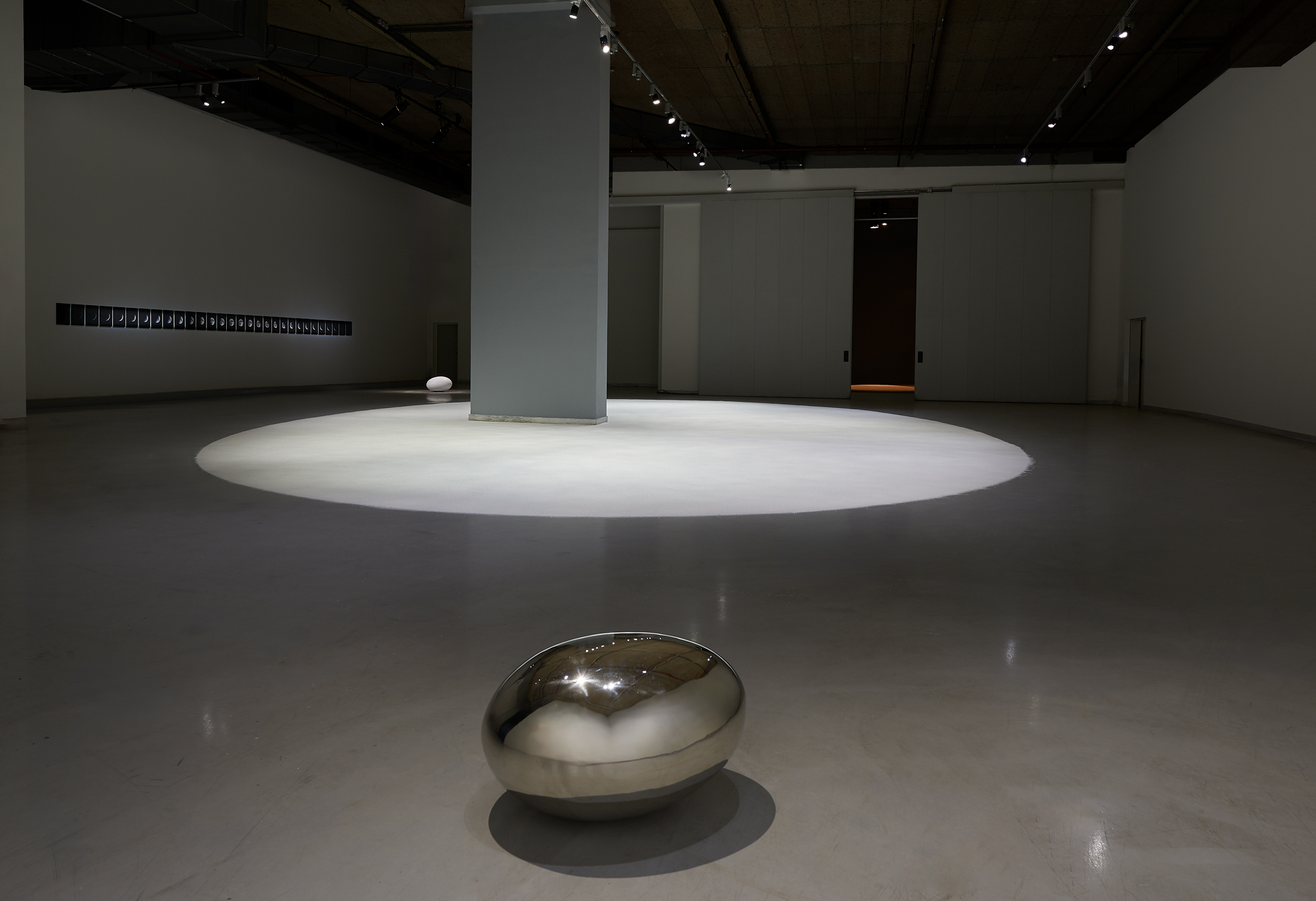
The works Afalés I and Afalés II, two sculptural transcriptions—in resin and metal respectively—of the same natural pebble collected from the beach of Afales in Ithaca, transform a small-scale natural find into monumental forms. In both versions, a 3D scan and digital rendering of the original pebble are combined with traditional casting techniques and hand-finished sculptural processes. These two sculptural pebbles retain in their forms the traces left by the action of water, connecting the natural model both to the title of the exhibition and to the oval sculptures of Potaga. Afalés is linked to the Greek word afalos—navel—as the trace left by the cutting of the umbilical cord and a point of transition towards autonomy, while the oval form of the sculptures recalls works by Eleni Potaga, among which Stratou grew up. Potaga’s Muse (2006), permanently installed in the Concert Hall’s Atrium, brings her work into dialogue with the exhibition.
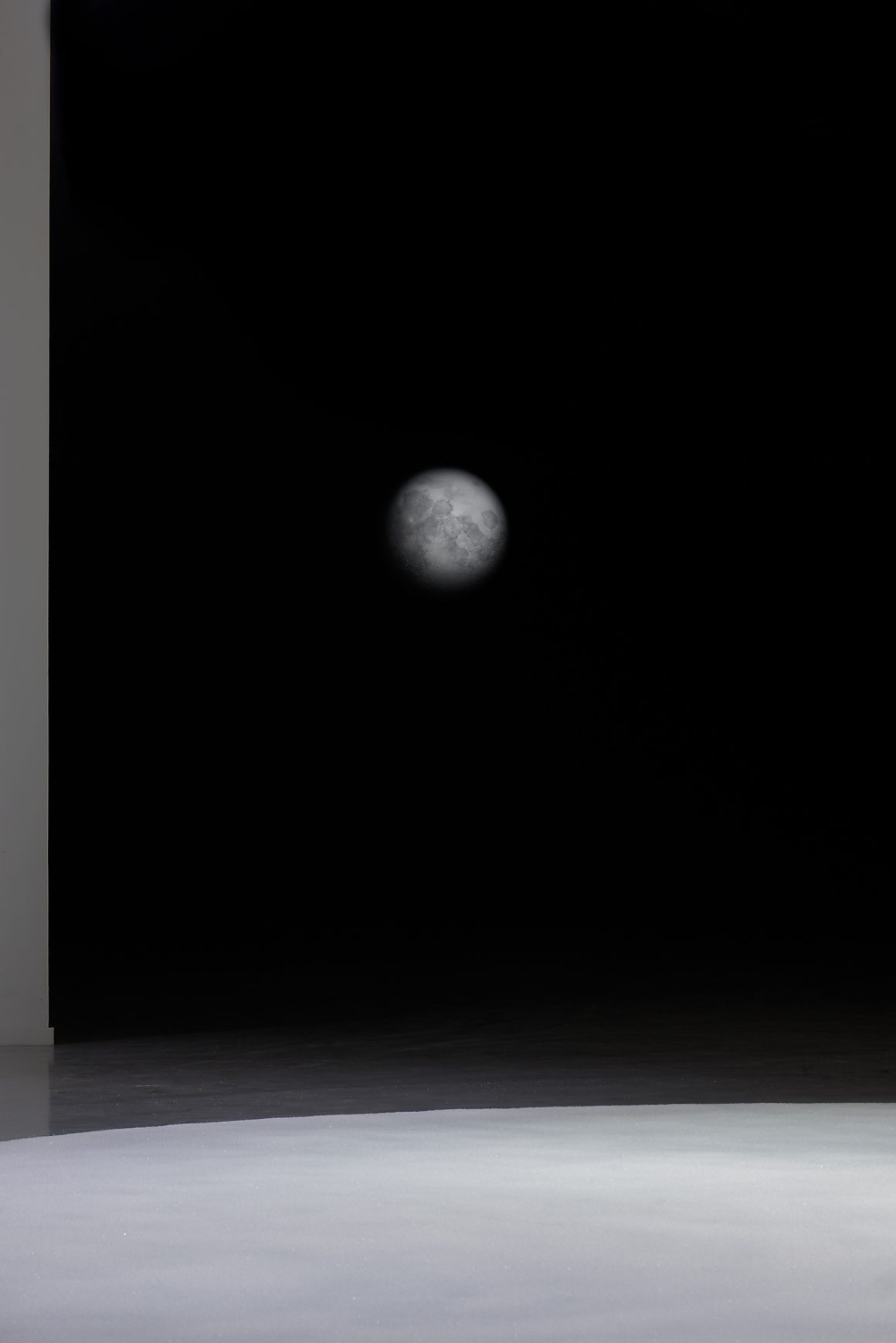
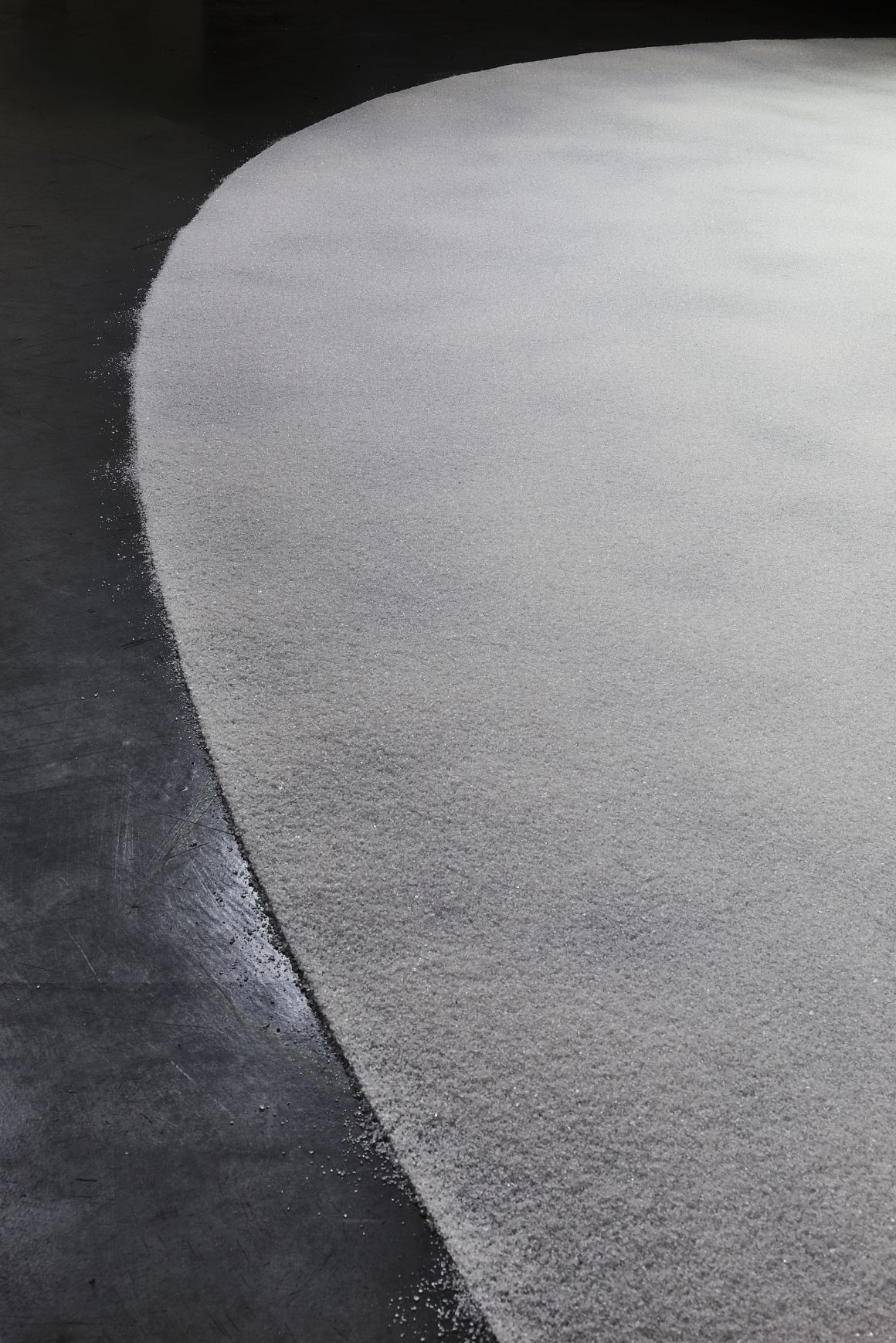
In close proximity to the two sculptures, Tidal Ellipse, a sixteen-metre-diameter elliptical disc made of raw salt, spatially renders the Moon’s orbit around the Earth. In the photographic-sculptural installation Moon, the Moon’s gravitational influence, which determines tidal movement, connects the installation to the pebbles, whose forms have been sculpted by the movement of water. A scaled sculptural representation of the Moon is suspended in space, following the succession of lunar phases through programmed lighting. The photographic installation Lunar Phases emerged from the systematic recording of the Moon as it rose over a period of three years. Each photograph captures a specific moment of observation, while the series as a whole records the succession of lunar phases through time.
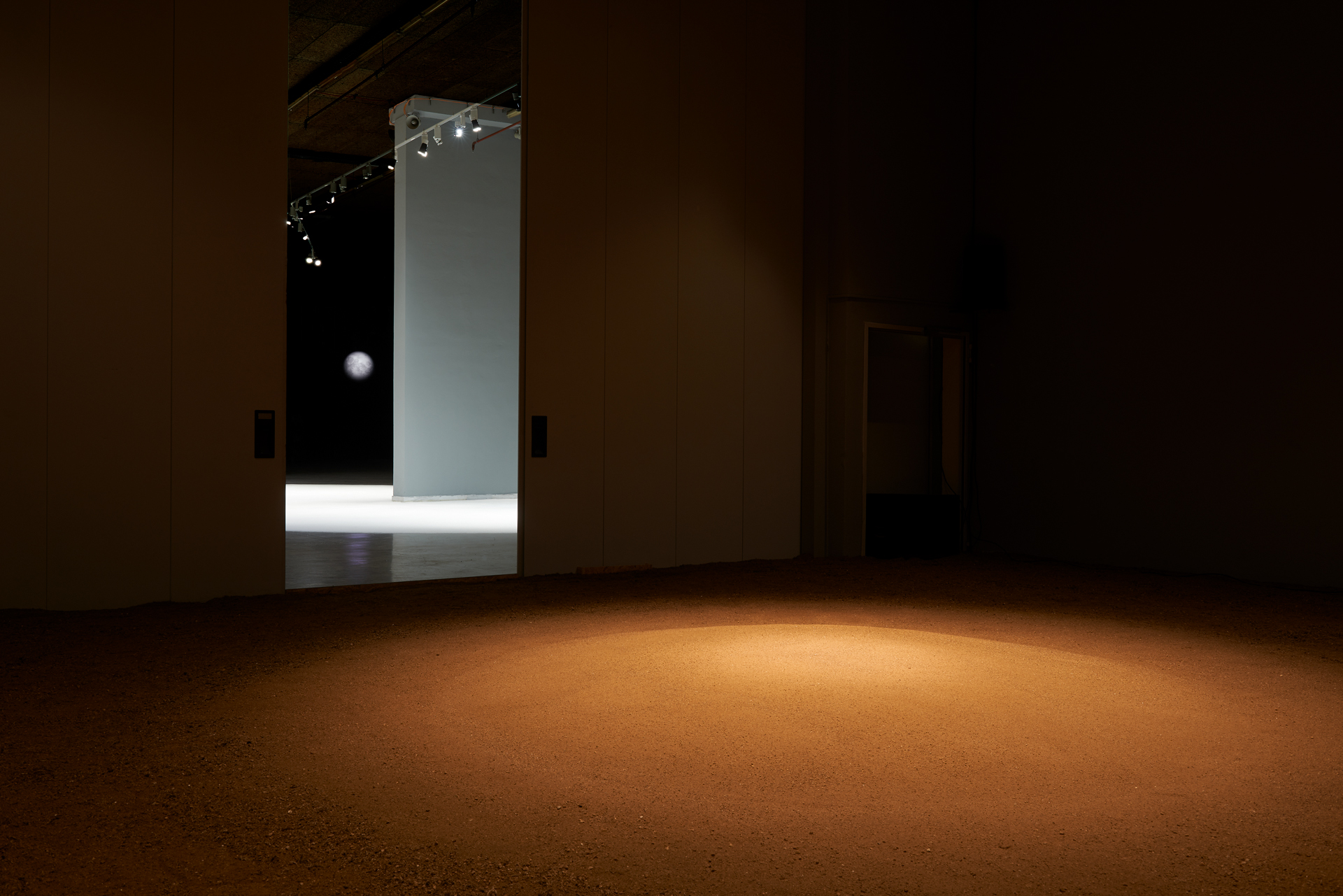
In Breathe (2000), circularity functions as an anchoring element, evoking the rhythm of the human body. The installation consists of earth, light and sound, together with a specially designed mechanism that causes the surface of the earth to rise and recede rhythmically, echoing both the tides and the act of breathing. The inclusion of Breathe in Afalés connects the new exhibition with enduring principles in Stratou’s practice, including the use of natural materials, the translation of landscape processes into the exhibition environment, and their rendering on a human scale.
As curator Alia Tsagkari notes, “As art becomes an extension of nature and nature an extension of art, the exhibition traces the constant oscillation between macrocosm and microcosm, natural process and artistic practice.”
Danae Stratou’s Breathe (2000) is presented in Afalés as a loan from the permanent collection of the National Museum of Contemporary Art (EMST).
Photo Credits Ilias Iliadis