You divide your time between Cambridge and Symi. Tell us your life story, what brought you to Greece, and the journey until Selene came to life.

I trained as a scientist and spent most of my career leading media, information and data businesses. I began as an editor at the journal Nature, before becoming Chief Executive of Macmillan Publishers, later leading a scientific data and analytics company, and then serving as CEO of Guardian Media Group. Today I sit on a number of boards, mainly in businesses working at the intersection of sustainability, data and long-term value creation. It has been a fascinating career, full of remarkable people, ambitious ideas and constant change.

Greece has always been the counterbalance to that life.
For more than thirty years it has been where my family and I came to slow down, spend time together and recharge. Symi, and then Selene, arrived gradually. Neither was ever part of a grand plan.

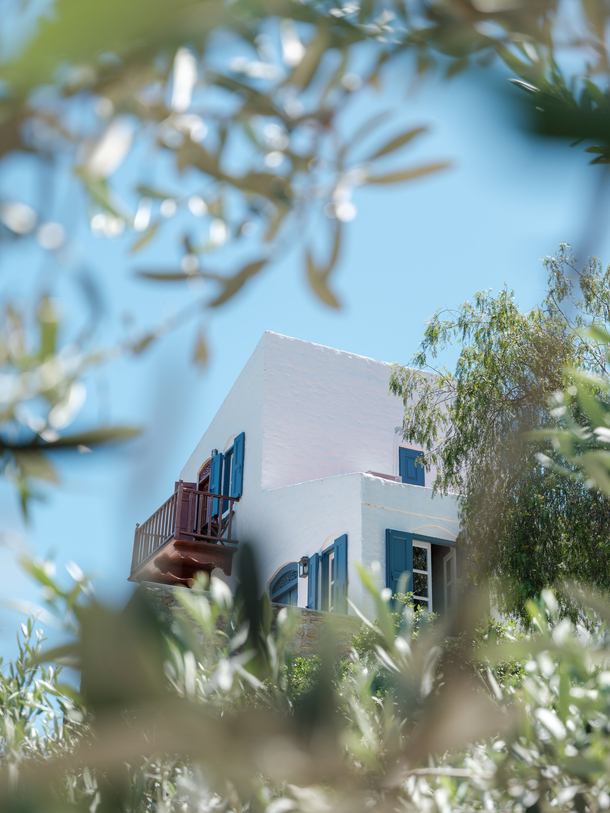
I first came to Symi in 2010, by boat, when we were sailing along the Turkish coast. Most summers we would moor for a night or two in Symi harbour or one of its bays; but it is different visiting an island by boat rather than staying on shore, which I did for the first time in 2017. This is when I discovered the house; walking along the coast road from the harbour into Nimborio, I remember being struck by the village’s perfect imperfection. It is utterly itself. There is nothing polished or performative about it, yet it is breathtakingly beautiful. Then I came upon the house, gently leaning over the water, a collection of cottages, terraces and gardens woven together above the bay. I fell in love with it immediately.

A few days later I was back in England, but I could not stop thinking about it. Before long I returned, this time with my children, and we spent two wonderful weeks there. It became one of those rare holidays where time seemed to expand. We read, painted, played endless board games, swam in the bay and wandered into the harbour each evening. It was wonderfully uncomplicated, and we returned whenever we could over the years that followed.

When Selina, who had created the house with extraordinary determination and imagination, decided in 2020 that it was time to let it go, she called me. I did not hesitate. I have never really felt that I own Selene; if anything, I became its next custodian. Selina gave the house its soul. My responsibility has simply been to look after it and add another quiet chapter to its story.

What qualities in this island made you take the decision to make it your home ?

Symi is one of the last Greek islands that has not been smoothed over for visitors. There is no airport, no large resort, and the entire island has been protected as a national monument for decades. It has retained an integrity that is becoming increasingly rare.
The beauty is extraordinary, of course. The harbour, the mountains, the hidden coves and the astonishing clarity of the sea have a way of slowing your thoughts almost without you noticing.

But beauty alone is not enough to make somewhere feel like home. What has kept drawing me back is the community. The people of Symi are generous, funny and quietly welcoming. Over the years I have been fortunate enough to become part of that community, and that has changed my relationship with the island completely.
After a working life lived largely at speed, I realised I wanted something different as well. Not less ambition, but more balance. Symi gave me that.

What is the story behind this beautiful guesthouse?

Selene sits on the edge of the water in Nimborio, the quiet bay that was once Symi’s ancient harbour.
The house had a rich life long before I arrived. It was built in the 1990s by Selina, whose determination and creativity made what seemed almost impossible possible. Over the years she welcomed family, friends and guests from around the world, creating a house that felt deeply loved rather than carefully designed.
That spirit is still very much alive. I never wanted to erase its history or replace it with my own. My role has been to continue the story, preserving what made the house special while quietly adding another chapter.

Annette Thomas

What were the greatest challenges in restoring and reimagining the property? What principles shaped the architecture and interiors, and how did you balance preservation with contemporary living?

On Symi, the island itself sets the rules. It is protected, so you work with local stone, local craftspeople and the traditions of the place, rather than against them. There are no swimming pools here, for example, so the house simply opens onto the sea instead.
The guiding principle throughout has been restraint. My professional life has often been about change; Selene has taught me the value of preserving what already works. Sometimes the hardest decision is knowing not what to change.
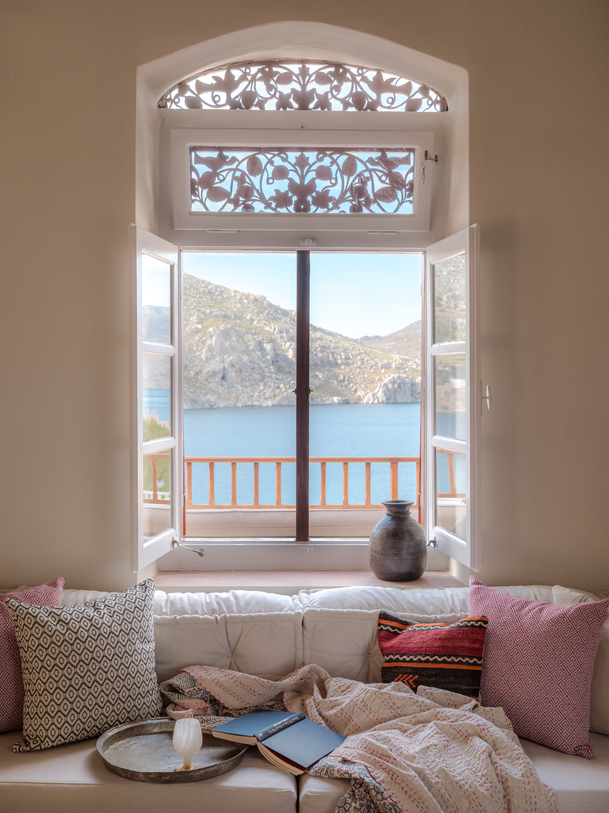
There are details I treasure. The intricate carved fretwork above the windows and doors was commissioned by Selina in Sri Lanka and brought to Symi piece by piece. The deep blue ceiling beneath the moussandra, scattered with painted gold stars by her brother, still catches my eye every time I walk into the room.
Where we have added, we have tried to do so thoughtfully. Reclaimed iron beds, antique painted chests from northern Greece, handmade brass lighting and furniture crafted by local artisans sit comfortably alongside the older pieces. We installed our own desalination system, which means guests can drink fresh water without relying on plastic bottles, and solar power is the next step.
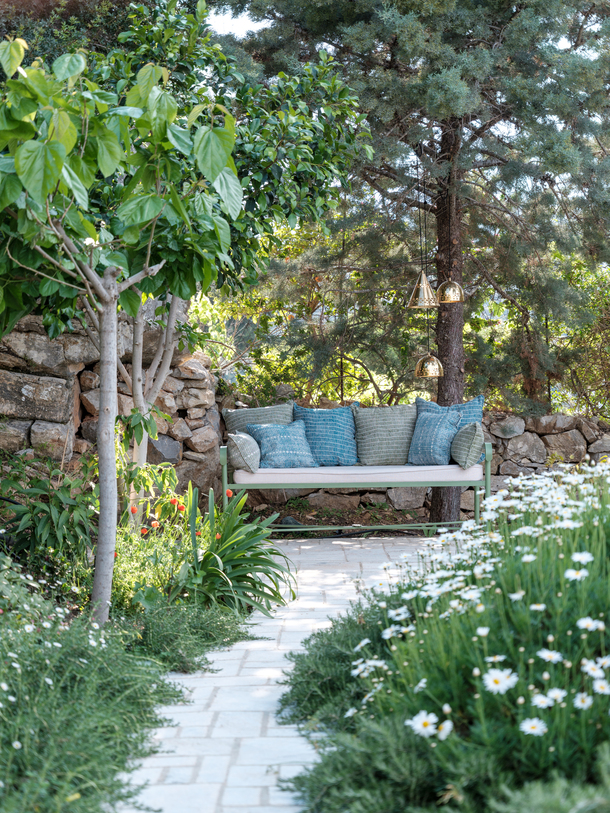
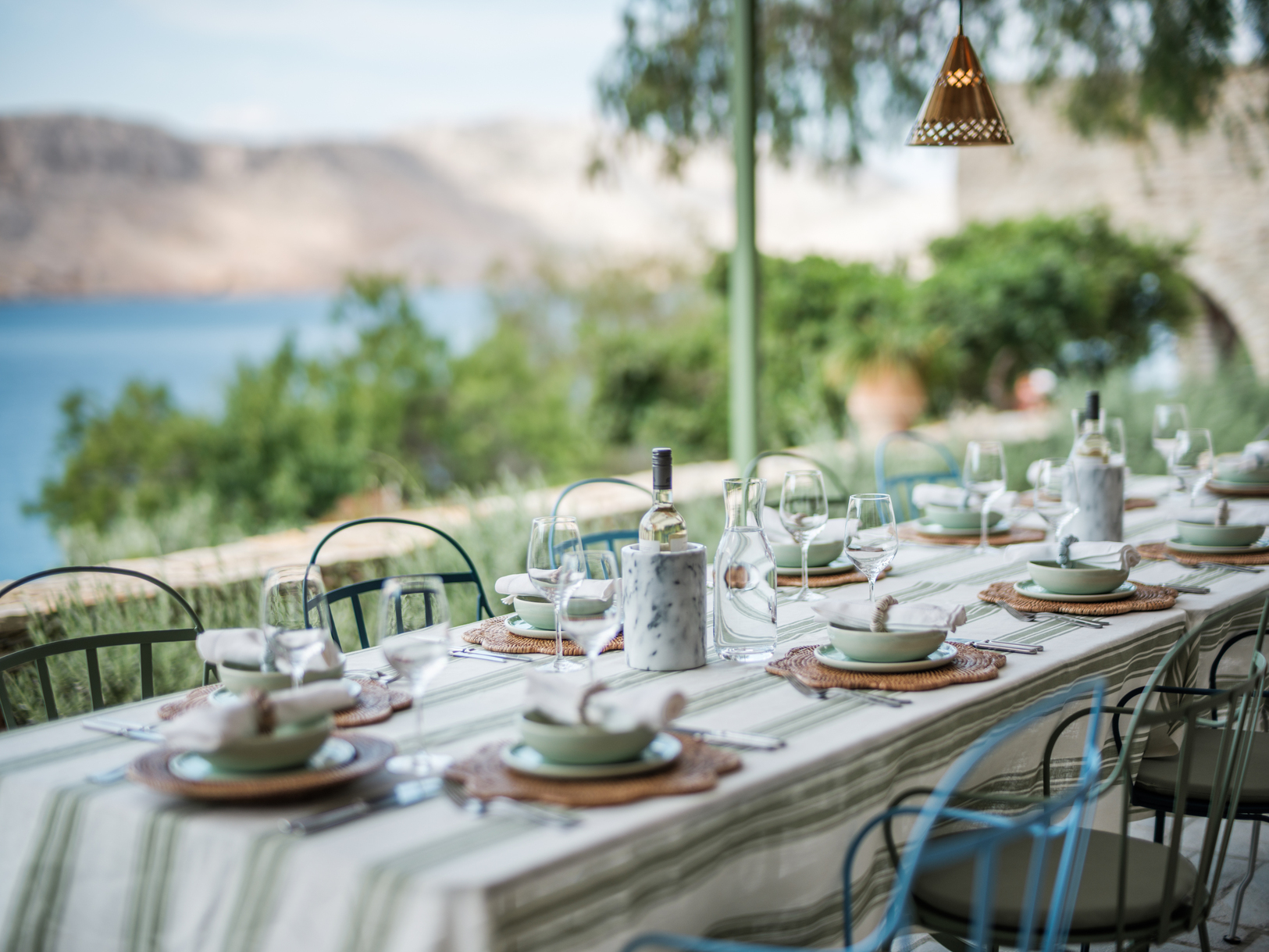
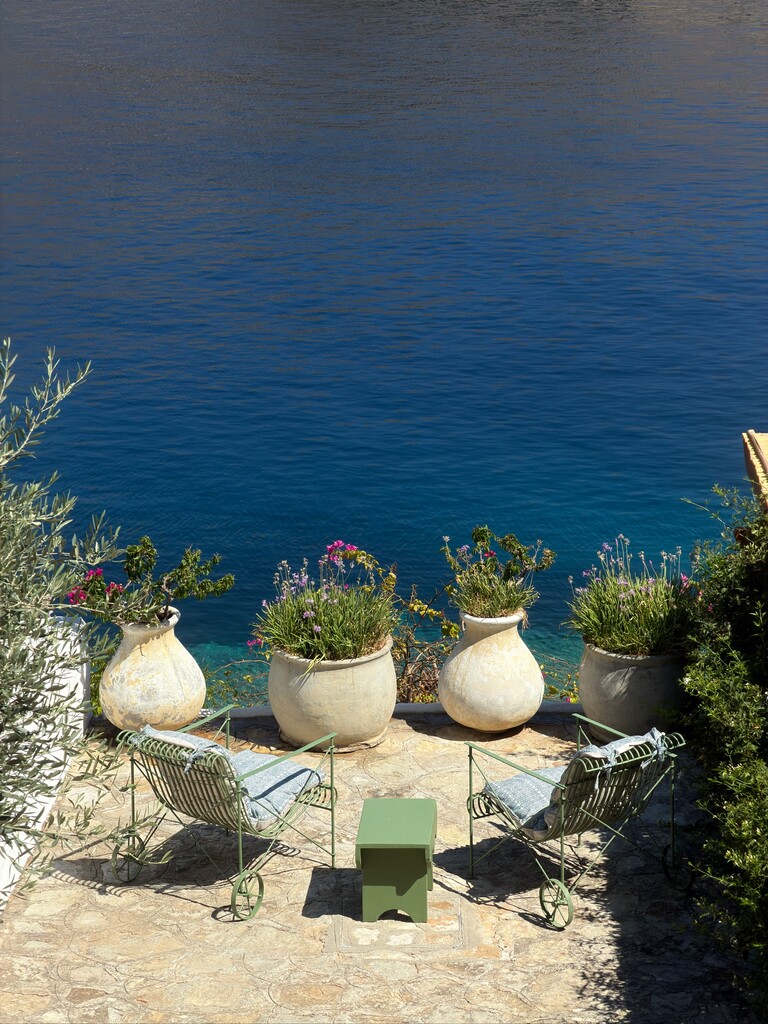
Working with local craftspeople, we have gradually reshaped the terraces with island stone, creating quiet places to sit, read or share long meals. One of the changes I love most is the new stone staircase linking the house directly to the beach below. It feels as though the house and the sea have found each other again.
Above all, Selene remains what it has always been: a home. One that welcomes people warmly, rather than trying to impress them.

What elements define The Selene’s unique identity? Which details do guests instinctively connect with the moment they arrive?

The sea is the first thing people notice. It is only a few steps from the terrace, and it quietly becomes part of every day.
Then there is the stillness. The light. The sense that this is a house someone genuinely lives in and loves, rather than a hotel trying to resemble one.
Nothing at Selene is trying too hard. There is no performance and no sense that every moment has been choreographed. People seem to relax almost as soon as they arrive. The house asks very little of you. It simply invites you to settle in, slow down and become part of its rhythm.

What kind of experience do you hope every guest takes away? What about authentic Greek hospitality?

I hope people leave feeling calmer than when they arrived.
Life has become so busy, so scheduled and so connected that simply having time to read, swim before breakfast, linger over lunch or watch the light change across the bay feels like one of life’s quiet privileges.
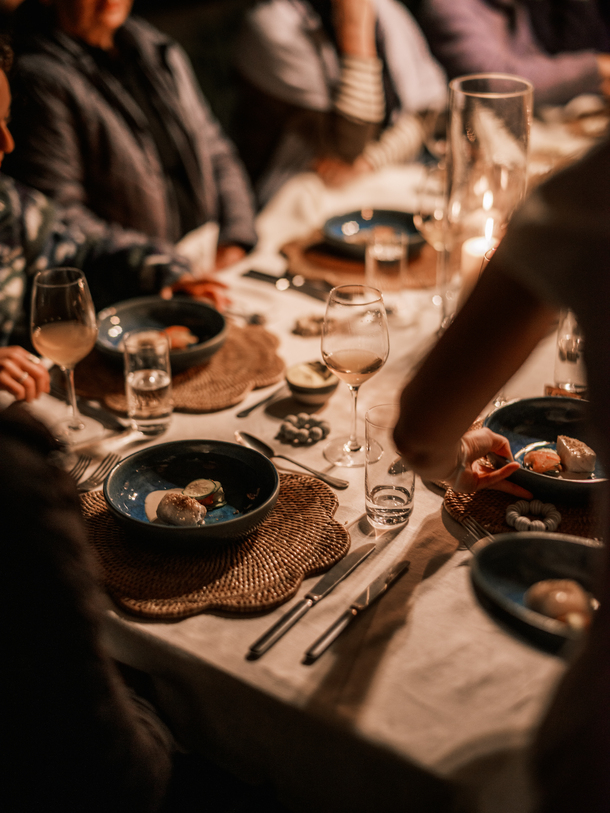
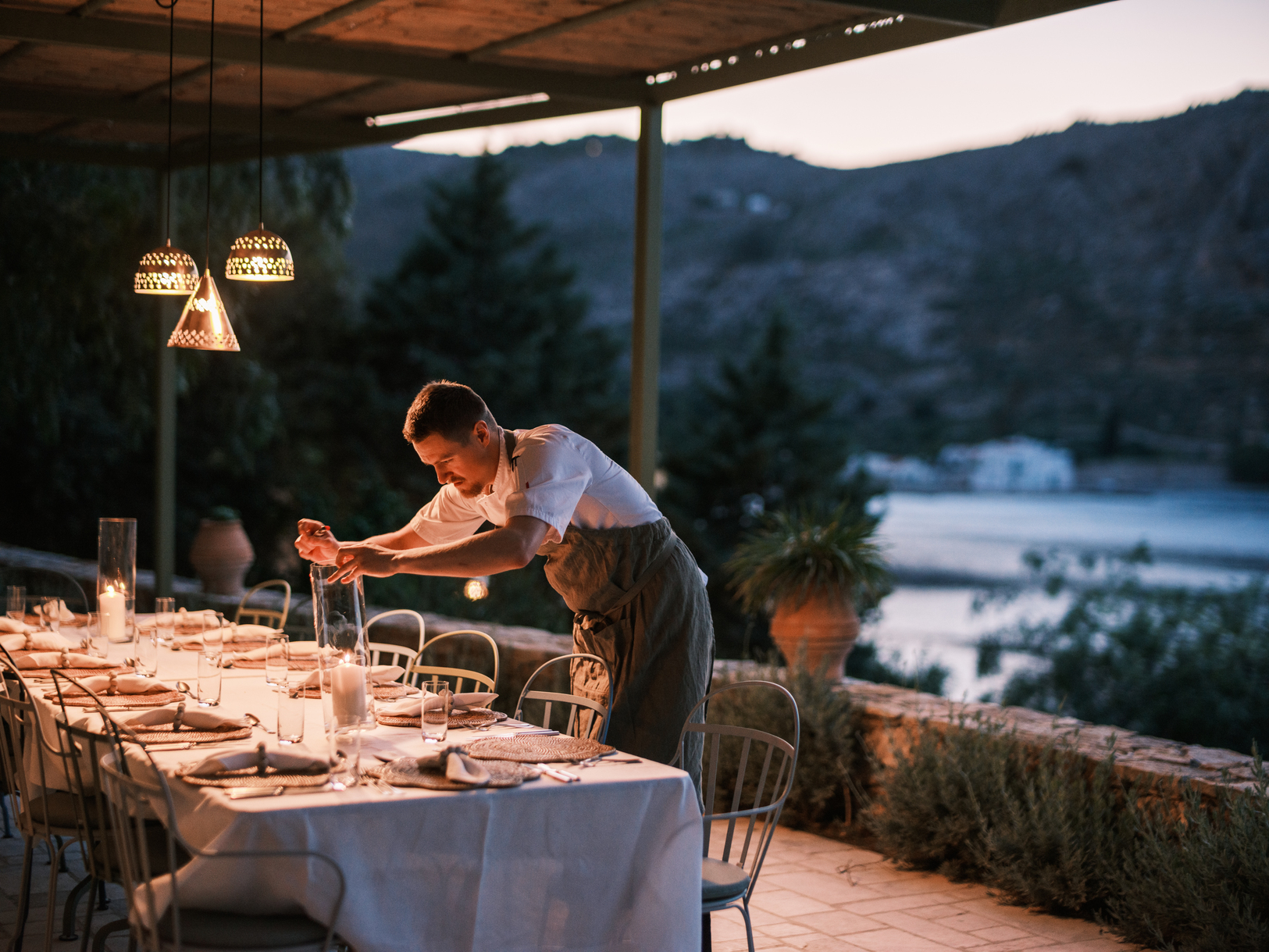
Selene is looked after by Claire, who lives on the island and knows it intimately. She helps guests discover Symi through the people who live here rather than through a list of attractions. Louli and Dimitri care for the house with extraordinary warmth and generosity. Lunch can become an unhurried afternoon under the trees, built around whatever has arrived from the sea or the market that morning. Guests sometimes bring their own chef; at other times we arrange private dining or point them towards favourite tavernas. Nothing is overly choreographed.
To me, authentic Greek hospitality is about generosity rather than formality. It is making people feel that they belong, not that they are being served. I hope Selene captures something of that spirit.

Where can guests discover the authentic spirit of Greece? How is the island’s history, culture and identity woven into a stay?

It is woven into the fabric of the place.
Nimborio, where Selene sits, was once Symi’s ancient harbour. According to Homer, King Nireus sailed from this bay to Troy. Homer describes him as the handsomest of all the Greeks after Achilles, before adding, rather drily, that he brought only three ships and very few men. Beauty and modesty in the same breath, which feels right for Symi.
But history here is not something kept behind glass. It lives in the harbour, in the sponge-diving tradition, in the stone houses climbing the hillside, in monastery bells drifting across the bay and in people who continue to make things by hand.
I hope guests experience Symi through those people: walking the mountain paths with someone who knows every turn, discovering Greek wines with Fotini, sailing with Francesca and Denis, or simply sitting in a taverna talking to the family who have run it for generations. Those encounters leave a deeper impression than any itinerary.

Which collaborations have been most meaningful in shaping The Selene, and which have become lasting pillars of its identity?

Almost everything that makes Selene special has been created through collaboration.
The house carries the work of many talented people on Symi. Miltos, our builder, helped reshape the terraces and pathways while Michalis the stonemason sourced marble and created the lovely terrazzo countertop on the breakfast terrace. Our neighbour Philemonas crafted the metalwork throughout the property; Komninos transformed the floors with polished Patiti concrete and created the outdoor kitchen; and local carpenters built the cupboards, bookshelves and new moussandra. Everywhere you look, there is evidence of skilled hands and pride in craftsmanship.
My great friend Dan Rentillo has been an invaluable creative partner. Dan, my daughter Lucy and I have spent some wonderfully improbable days travelling across Greece in search of old furniture and reclaimed materials, returning with far more than we intended (we have become good friends with Ilias Vrouvas in Tripoli who sourced and restored the iron beds, antique chests, traditional old stools and copper ottoman trays which we use as coffee and bedside tables). He has an antique and folk art shop (palaiopoleio) offering traditional items, vintage goods, and architectural elements. We have also made winter trips to Athens and Paris for lighting, fabrics and small details. When time ran short before the first guests arrived, Dan even brought out his old sewing machine to finish curtains and cushions.
Then there are the people who help guests discover the island. Fotini Kyriaki has an extraordinary knowledge of Greek wine and shares it with infectious enthusiasm. Francesca and Denis, aboard Infinity, reveal Symi and the neighbouring islands from the sea, perhaps the most beautiful way to understand this part of Greece. Also our incredible garden designer,  Dimitris Launder an ‘artist gardner’ who saw the potential of the gardens and has helped shape and bring them to life.
And finally, there is Team Selene: Claire, Louli and Dimitri, who care for the house and our guests with remarkable warmth, and Shiv, one of the first people to understand what I hoped Selene might become and who has worked tirelessly to help bring its identity and business to life.
Looking back, Selene has never really been one person’s vision. It has been shaped by talented, generous people who care deeply about the island.

Has the final result fulfilled your vision? Is it everything you imagined?

A house like this is never really finished, and I rather hope it never will be.
Each season something changes. A tree matures. A terrace becomes softer. A favourite chair finds a new place. The house gradually becomes more itself. It is close to what I hoped it would be, but perhaps the greatest pleasure has been discovering that the process matters more than the destination. Looking after a place like Selene teaches patience. There is always another small improvement waiting for next winter. I rather like that.

What do you consider The Selene’s rarest qualities?

The intangible details guests cannot easily find elsewhere?
Quiet. Not simply the absence of noise, but the kind of quiet that allows you to hear the sea, the cicadas and your own thoughts again.
Then there is the light, which changes constantly throughout the day, and the extraordinary privilege of stepping directly from the house into the sea rather than sitting beside a swimming pool.
But perhaps the rarest quality is harder to describe. Selene feels like a home because it is one. It has grown slowly over many years and carries the marks of the people who have loved it. On an island that has resisted becoming overdeveloped, that sense of authenticity cannot be designed or manufactured. It simply emerges over time.

Photo @Ginevra Focolari

What is your personal relationship with Greece, and how has that connection evolved over the years?

Greece began as somewhere I came on holiday. Over more than thirty years, it has become part of the rhythm of my life.
At first, it offered rest from a demanding working world. Later it became a place of family memories, friendships and belonging. Now it feels less like an escape from my life and more like an essential part of it.
Greece has also changed my understanding of what makes a rich life. It has taught me to be present, to make time for the people I love and not to confuse activity with meaning. Those lessons are simple, but they are easy to forget.

Why did you choose Symi, and what makes the island unique in your eyes?

Symi has stayed itself. There is no airport and no large resort; the island has been protected for decades. It has one of the most beautiful harbours in Greece, yet Nimborio, where Selene sits, remains quiet and unassuming. Most places this beautiful have been discovered and altered. Symi somehow has not.
I am not sure I chose Symi so much as it chose me. During my first stay at the house, I was facing an important decision. I thought long and hard and took the less expected path. It proved a difficult road at times, but it has led somewhere beautiful. Symi became bound up with that moment: a place where I learnt to trust a quieter instinct.

Which are your ten best on the island?

My list changes with the season, but these are the places and small rituals I return to again and again:
Cycling (e-bikes!) across the island to Panormitis, enjoying breathtaking 360 views, leaving the bikes on the hillside behind the monastery and walking through the oregano- and thyme-scented valley to Faneromeni Bay. There is a tiny chapel above the water, a platform to lay out your towels and picnic, and, more often than not, no one else there.
An early morning walk past St George and behind the harbour, following the old stone paths into Chorio, getting slightly lost and eventually finding my way down the Kalistrata for coffee and a fresh doughnut at Akoumi.
Cycling from Nimborio into the harbour for breakfast at Mediterraneo. My friend Marta makes wonderful eggs, salads, juices and iced coffee – and an excellent basil gin smash later in the day.
Cocktails with Adonis at Eva’s. He is a true mixologist and always seems to know exactly what the evening requires.
Hiring a small boat and heading to Agios Vassilios for a swim, lying on the beach and eating sweet peaches with a final swim at Maroni bay before returning home.
Toli Bay for a late lunch at Dafne’s, sititng beneath the bougainvillea watching the sunset
Dinner: at Kantirimi with fresh grilled fish, horta and lemon potatoes. Simple, honest food, exactly as it should be; or at Nikki’s in the small square at the top of Chorio. The lamb chops and bean salad are favourites, but it is the easy, welcoming atmosphere that brings me back; or at Tholos, beside the water and under the stars, looking back towards the lights of Symi harbour. It never loses its magic.
The Symi Museum in Chorio, housed in an old Symi home with a lovely courtyard. I particularly love the painted wooden eaves and traditional black-and-white pebble mosaics, the chochlákia.
Nimborio Bay itself: sitting beneath the trees with my feet in the water, a cold glass of rosé and a good book. Even on the hottest day, it feels cool and still.
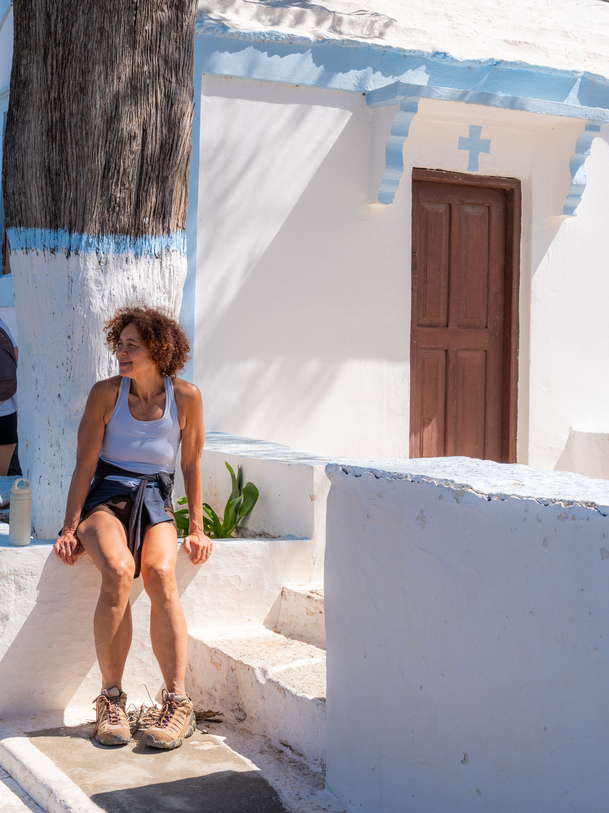
Hiking in the spring or autumn; my favourite is climbing the hillside behind Agios Marina cemetery and then across the ridge to the valley where Micros Sotiris sits. In the spring it is full of white, yellow and purple wildflowers and is truly stunning; or hiking through the forest and clambering over the rocks to the monastery of Stavros To Palemo, where you feel on top of the world and you can touch the sky. And finally, walking from the historic monastery of Rokouniotis across the ridge to Agios Theologis, then on to Agios Philemonas and finally to Agios Emilianos which is perched on a thin spit of land jutting out into the sea.

What do you most love doing at Symi?

Waking early, when the water is like glass and the sun is just beginning to appear above the mountains of Turkey. I swim from the steps of Selene across Nimborio Bay towards the monastery and back again, then have coffee on the lower terrace, directly above the water.
It is a very simple ritual. Perhaps that is why I love it so much.

What are your future plans?

To keep Selene small and keep it well.
There are a few gentle threads I would like to develop: walking, yoga and painting retreats in the shoulder seasons, and the occasional gathering shaped around the house. But the plan is not to grow for growth’s sake. I would rather deepen what is already here and look after it properly.

If you had to recommend just one room at The Selene to someone you love, which would it be and why?

Letos, is a little cottage tucked away at the edge of the property. It is private and sheltered, almost like a retreat within the retreat, yet the sea is still immediately there.
It is my private cottage and a room I would choose for someone I love because it offers that rare combination of seclusion and connection: a place to disappear for a while without feeling cut off from the life of the house.

Three places you love to return to, and why.

My home in England, in a small village outside Cambridge. The garden runs down to the River Cam and there is space for everyone, including Alfie, our golden retriever. It is where family life gathers.
Paris, where I travel regularly for work and stay in a tiny hotel that feels part of its neighbourhood and always welcomes me like family. I cycle everywhere. The city has been transformed for cyclists over the past decade and moving through it that way gives me a very different relationship with it.
And the Bavarian Alps, where I spent time as a child and still return every year, once in winter and once in summer. We hike in the mountains, swim in ice-cold alpine streams and drink wine by the fire. It is another landscape that has marked me over time.

How do you envision The Selene ten years from now?

Much as it is now, I hope—only more so. A little more lived-in, a little more itself, quietly cared for.
I would rather it deepened than grew. Perhaps the gardens will be fuller, the stone softer and the rooms richer with stories. But the essential character of the place should remain unchanged.

What is your personal definition of beauty?

Beauty is something unforced. It is found in people, places and objects that have been allowed to age, to carry their history and to become fully themselves.
Perfection can be impressive, but it is rarely moving. I am much more drawn to character, patina and the small irregularities that reveal a human hand or a life lived.

What does authenticity mean to you today?

Authenticity is the opposite of performance.
We use the word very easily now, as though authenticity can be designed, packaged or marketed. I do not think it can. It belongs to people and places that are not trying to be seen in a particular way. They have been shaped slowly and imperfectly over time. They do not perform; they simply are.
Perhaps that is why I love Symi so much. It has never tried to become somewhere else.

Photo: Will Slater

Author