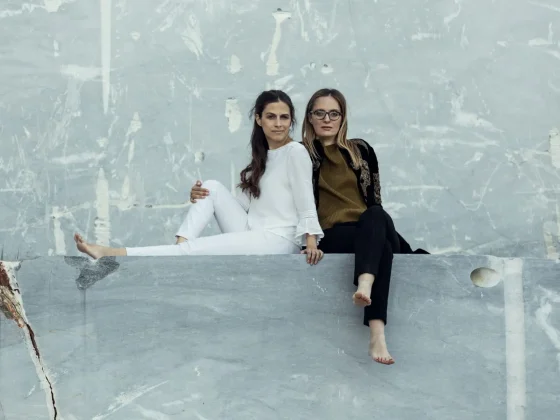
Tender and soft colors in contrast to the rigorous and sharp anthracite, coexist in a balanced complementarity, reflecting the essence of the creative couple Alberto Nespoli and Alessia Bossi.
A small wrought iron door with extremely sophisticated details, invites you to enter in a classical palace in the heart of Porta Venezia in Milan. It was the residence of an iron-working family in the early 1900s. Today, one of those flats is the home of Alessia Bossi co-founder of the creative agency We Are Lovers and Alberto Nespoli co-founder of the interior design studio Eligo Studio.
The flat, although with some alterations dating back to the 1970s, hadnbeautiful period finishes, was extremely bright and on the main floor. “Alessia and I immediately fell in love with the Italian charme of this flat. You could say it was a perfect project for Eligo Studio. We really like to work with the comparison between past and present, enhancing history, creating contemporary contrasts. The project was extremely conservative, restoring the spaces with a philological approach, maintaining the structure of the flat as much as possible. The decision to move the kitchen, joining it to the dining room, allowed us to connect several functions, an essential choice for living the house in a convivial way.” In fact, the classic Milanese layout envisaged an independent kitchen, and the dining area comunicating with the living room. With this gesture, the young couple achieved a fluid space while preserving the pre-existing layout.
Alessia and Alberto worked in synergy to fullfill a project that reflects both “I have always had a great imagination and passion for beauty, and I am happy to have transformed them into my daily work. Because of my passion, I certainly wanted to participate in our home project. It was a nice challenge, made up of constant discussion with Alberto, to realize a project that could reflect the very different souls of both of us. I must admit that the result is a beautiful crasis of what our couple is all about. Well-defined shapes and colors to identify spaces, extremely expressive decorative elements, and a cleverly concealed functionality,” continues Alberto.
“Our idea from the beginning was to work on contrasts, to bring in the colors and volumes the characteristics that distinguish us as a couple. Each of us contributed, with our own choices and needs, to shaping the project. One of our first intuitions was to express ourselves with clear colors, without nuances. Light versus anthracite. Feminine finishes such as chalk or plaster friezes versus the hardness of iron and mirrors. On this basic principle, we then played with various customised architectural and interior design elements.
Eligo, from the latin word eligere: to choose with care and elegance. “It means possessing the sensitivity to select reference archetypes and to develop, on the basis of these, new projects of superior quality,” says Alberto. The distinctive character of Eligo Studio is precisely its ability to combine traditional Italian techniques with contemporary design to create new contemporary spaces. “Each project is unique, and brings with it the charme of Italian design, craftsmanship and history”.The large area created by combining kitchen, dining and living is the heart of the young family’s home. The hallway, in anthracite resin, distributes access to the different rooms. A clear and decisive sign that juxtaposes the antique with the contemporary. A line between the different spaces, softened by the renovation of the original wooden doors that had been replaced with 1970s elements over the years.
The old kitchen-living room has been transformed into a large bathroom, a free-standing bathtub with classical lines is the protagonist of the space, contrasting with the contemporary lime and resin floor. The ceilings of the bathroom and the “en-suite” bathroom in the guest room, now belonging to little Ennio, have been stripped of their 1970s paintwork and left unfinished, revealing the signs of the layers of time. The walls of the room, where the dominant color is white, are finished with slaked lime, which lends softness to the space. The fireplace, belonging to an old villa in San Remo dating back to the beginning of the 20th century, is the focus around which the room’s furnishings have been built. Art and design coexist in a balanced way, the juxtapositions between the new and the icons of the past enhance every single piece, from the vintage LC1 armchairs by Le Corbusier, to the console table by Ico Parisi, to the custom furnishings designed by Eligo Studio. The deep trapezoidal iron portal connecting the living and dining areas is a strong scenographic element, standing out between the two areas and framing the imposing painting by contemporary artist Lorenzo Vitturi. “I asked Lorenzo about the possibility of including one of his works of art in the design of the house. We chose Creamy Dalston Stuff from the Dalston Anatomy series. The work is a photograph of a sculpture by Lorenzo, who has assembled with talent and harmony parts of food and objects of different kinds, mainly from Ghana and China, salvaged from the Ridley Road neighbourhood market in Dalston. It is a modern reinterpretation of a Caravaggio still life that celebrates the cultural diversity of the London borough.
Photography: Nathalie Krag