The Neue Nationalgalerie presents NIGHT, the first major solo exhibition in Germany by Italian artist Maurizio Cattelan, recipient of the Preis der Nationalgalerie 2026. Conceived for Mies van der Rohe’s glass hall, the exhibition brings together seminal historical works and new commissions in an installation that lends the museum the character of a contemporary church — a space of gathering, elevation and reflection.
NIGHT takes shape around themes of history, power, memory, identity and belief. Across the exhibition, familiar images and figures are shifted just enough to unsettle their meaning, opening them to readings that move between irony and ambiguity. In dialogue with Mies van der Rohe’s architecture, Cattelan’s works activate the building not as a container, but as part of the exhibition itself.
The title NIGHT evokes a condition in which things are seen not less clearly, but differently. As Maurizio Cattelan puts it: “Night is not simply the absence of light. It is a condition. The exhibition is not about darkness. It is about the loss of certainty. Night is also temporary — it always contains the possibility of morning, even if you cannot see it yet.”
The exhibition reaches beyond the glass hall. On the museum terrace, Scar (2026), a cast-iron manhole cover inscribed with the titles of every work in the show, condenses the exhibition into language at street level. High on the roof, Never (2003) appears as an animatronic child drummer drawn from the protagonist of Günter Grass’s The Tin Drum — a figure of resistance and warning whose irregular beat rings out across the city, between parade and alarm.
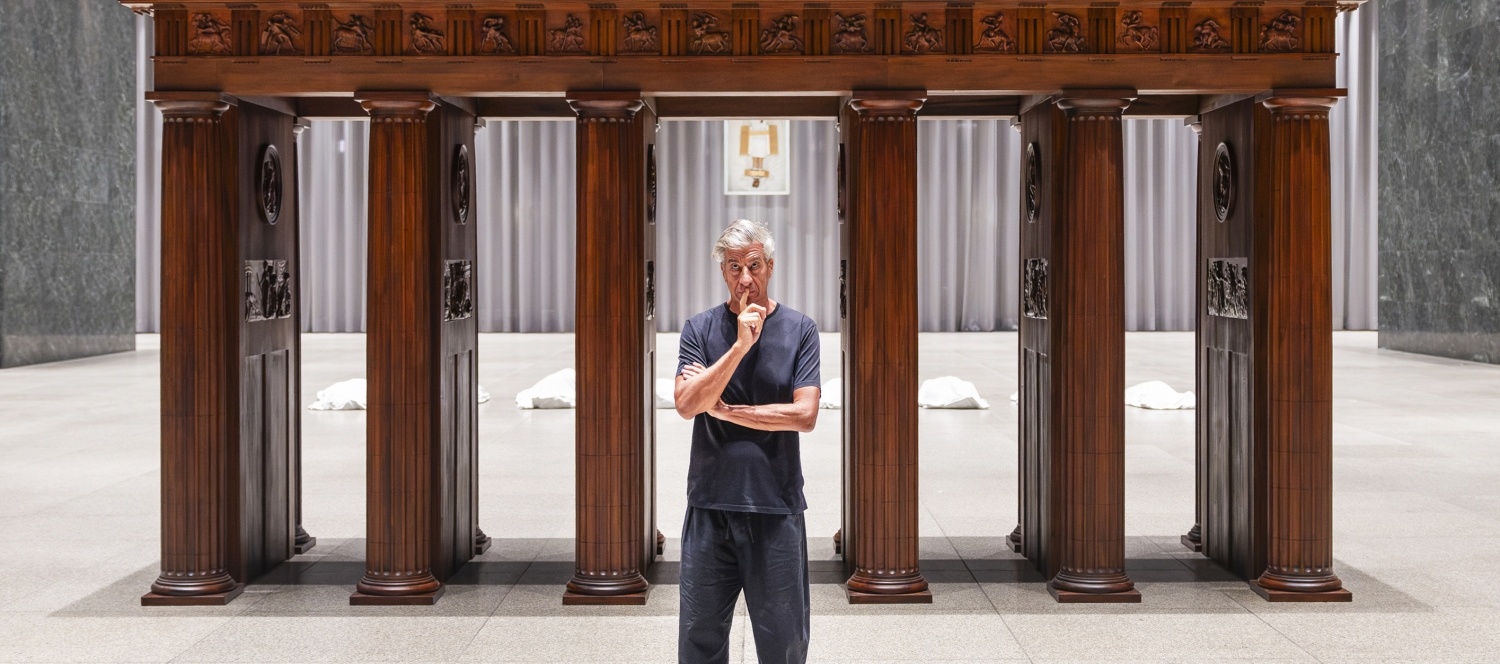
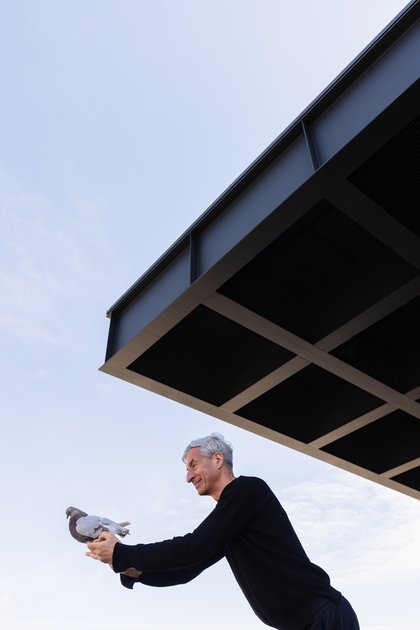
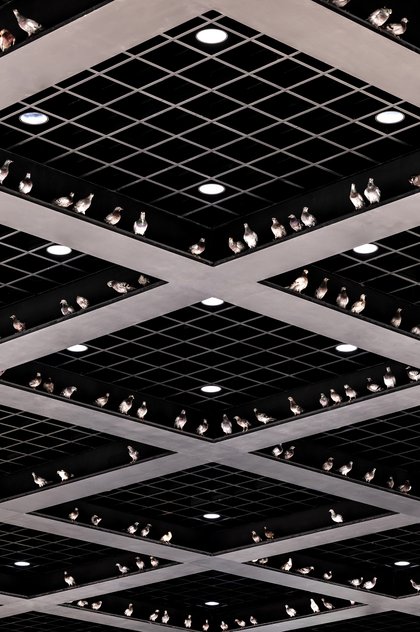
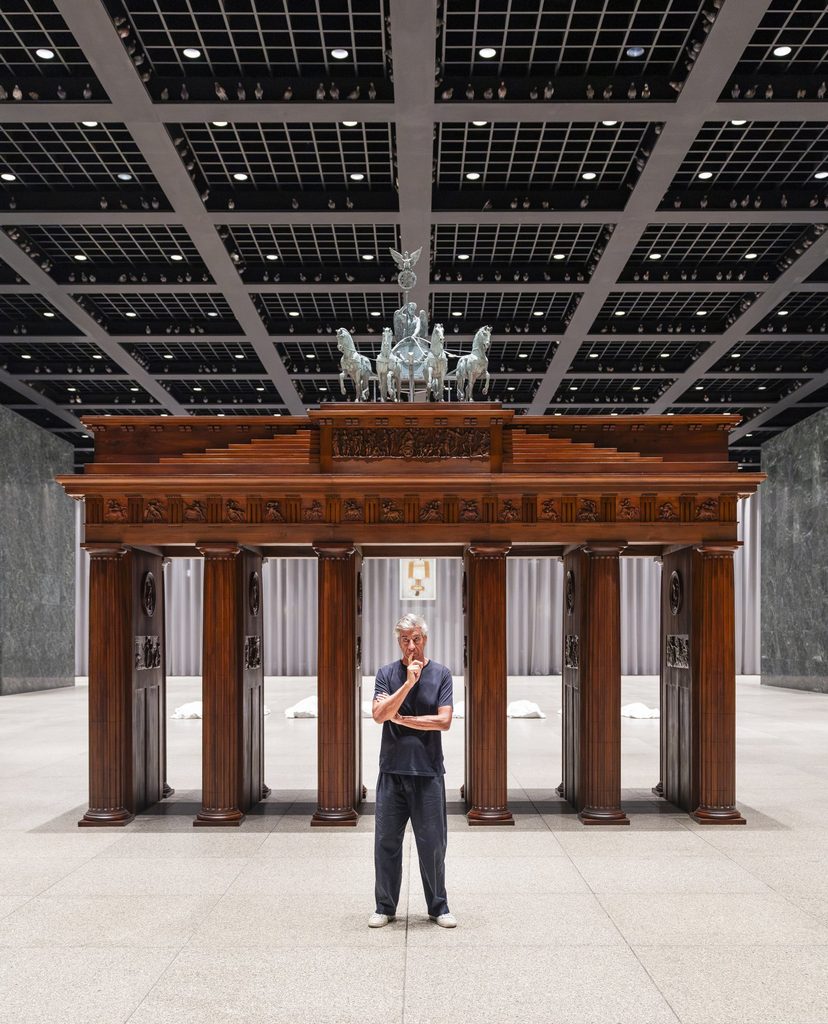
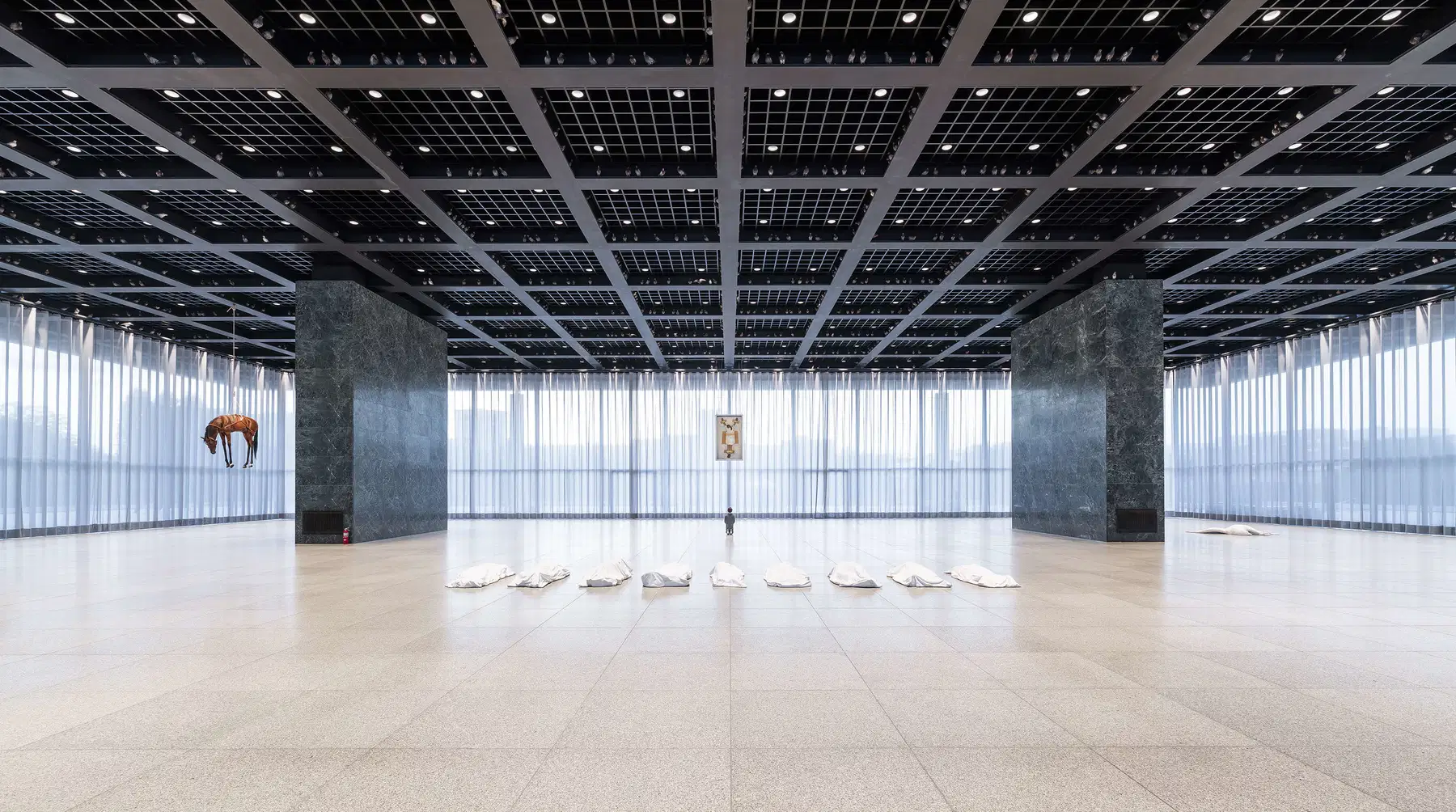
Visitors enter through Purgatory (2026), a new commission that places a scaled-down Brandenburg Gate inside the museum. One of Germany’s most recognisable monuments becomes a threshold to walk around and through — repositioned as a space of passage, reflection and historical ambiguity. At the centre of the hall, a strong vertical axis is established between Him (2001), a kneeling male figure in contemplative pose, and Dawn (2007), a female figure suspended in cruciform posture within transport crate. Overhead, thousands of taxidermied pigeons titled People (2026, first shown in Venice in 1997) settle across the ceiling structure, reshaping the space into a place of collective gathering and quiet observation.
“A church is a beautiful invention because it gives shape to something invisible,” says Maurizio Cattelan. “The Neue Nationalgalerie already has something ritualistic: its scale, symmetry, silence and distance from everyday life. I imagined the space almost like a contemporary church: a central nave, side aisles and a sequence of presences.”
Among the works gathered beneath the hall is Him, a small yet profoundly unsettling sculpture that appears from behind as a kneeling child at prayer, until the viewer recognises the figure of Adolf Hitler. Stripping away the familiar markers of power and ideology, the work stages a moment of recognition rather than a statement, confronting the difficulty of representing evil without diminishing its reality. Shown in Berlin, its kneeling posture also resonates with the memory of Willy Brandt’s Kniefall in Warsaw in
1970. Rather than commemorating history, Him unsettles the present.
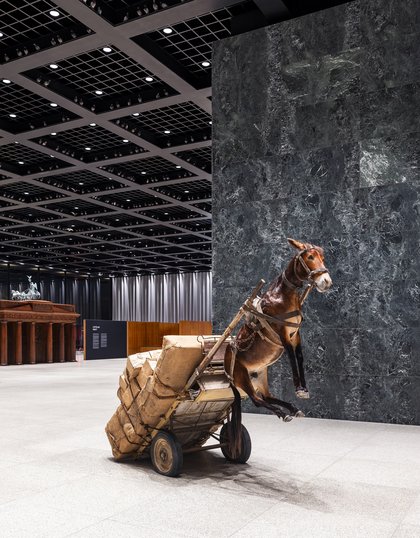
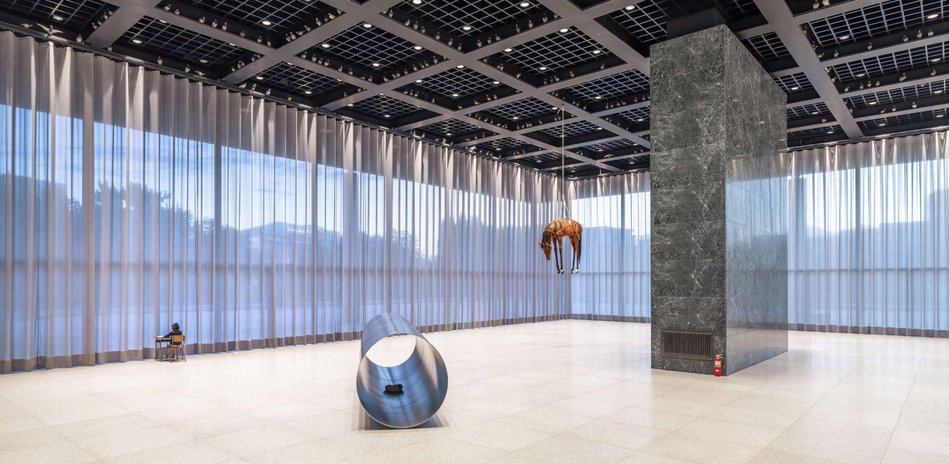
A group of marble works draws on the Italian sculptural tradition: All (2007), nine shrouded, life-sized bodies carved from Carrara marble as a horizontal monument to death that is universal and anonymous; Bones (2025), a monumental fallen eagle in Statuario marble, an emblem of power brought to the ground; and First (2025), a marble egg pierced by a single iron nail. Elsewhere, Novecento (1997) suspends a life-sized taxidermied horse in mid-air as an allegory of a century of exhaustion, while Pentecost (2002) harnesses a taxidermied donkey to an overloaded cart on the verge of failure.
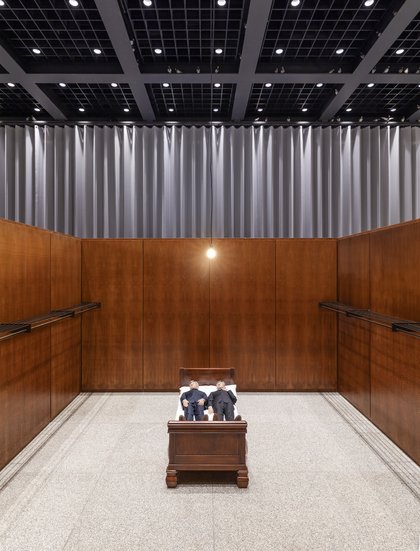
The exhibition returns repeatedly to the self-portrait and to failure as a subject. Charlie Don’t Surf (1997) seats a schoolboy at a desk, his hands pierced by pencils; La Rivoluzione Siamo Noi (2000) hangs a miniature Cattelan, dressed in a Joseph Beuys felt suit, from a coat rack in one of Mies van der Rohe’s cloakrooms; and We (2010) lays two identical figures of the artist side by side on a bed. Two further new commissions measure time and mortality: After (2026), a six-metre iron pipe struck like a bell, with a sleeping dog at its centre; and Dust (2026), a fire extinguisher that holds the cremated remains of a friend of the artist, realised in accordance
with the wishes of the deceased.
Presented in Berlin, NIGHT unfolds in a context shaped by layered histories and ongoing processes of remembrance. Through a sequence of encounters that move between monumentality and intimacy, visibility and concealment, the exhibition invites viewers to reflect on how images, symbols and structures of meaning circulate and transform over time.
For more than three decades, Maurizio Cattelan (born 1960 in Padua, Italy) has been one of the defining voices in international contemporary art, developing a body of sculptures, installations and conceptual interventions that engage with authority, collective memory and social power. His work has been shown worldwide, including several Venice Biennales and major solo exhibitions at the Solomon R. Guggenheim Museum, New York (All, 2011) and the Monnaie de Paris (Not Afraid of Love, 2016).
MAURIZIO CATTELAN. NIGHT
Preis der Nationalgalerie 2026
10 September 2026 – 7 March 2027
Images
Maurizio Cattelan, Neue Nationalgalerie, 2026
© Neue Nationalgalerie – Stiftung Preußischer Kulturbesitz / David von Becker