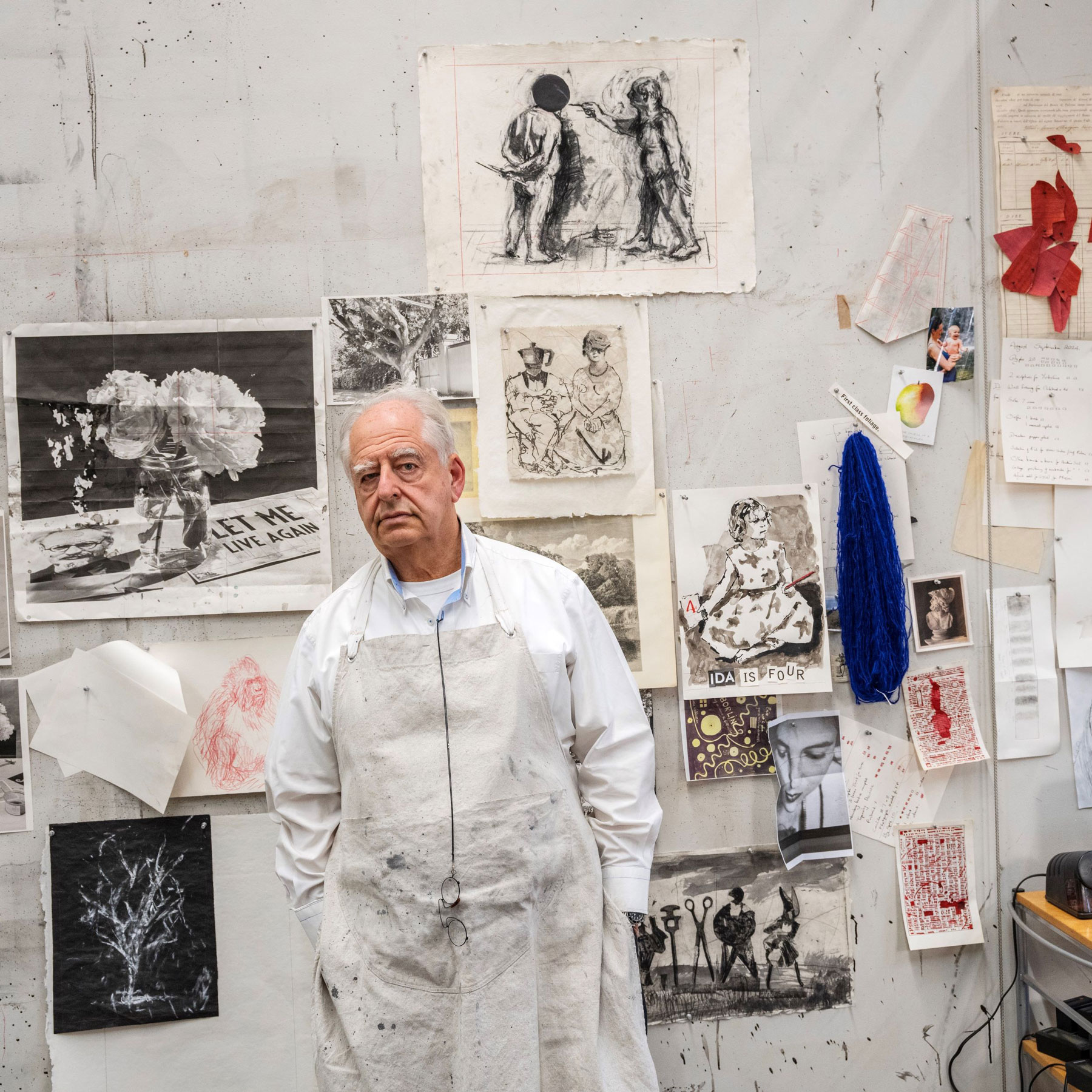
The exhibition Imitate the Sleep of Stones places contemporary work by the artist William Kentridge in dialogue with artefacts from the collections of the Hellenic National Archaeological Museum. It draws inspiration from the ancient Greek myth of the Orpheus’s descent into the underworld to bring his beloved Eurydice back to life. Kentridge’s rust-painted steel figures and paper tree silhouettes appear among galleries of kouroi, sphinxes, funerary monuments, and sculptural fragments, guiding visitors toward a central gallery, where the artist’s drawings and a diorama are presented alongside archaeological objects connected to music, death, and transformation.

The exhibition opens on the eve of the Greek National Opera’s premiere of Claudio Monteverdi’s L’Orfeo at the Stavros Niarchos Hall at the SNFCC, directed by Kentridge. L’Orfeo is an international co-production of the Greek National Opera with Glyndebourne Opera Festival and the Metropolitan Opera of NY, made possible by a grant from the Stavros Niarchos Foundation. The drawings, moving images and theatrical forms Kentridge created for the production are one of the exhibition’s points of departure.

At the core of the exhibition is the diorama, which uses an optical technique from nineteenth-century theatre – known as Pepper’s Ghost – to bring reflected moving images into a physical model. Projected figures appear within the constructed space as fleeting presences, uniting drawing, performance, film and theatrical illusion. The diorama forms a passage between visibility and disappearance that echoes Orpheus’s journey. Elsewhere, Kentridge’s paper-tree silhouettes refer to Rainer Maria Rilke’s interpretation of the myth, in which Eurydice has become part of the earth, and in their presentation alongside archaeological artefacts they connect her transformation with stone, soil and excavation.

The selected antiquities articulate connections with music, love and the passage between life and death. Among them are a Corinthian, red-figured calyx krater (ca. 400–375 BCE) showing Orpheus playing the lyre, an ivory lyre and its surviving fragments from the Menidi Tholos Tomb (14th–13th c. BCE), and a significant loan from the Acropolis Museum: a white-ground kylix, attributed to the Pistoxenos painter (ca. 470 BCE), depicting Orpheus raising his guitar as a Thracian woman attacks him.

A group of seven sculptures from Kentridge’s Frieze (13 rusted figures) (2026) is installed along the exhibition’s route. Made from stainless steel with rust paint, they form hybrid silhouettes in which human figures meet trees, clothing, tools and objects such as a megaphone and a knapsack, continuing the processional imagery and its associations with displacement and history that have long occupied Kentridge’s practice.

The exhibition establishes a series of visual, material and conceptual connections between stone and paper, excavation and drawing, stillness and movement, survival and disappearance. The theme of transformation connects the exhibition’s mythological, artistic and institutional dimensions, and extends to the museum itself, which is approaching a major architectural transformation led by David Chipperfield Architects and Alexandros N. Tombazis & Associates.

Artwork of William Kentridge, Composite for L’Orfeo (Spile), 2026 Indian ink on found pages Before mounting – estimated pre-mount size: 94.5 × 94.5 cm

Statement by the Minister of Culture Dr. Lina Mendoni: “At the Hellenic National Archaeological Museum and in Athens, we welcome a unique and multifaceted artist, William Kentridge, with the emblematic exhibition ‘Imitate the Sleep of Stones.’ Kentridge’s works engage in a dialogue with selected antiquities, with a thematic core centered, on the one hand, on the ancient myth of Orpheus’s descent into the Underworld and, on the other, on its universal themes: life, love, and death. It offers a unique and multifaceted example of the inexhaustible inspiration classical heritage provides to contemporary art. The exhibition at the Hellenic National Archaeological Museum culminates at the Greek National Opera with the new production of Monteverdi’s “Orfeo”, directed by Kentridge himself. Α comprehensive set, an international benchmark, whose creators deserve every bit of praise.”

Statement by the HNAM President Mrs. Ioanna Dretta: “At the Hellenic National Archaeological Museum, we are extremely proud of this exhibition. It is a sample of our effort to offer our audience high-level cultural experiences. At the same time, the myth from which the exhibition is inspired also inspires us, since it finds the museum itself in a phase of transformation and rebirth.”

Statement by Willliam Kentridge: “I am very happy to be showing at the Hellenic National Archaeological Museum in Athens, and to see the works created around the story of Orpheus and Eurydice enter into conversation with the Museum’s collection and with the enduring questions of loss, memory and return at the heart of the myth.”

Statement by Burcu Fikretoğlu: “The myth of Orpheus binds three of life’s most fundamental forces; love, art and death in a triangle. For decades, William Kentridge has thought through these questions. To witness this encounter feels both rare and unforgettable. I am deeply grateful to witness it.”

Biography of William Kentridge
William Kentridge (b. 1955, Johannesburg, South Africa) works across drawing, writing, film, performance, music, theatre, and collaborative practices to create works of art that are grounded in politics, science, literature, and history, yet maintaining space for contradiction and uncertainty. His work has been seen in museums and galleries around the world since the 1990s and is held in collections of museums and art institutions worldwide. He has directed operas for the Metropolitan Opera in New York, La Scala in Milan, English National Opera in London, Sydney Opera House, the Salzburg Festival, Opera de Lyon, and Amsterdam Opera. His original works for the stage combine performance, projections, shadow theatre, voice, and music. These include Refuse the Hour, The Head & the Load, Waiting for the Sibyl, and The Great Yes, The Great No. Kentridge is the recipient of honorary doctorates from several Universities, including Yale, Columbia, and the University of London. His honours and awards include the Kyoto Prize (2010), the Princess of Asturias Award (2017), the Praemium Imperiale (2019), and an Olivier Award in 2023.

WILLIAM KENTRIDGE

IMITATE THE SLEEP OF STONES

ORPHEUS AND EURYDICE: TRANSFORMATION AND RETURN

Hellenic National Archaeological Museum, Athens

30 October 2026 – 24 January 2027

Author