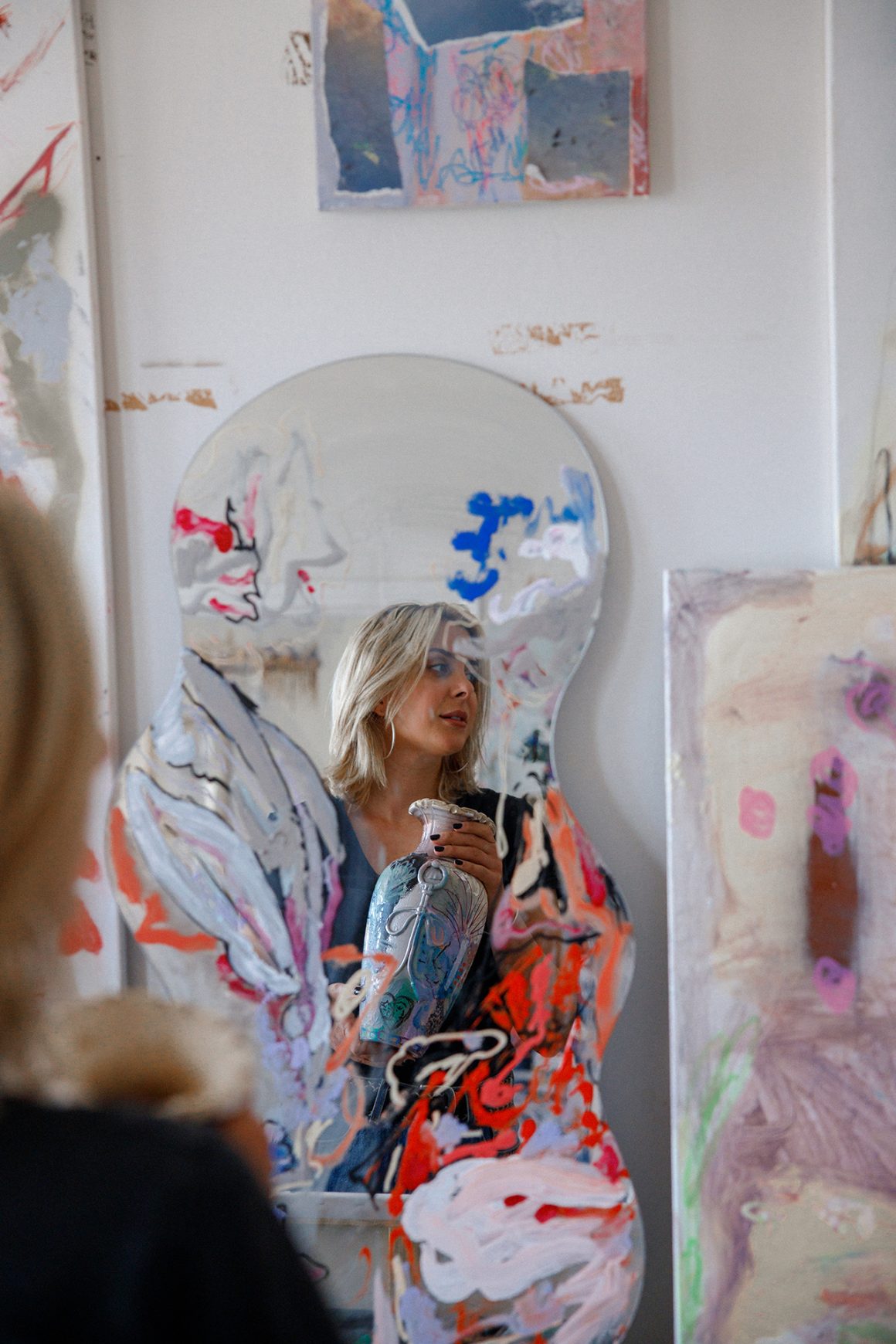
Tell us about your creative journey and what you hold closest to your heart as your most important achievements.
My creative journey, I believe, began the moment I was born. From a very young age, I remember constantly dreaming of how to transform the space around me—reimagining my family home over and over again, envisioning furniture inspired by Bauhaus, textiles reminiscent of Etro and Missoni, and details that echoed the English countryside. My grandfather, who was an architect, played a defining role in this. From early on, we had conversations about beauty and functionality, which deeply shaped the way I perceive space, creation, and innovation.
At 18, when I moved to study at the University of the Arts London, I felt for the first time that I was exactly where I belonged. I was accepted based solely on my portfolio, with an unconditional offer. At that time, I was deeply dreamy—not particularly disciplined in my studies, but open to absorbing images, experiences, and stimuli. That later changed when I realized how much discipline creation truly requires.
London gave me the opportunity to experience the creative industry from within. I began at the studio of David Sims, working on projects for houses such as Balenciaga, Jil Sander, Givenchy, Louis Vuitton, as well as publications like Vogue France and Arena Homme Plus. That’s where I truly understood what it means to create at a high level, and how important it is to see what you love from multiple perspectives.
Later, working alongside Katy Wickremesinghe, I was introduced to the world of contemporary art and cultural production through organizations such as Unit London, Belmond, and Dorotheum. This period was pivotal, as it gave me access to artists, exhibitions, and projects of varying scales and philosophies.
However, the most important moment in my journey was not a collaboration—it was the decision to step into the role of the creative core behind everything I do. To trust my own voice and to create works and cultural initiatives that genuinely express me. That’s when I understood that to truly stand in this field, you need strength, empathy, luck, and above all, hard work.
There were also moments that felt almost surreal—when my work was published in Vanity Fair and British Vogue. Those were “pinch me” moments that make you pause and realize how far something deeply internal can go.
Today, I have the privilege of doing what I love and collaborating with institutions, companies, and people I once only dreamed of. I am also a board member of MOMus, which is a very important personal achievement for me. At the same time, I continue to develop my own projects and seek new ways to contribute to the art world. My vision is to keep creating and giving for as long as I live, because I deeply believe that art is not a luxury—it is a necessity. It is a form of therapy, a remedy that can offer meaning, connection, and strength in our lives.
What is Art to you, and how have you entered the field not only as an artist but also as a curator and creator of art events?
For me, art a deeply personal necessity—a form of release. I am someone who experiences anxiety intensely, and creativity acts as a way to process it, to understand it, and ultimately to transform it into something visible and meaningful. My passion lies in expressing and realizing everything I have dreamed of. As an artist, I feel almost obligated to filter my experiences through my work—to translate them into images, forms, and narratives. Everything I create is deeply autobiographical.
Although I grew up in conditions that could have kept me protected, life brought me face to face with several traumatic experiences. Transforming them into inspiration softens the pain and gives me a sense of empowerment—almost as if I am reclaiming control. Art has this transformative power; it can heal you, redefine you, and give you a voice.
At the same time, I love this world so much that I felt the need to contribute beyond my own artistic practice. My relationship with other artists began very organically—through an almost “maternal” instinct to support, guide, and encourage those around me. This gradually evolved into something more substantial: mentoring creatives, curating, and eventually creating cultural initiatives.
Today, beyond painting, I am active as a curator and cultural producer, designing and executing art events of different scales, always guided by contemporary culture and social impact. Through this role, I feel I can highlight voices, create platforms, and actively contribute to shaping the artistic landscape. For me, it is just as important to create as it is to create space for others to exist. Because in the end, art is not only individual expression—it is a collective experience, connection, and evolution.
What are your most important achievements in this field?
My most important achievements are not only specific professional milestones, but primarily the moments that show me that what I do creates real connection and impact. My journey has led me to build my own path within the field—not only as an artist, but also as a curator and cultural producer.
It is very important to me to operate across all scales, because I truly believe that art has no limits. I enjoy creating exhibitions and experiences that can exist anywhere—from the Megaron Concert Hall Thessaloniki, to Bord de l’eau on Egnatia Street, in the streets, in former slaughterhouses, and today at the port of Thessaloniki. This freedom of space and expression is a core part of my identity.
Equally important, if we truly want to evolve as a city, as a country, and as an artistic community, we need to move beyond narrow frameworks and outdated labels. We need greater adaptability and openness to difference, from all sides. It is exhausting to reproduce divisions that no longer serve us. Instead, we must allow art to fulfill its role—to unite, to cultivate ethics, and to reconnect us with an authentic, almost childlike part of ourselves.
However, the most profound and genuine achievement is something much more human. It is the everyday communication with people who were once strangers, and with whom a meaningful connection is created through my work. It is the trust they show when they choose to live with one of my pieces—when the studio empties and they return asking for more, when something so personal finds a place in someone else’s life.
And of course, it is the small, personal moments—like when my daughter sees one of my works out in the world and says, “that’s my mom’s.” That’s when I realize that what I am building goes beyond a professional framework and becomes something far more meaningful.
My relationship with this world is deeply emotional. It is an exchange that gives me life, strength, and confidence. And in the end, this connection with people is perhaps the greatest achievement of all.
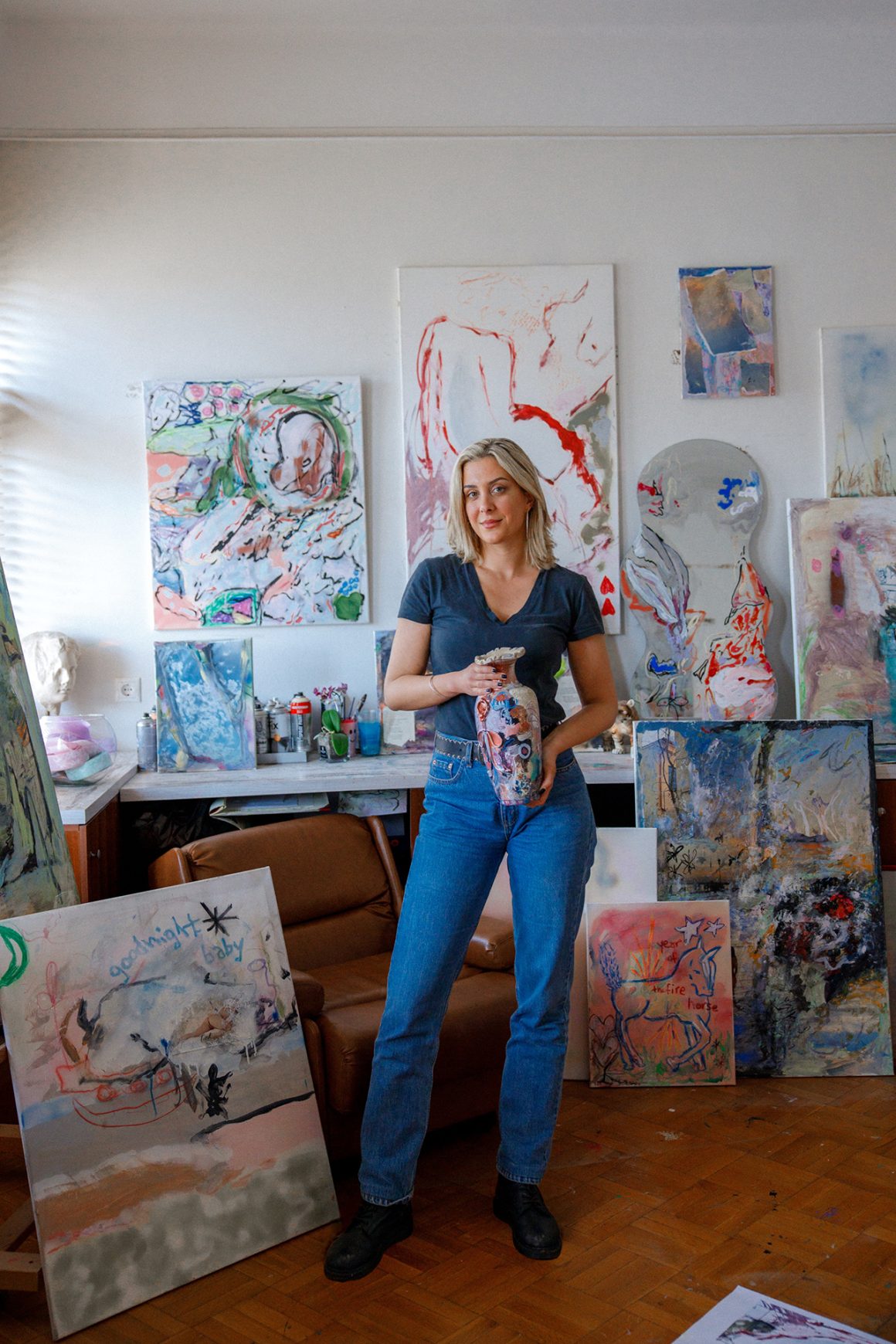
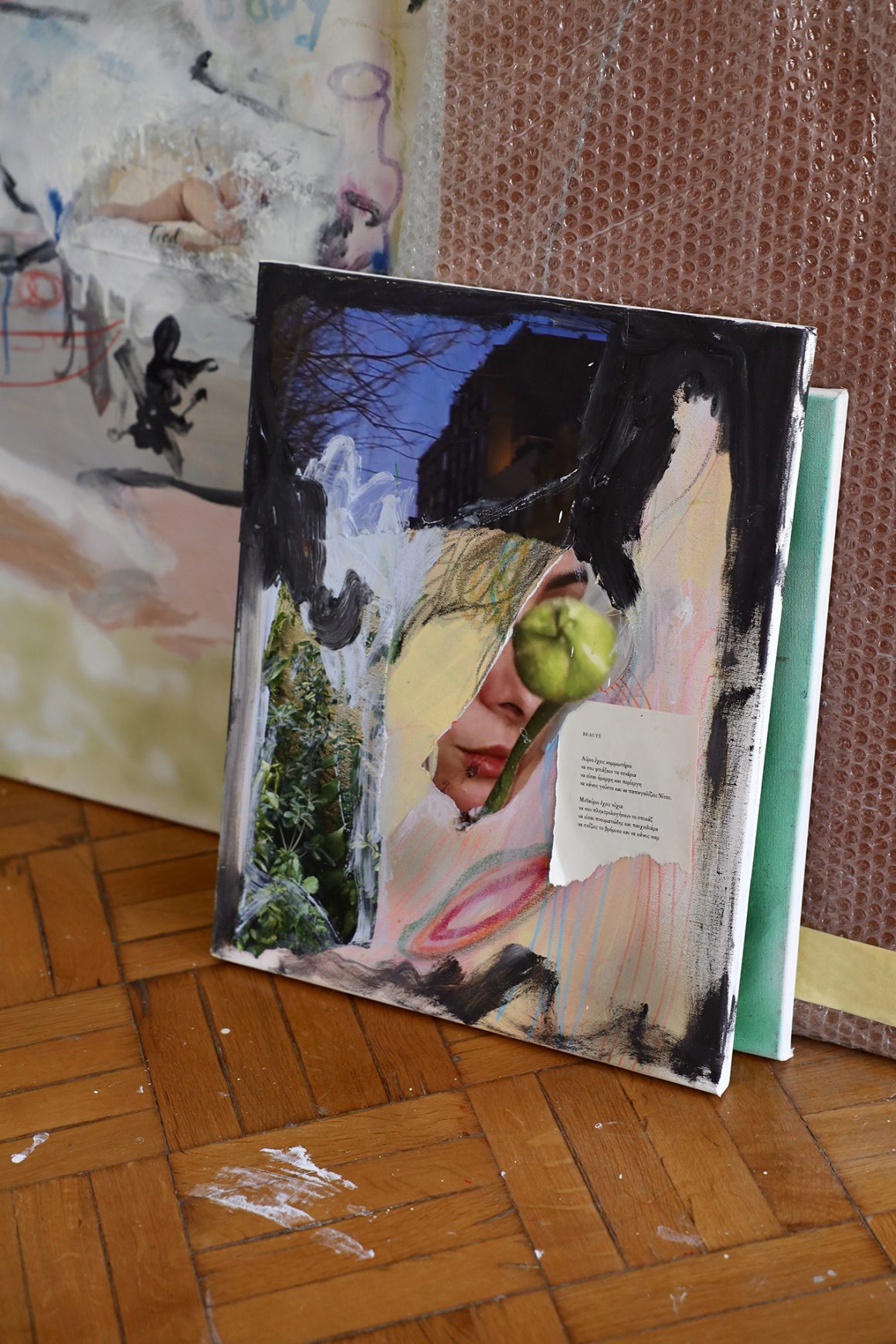

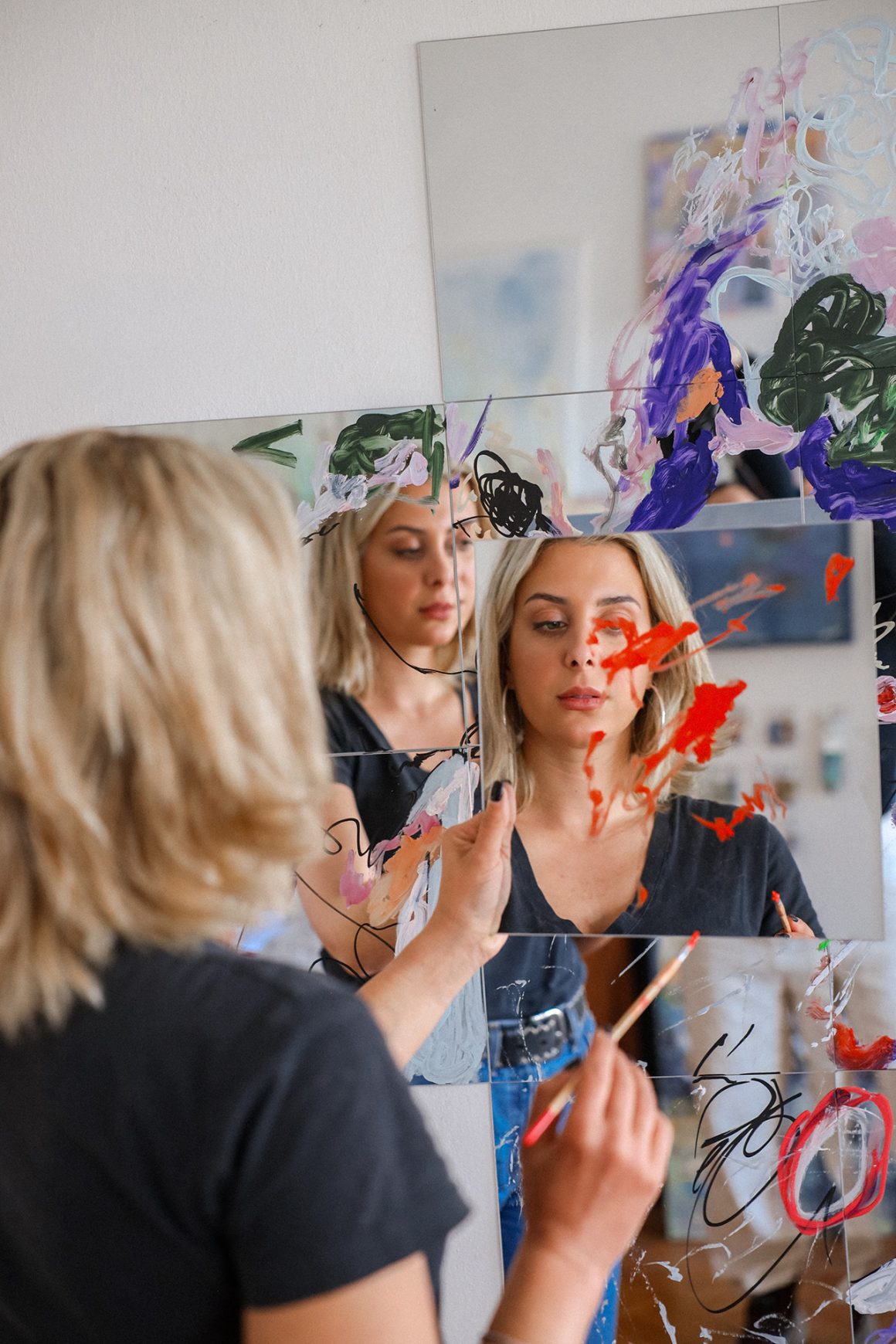
What is the ArtGate Project, how was the idea born, and what did you receive from the Thessaloniki audience during its debut last year?
The ArtGate Project was born out of a truly meaningful encounter. Before our first festival, I was approached by Konstantinos Tikis, who had visited an exhibition I curated at Bord de l’Eau with 40 Roomors. He shared his vision of creating a large-scale celebration of art together. From the very first moment, there was a shared aesthetic and a strong desire to go beyond expectations—to transform a common dream into reality.
We joined forces, combining his extensive experience in major music productions and festivals with my background in art and curation. The result was something that truly shook Thessaloniki. At the Old Slaughterhouses, artists from around the world came together, along with musicians and people of all ages—everyone eager to be inspired, to connect, to engage, and to enjoy.
What we received was far more powerful than just a successful event. We realized how much something like this had been missing from the city. There was a real need for an open, vibrant, and inclusive platform—an experience not only for insiders, but for everyone.
This year, on March 28th, we return stronger, more organized, and full of inspiration. We are preparing an immersive audiovisual spectacle that will take place at Warehouse C, at the port of Thessaloniki—the next step for ArtGate, as it continues to evolve and open new paths for art and experience.
What new story does the second ArtGate have to tell?
The second ArtGate comes to tell something deeper, more mature, and at the same time more daring. It brings together artists from all over the world, with completely different perspectives—between light and darkness, the personal and the collective.
Yet through this diversity, a shared emotional narrative emerges: a story of the present. A reflection of how people from different backgrounds live, endure, and ultimately find ways to be reborn.
This year, the project also evolves on an experiential level. It includes more artists, a stronger interactive element, performances, and musicians from different genres and corners of the world. It is not simply an exhibition or an event—it is a total experience.
Every detail has been carefully curated so that, for a few hours (Saturday, March 28th, 16:00–24:00), visitors are transported into another world. A few hours that have the power to stay with you for much longer. That is our goal: to create something you don’t just see—you live.
What response have you received from the city’s art community, and what opportunities do participating artists have?
The art community of Thessaloniki has truly embraced ArtGate, and we feel that on every level. People understand that behind this project there is deep dedication, personal effort, and care. It is not just an event, but a genuine attempt to build something with values and consistency.
One of the most important elements for us is respect towards artists. We do not take commissions from the sale of their works—this is a very conscious choice. We want artists to feel that what they earn fully belongs to them, and that they are part of a platform that genuinely supports them.
With an accessible participation fee, artists are not just exhibitors—they become collaborators. Together, we enter iconic buildings of the city and create exhibitions with professional standards, including press support, photographers, and overall organization that allows them to participate with dignity and pride.
At the same time, accessibility is essential to us. Fine arts students have free access to ArtGate, as do artists who applied through the open call but were not selected for this edition. For us, art is not about exclusion—it is about community and access.
Through ArtGate, a living network is constantly formed. Relationships develop and evolve into future collaborations, projects, and exhibitions. It is not something momentary—it is an ongoing process of connection and growth. In fact, I am currently preparing an exhibition in Europe, where I intend to propose the participation of several artists I met through ArtGate, because I truly believe their work can stand on an international stage and travel even further.
That is perhaps the most important thing: ArtGate does not end when the event is over. It continues to create opportunities, relationships, and pathways for the artists involved.
What role does art play today, and what feedback do you receive from your audience? Does it receive the appreciation it deserves?
Today, art plays a more essential role than ever. It exists to unite, but also to challenge; sometimes even to divide—pulling us out of ourselves and bringing us back again in a new way. It is a continuous process of rebirth, both personal and collective.
I feel that people need more art. They turn to it to feel, to understand, to endure. It may not always be supported in the way it deserves, but it is clearly needed—especially in a time marked by uncertainty and emotional heaviness.
The feedback we receive is deeply meaningful and moving. People don’t come just to see—they come to feel, to connect, to experience something real. And this shows that even if art is not always valued as it should be structurally, on a human level it remains absolutely essential.
In the end, that may be what matters most: that art continues to find its way to people—and people to art.
Tell us about your own participation and the ones you stand out
My artistic participation in ArtGate is something deeply personal. It is a project I would never want to be absent from as an artist, because every work presented carries an aesthetic and an energy that resonates with me directly. There is an indescribable connection to what is created as a whole, along with a strong sense of pride.
This year, I am participating with a new work—an installation with mirrors that invites the viewer to become part of the piece. It is not something you simply observe; it is something you engage with. You see yourself and enter into a more immediate relationship with your own image. I am very interested in this moment—when the viewer becomes a participant.
The exhibition as a whole revolves around the self—between light and darkness, and how we manage to remain authentic while carrying so many different sides within us. As for the participants, all works have been carefully selected through an open call that received an overwhelming response from artists around the world. I couldn’t single anyone out—and that is exactly what makes this year’s edition so powerful. Each artist has their own voice and story.
What have been the brightest moments of this journey, and what is now non-negotiable for you?
Behind this project, there is an immense amount of hard work from a team of young professionals, all of whom balance multiple roles in order to support what we love. Each person contributes their own piece, and together we build something greater than ourselves. It is a collective effort grounded in a shared vision.
The “brightest” moments are not isolated—they exist throughout the entire journey. For me, the greatest satisfaction is a moment that repeats itself every time: when I see the faces of the team, the artists, and the visitors as they first encounter the exhibition. That is when I understand whether what we created has meaning. When I see that it moves them, absorbs them, resonates with them—that is where true success lies.
As for what is now non-negotiable for me, it is the idea of the team. I want people around me with clear intentions, a shared goal, and trust. I deeply believe that when we come together and truly accept one another, we create a driving force far greater than the sum of its parts. And that is the force that can bring real growth and substance to everything we do.


How important is it for you to be in direct contact with people and their reactions during a public event?
Direct contact with the audience during a public event is, for me, something intimidating, immediate, multidimensional, and unpredictable. Even if it may not appear so, at my core I am a deeply introverted person, and this kind of exposure is a constant challenge.
I try to move beyond this sense of agoraphobia and rise to something much bigger than myself—to create the conditions where visitors feel at ease and where energy can flow naturally within the space. And this goes far beyond the setup or the selection of works. It’s a living process, where we all become part of the experience—the artists, the visitors, and myself.
In that moment, something is created that you can never fully control—and that is exactly where the magic lies.
Do you believe Thessaloniki has the potential to take significant steps forward in the field of art?
I deeply believe that Thessaloniki has immense potential to take important steps in the art world. It is a city with a strong identity, rich history, and a vibrant creative energy. There is talent, there are people with vision, and there is a real need for expression.
What is needed—and is slowly beginning to take shape—is greater openness, collaboration, and trust in difference. We need to expand our frameworks, make space for new ideas, and move beyond limiting structures or outdated perceptions.
I see a genuine hunger, both from artists and from the audience. And when those two meet under the right conditions, they can create work with real impact—not only locally, but internationally. For me, the most important thing is to keep creating opportunities, to support one another, and to build communities. Art does not evolve through isolation, but through connection. And Thessaloniki has all the elements to grow into an even more dynamic cultural hub.
Tell us your most beautiful story
The most beautiful story for me is about love. About a perfect moment in time. About a multilayered love that supported me more than anything else in this world—exactly when I needed it most, and from a very young age.
It’s the story of me and Markos. My man—who stood by me like a rock when, during my pregnancy with our daughter, in my fifth month, I was diagnosed with cancer.
This story has the most beautiful ending, because through that entire journey, we all came out safe. And perhaps even a little wiser—more connected to ourselves. And with a baby—now a little girl—Anna Maria.
My heroine, with the biggest green eyes and the wildest blonde curls.
This is, for me, the most beautiful story. One that does not pretend there is no dark side. One that continues to value the present moment and finds richness in simplicity. That, to me, is art.
What about the collaborations you’ve had and how they’ve evolved over time
Today, I have the privilege of choosing the people I collaborate with across all my projects. That is something I don’t take for granted—it is the result of time, experience, and deep inner work.
But it wasn’t always like that. In the early stages of my career, especially in London, things were much more challenging. I worked within teams as the youngest member, without much choice. There was intense competition and a pace that left little room for personal boundaries or for defining how you truly want to collaborate.
Over time, this changed. Now, at 32, I feel that having the ability to choose is a great luxury. I have the awareness and experience to understand what suits me and what doesn’t.
In the end, I’ve realized that it’s not only about what you do—it’s about who you do it with. And even more importantly, being on the same side of the story. Sharing the same “why.” Moving with the same intention, direction, and a deep respect for what you are building together.
Collaboration, in my work both as an artist and curator, is not just practical—it is deeply emotional. I feel strongly about the people we choose as milestones in our journey. There is mutual support, a willingness to help wherever possible.
Whether it’s brand collaborations, galleries, artists under my wing, or young creatives seeking guidance—everything holds equal value for me.
And I’m happy to be at a stage where I feel my work is recognized. Two simple things show me what that means: my phone never stops ringing, and at night I go to bed tired—but full.
Because in the end, collaborations are not just professional relationships. They are human connections that shape our path, help us grow, and keep us connected to what we do.
What do you love—and what don’t you love—about the field you work in?
What I love is the intensity that art can create. I love when a work sparks strong reactions—like Wuthering Heights, recently adapted for the screen—when it pushes people into debate over whether it is a masterpiece or complete nonsense. (I personally consider it a masterpiece.)
I love that tension, that need to take a position.
I also love the moment when we move beyond ourselves and try to communicate how we see something—to share a perspective that has depth and multiple layers. That’s where true dialogue begins.
What I don’t love at all is when art is dismissed or devalued. To me, it feels as disturbing as hearing about cruelty toward animals. It creates a gap I cannot easily comprehend. It feels foreign, threatening, and deeply unsettling.
Because for me, art is not secondary. It is a way of existing.
What would be a dream project for you?
I carry many dream projects within me—and I hope to gradually bring them to life.
One of them is an experience that combines art and wellness, which I am creating with my sister, who is a Pilates instructor. It will bring together meditation practices, artistic exploration, healthy nutrition, immersion in nature, breathing in green landscapes, connection with animals, and a deeper exploration of the self.
I cannot separate personal wellbeing from my work. For me, it is essential to care for ourselves within the chaos. And at the same time—as my work reflects—I am equally interested in bringing that chaos to the surface, observing it, processing it, and transforming it.
Another dream project is to create an exhibition with leading artists from around the world, set outdoors. Facing the horizon, surrounded by fields, with the sky constantly shifting light. With horses moving freely through the space, and the sounds of nature becoming the “music” of the experience.
Something both grounded and dreamlike. A space where art, body, and nature are no longer separate.
An exhibition you will never forget
There isn’t just one. At the Royal Academy of Arts, the encounter between Bill Viola and Michelangelo left a profound mark on me. That dialogue between the classical and the contemporary—between the body, light, and mortality—felt almost existential.
And in Paris, at the Musée Picasso, the exhibition bringing together Pablo Picasso and Francis Bacon was one of the most powerful experiences I’ve ever had. Two raw, intense, emotionally charged worlds, confronting you with human nature without any filter.
Your definition of Beauty
Beauty, for me, is a spring day after a heavy winter.
Nature suddenly becomes vibrant and fragrant. You’re in the car, observing it all, on your way to Halkidiki, while Golden Brown plays on the radio.
Everything blooms effortlessly, as if it instinctively remembers what it needs to do.
What feels Authentic to you today?
Authenticity is anything that does not try to be something else.
In a world that constantly pressures you—judges you, shapes you, measures your worth through followers and visibility, through routines and curated identities, authenticity is refusing to perform what you don’t truly feel.
It is finding your voice within the chaos and staying there.
Not changing to fit in. Having the strength to remain yourself, even when it’s difficult. Creating work that is meant, first and foremost, to resonate with you.
Keeping your voice clear, without excessive filtering. Showing both your light and your darkness without apology.
For me, authenticity is a quiet strength. A powerful one. And something I deeply admire—and truly enjoy recognizing, especially in spaces like The Authentics.
Photo: Christina Dimitriadou