At first glance, the pairing seems obvious. Yves Saint Laurent openly admired Henri Matisse, collected his work, and paid direct tribute to him in several collections. Yet this summer’s exhibition at the Musée Matisse in Nice, France, suggests a deeper connection. Moving among paintings, drawings, and couture creations, the 160 works on display reveal how both men drew on a remarkably similar visual vocabulary of line, color, and decoration.

Visitors are greeted by enlarged photographs of Matisse and Saint Laurent alongside fabric samples and archival material arranged in an atelier-like setting. For Matisse, who grew up in northern France, a region long associated with the textile industry, costumes and decorative objects became fixtures of his studio. Saint Laurent approached them with similar curiosity, using them as a starting point for experimentation with pattern and form.

Some of the exhibition’s most compelling moments are the visual conversations staged between paintings and couture. A portrait of a woman in a voluminous blue dress finds an unexpected counterpart in a Saint Laurent evening gown of midnight-blue fabric and cascading white ruffles. Elsewhere, the vivid striped geometry of the “Scottish” skirt worn by one of Matisse’s sitters in Deux jeunes filles, robe jaune et robe écossaise, reappears in a Saint Laurent design built around the same graphic zigzag pattern. Matisse’s Les Plumes Blanches is so delicately painted that viewers will want to reach out and touch the hat, if only to confirm that the feathers are made of paint.

Left: Henri Matisse, Purple Robe and Anemones, (1937). Right: Yves Saint Laurent, exploratory sketch, Fall/Winter 1988 haute couture collection. Photo: Left: © Mitro Hood. Baltimore Museum of Art, The Cone Collection, established by Dr. Claribel Cone and Ms. Etta Cone of Baltimore, Maryland. Right: Yves Saint Laurent Paris © Yves Saint Laurent © Fondation Pierre Bergé–Yves Saint Laurent
Henri Matisse, The Blue Dress Reflected in a Mirror, sketch, (1937). Photo: The National Museum of Modern Art, Kyoto
Yves Saint Laurent, evening dress worn by Trish Goff Autumn/Winter 1981 haute couture collection. Photo: Musée Yves Saint Laurent Paris
Henri Matisse, La Robe rayée, (1938). Photo: Courtesy of Musèe Matisse
Yves Saint Laurent 1994. Photo: Courtesy of Yves Saint Laurent
Henri Matisse, La Conversation, 1938, huile sur toile, 46,7 × 55,4 cm San Francisco Museum of Modern Art Legs de Mr. James D. Zellerbach © Photo : San Francisco Museum of Modern Art/Bridgeman Images
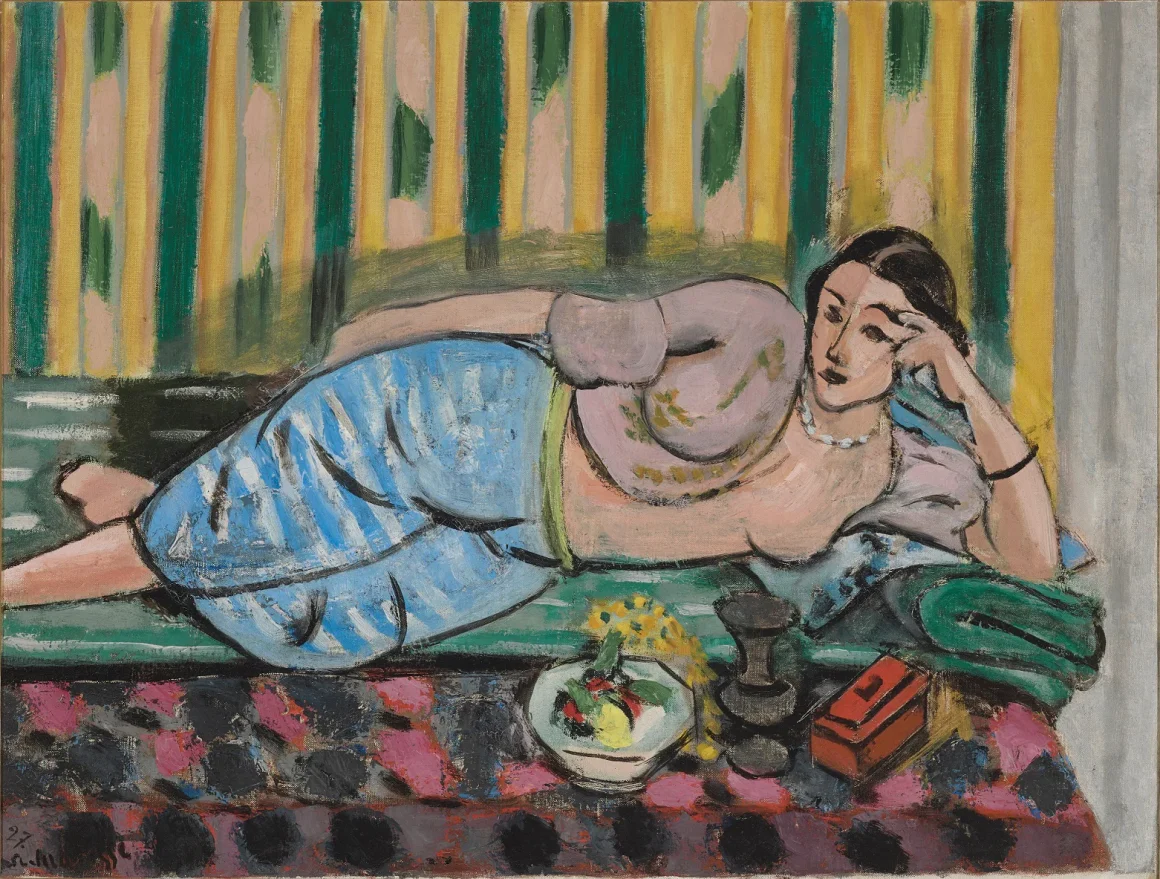
l’ Odalisque au coffret rouge, one of Matisse's iconic works, painted in Nice in 1927
For Matisse, decorative prints and their inherent energy were essential tools for building a pictorial space that expanded far "beyond the limits of the tangible." For Yves Saint Laurent, painting offered an open window to transition from flat sketches to structural volumes, allowing him to treat clothing as a form of mobile art that unfolds in space. Sewing and painting become twin gestures here, sharing the exact same experimentation with lines and a deep sensitivity to contrasting textures and shapes.
Yves Saint Laurent avec le tableau de Matisse Les Coucous, tapis bleu et rose, dans son appartement 55, rue de Babylone, Paris, 1983 © Photo : Duane Michals

The dialogue becomes even richer in the room devoted to Matisse’s odalisques. Draped in embroidered jackets and flowing harem pants, his models are surrounded by patterned screens, carpets, and decorative objects that transform the paintings into immersive interiors. The women themselves often seem inseparable from their surroundings, enveloped in a world of color, ornament, and theatrical staging.

Years before these artworks were painted in Nice, a trip to Tangier in 1912 would prove transformative. Matisse later famously wrote that “the revelation came to me from the Orient.” Decades later, Saint Laurent found his own creative refuge in Marrakesh, where he and Pierre Bergé acquired the Villa Oasis beside the Majorelle Garden, the lush botanical landscape that would become one of the defining settings of his later life.

“The Mediterranean light, the brilliance of the colors, and the imagery of North Africa nourished both men’s work throughout their lives,” observes Madison Cox, president of the Fondation Pierre Bergé–Yves Saint Laurent.

Romanian peasant blouses also occupy a special place in the show. Collected by Matisse and incorporated into both his paintings and studio environment, their embroidered motifs and bold geometric patterns helped shape his increasingly decorative approach during the 1930s and 1940s. Seen alongside Saint Laurent’s folkloric designs, they feel strikingly contemporary.

Dance provides another point of connection. Matisse’s collaborations with the Ballets Russes and Igor Stravinsky reflect a lifelong interest in movement, costume, and performance. A gallery devoted to Le Chant du Rossignol places his décor and costume designs alongside Saint Laurent’s creations for the stage.

From there, the exhibition moves toward Matisse’s late paper cut-outs, where form is reduced to essentials, and motifs reemerge in Saint Laurent jewelry. Leaves, stars, and fruit shapes seem to leap from paper into metal, demonstrating how readily Matisse’s visual language could move between mediums.

Saint Laurent himself summarized the relationship best: “Matisse had a decisive influence on my use of color because in the beginning, I only believed in using black. Today, I believe I handle color brilliantly.”   


“Henri Matisse—Yves Saint Laurent: Beauty, Fashion, and Happiness” is on view through September 28, 2026.


Matisse painting Carmen Leschennes, Régina, Nice, around 1951. Photo: Courtesy of Musée Matisse
Henri Matisse, Fleurs et fruits, (1952-1953). Photo: Courtesy of Musée Matisse

Author