James Turrell’s new dome under Aarhus is an experience that is difficult to describe
ARoS As Seen Below – The Dome, a Skyspace by James Turrell opens. The permanent artwork is hidden beneath the Musikhusparken and is the artist’s 100th Skyspace worldwide. With a dome measuring 40 meters in diameter and an experience where light, architecture and the sky above Aarhus come together in one, it is also the largest Skyspace that James Turrell has created in a museum building.
I have read the descriptions beforehand and heard the stories about the visions behind the work. I know it is big and that it is something special. Yet it is only when I begin the journey underground that I realize that I am entering something much bigger than just another new attraction in Aarhus.
Maybe it’s the thought that generations to come will be sitting in the same room looking up at the same sky. I don’t really know. I just know that I feel a kind of awe that’s hard to put into words, and that feeling begins surprisingly long before I reach the dome itself.
The long road to the light
You might think the experience begins when the door to the dome opens. But already in the tunnel, you realize that James Turrell and ARoS have other plans.
The long corridor winds underground in a blue light, while the raw concrete walls slowly close the city out. With each step, it feels as if Aarhus disappears a little further away. It is not a dark tunnel leading to anything. It is more like a transition between two worlds, where you gradually let go of everything you brought with you.
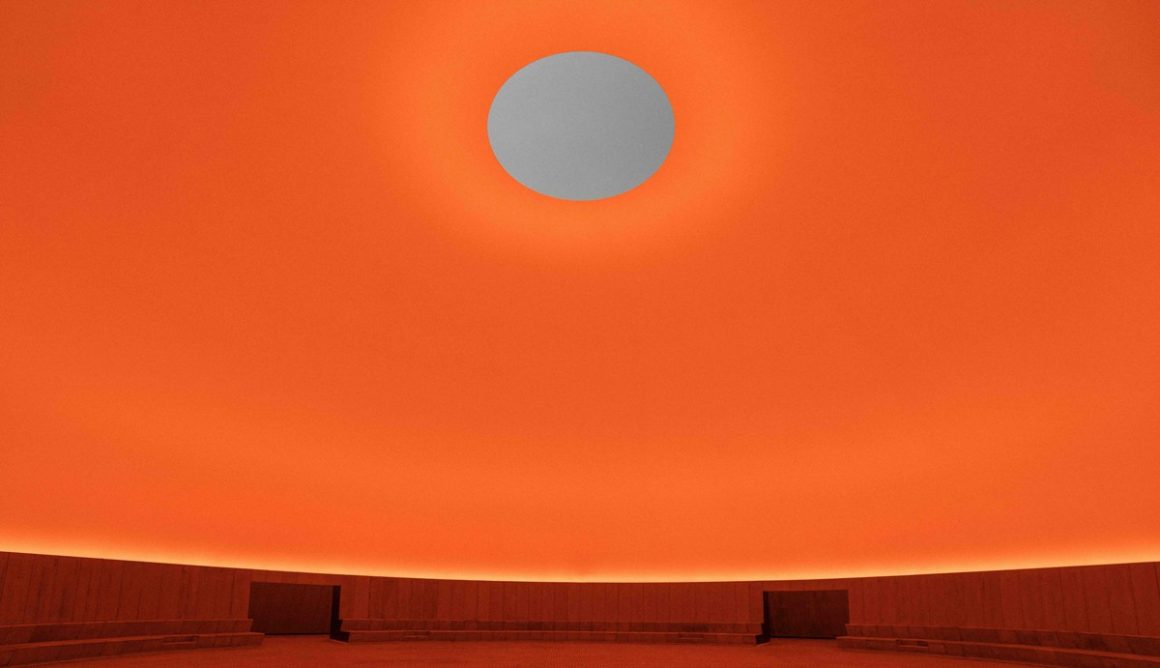
At the end of the hallway, an orange light shines like a beacon in the blue universe. The color almost glows, and the contrast between the cold blue light and the warm orange opening creates something very special about the anticipation.
A room that at first seems quiet
Inside the dome you just have to orient yourself.
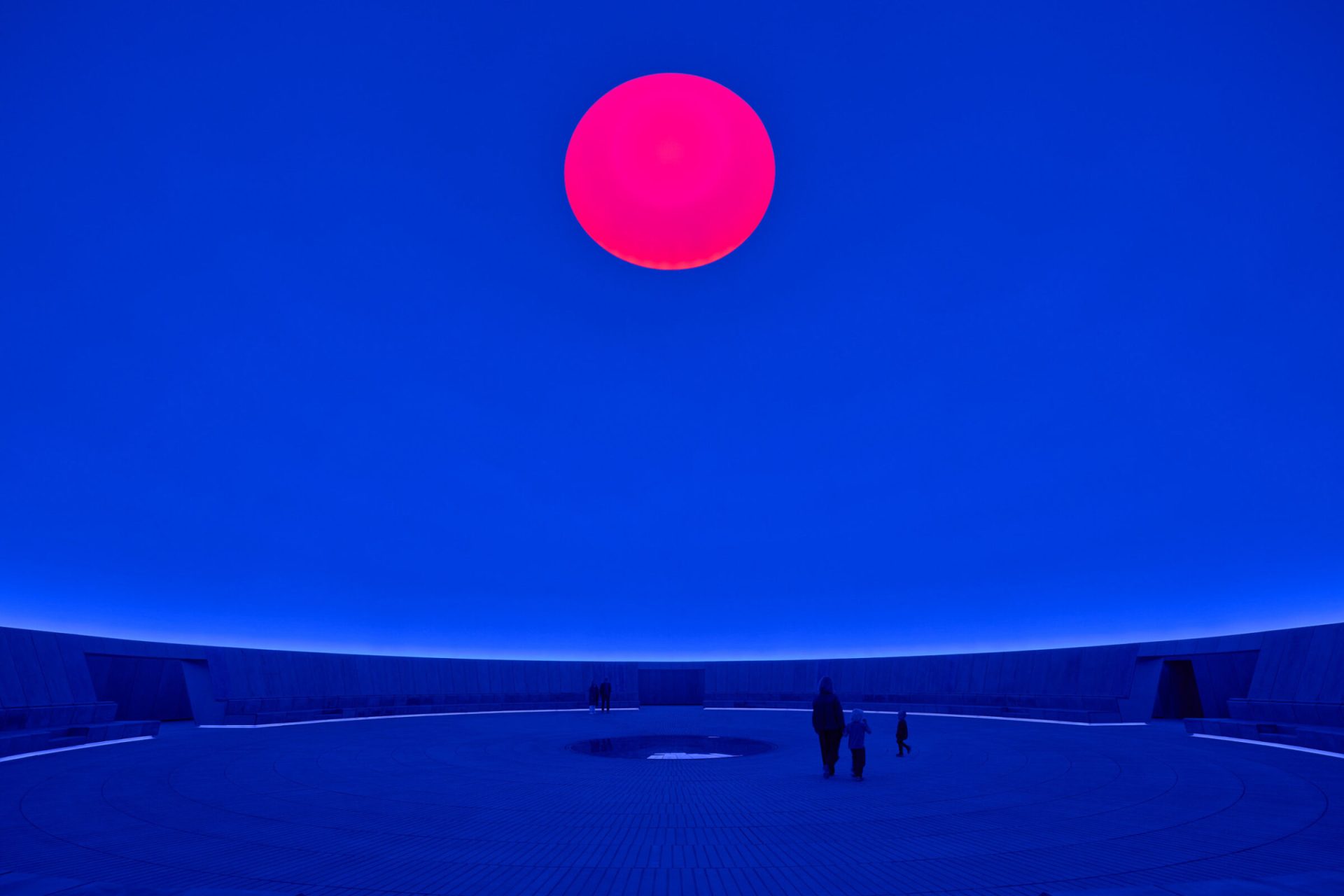
Daylight streams down through the circular opening in the ceiling, and guests sit scattered along the walls, their gazes slowly searching upwards. In the middle of the room lies a circular mirror surface that reflects the sky above.
The first question arises almost immediately: What exactly am I looking at?
Is it space? Is it the sky? Or is it the light?
There is no obvious answer, and perhaps that is precisely the point. For more than 60 years, James Turrell has been working on the question of what it really means to see. Not to look at something, but to become aware of the very experience of seeing. It sounds almost philosophical when read on paper, but down here it slowly starts to make sense.
Silence has its own sound
One of the first things you notice is the acoustics.
Normally you don’t think about sound when you visit a work of art. But here it becomes part of the experience. Even the smallest sounds move clearly through the room, and I find myself thinking several times about the expression of being able to hear a pin drop. If there’s one place where that makes sense, it’s here.
At the same time, people become quiet. Not because someone asks them to, but because the space almost invites it. Conversations turn to whispers, and gazes turn skyward, as if everyone is waiting for something to happen.
And it does.
When the sky begins to change
At first it’s barely visible. A color glides over the walls. Then a new one, and another.
Suddenly you are sitting in a room that feels completely different than it did just a few minutes ago.
The most fascinating thing is that it is not only the room that changes character. The sky does too. The circular opening in the ceiling keeps drawing the eye, and the more the light changes down here, the more the opening up there changes with it. When the dome is orange-red, the sky appears cold blue. When the room is bathed in pink and purple hues, the sky takes on a completely different character.
This is not a trick. The light in the dome affects our perception of color, and when we then look up at the neutral sky, we experience it in a new way. The sky doesn’t change. But we do.
Occasionally a bird flies across the opening. It’s only for a brief moment, but it makes an impression every time. Because the bird is real, and the clouds are real. The sky is real. Yet it feels as if you’re looking into something that doesn’t quite belong to the world you came from.
The colors continue to change. Sometimes slowly. Other times so quickly that you barely have time to get used to one mood before the next takes over.
A place that becomes part of the city
As Seen Below doesn’t feel like a place you visit once and check off a list. It feels like a place you return to because the sky is never the same. The seasons change the experience, and because you yourself are a different person every time you return.
Museum director Rebecca Matthews has stated that she hopes that people in 10, 15 or 20 years will remember that they sat under the Jutland sky with someone they care about.
Mayor Anders Winnerskjold describes the project as a gift to Aarhus that has only become possible because the city has an art museum with great ambitions: “This project and this gift to the city has only become a reality because we have an art museum with enormous ambitions.”
Cultural Affairs Councilor Jesper Kjeldsen says that the experience gave him the same feeling as when he first saw the northern lights in Greenland.
Architect Morten Schmidt describes the dome as a place where you both look out towards the cosmos and into yourself: “It is a sanctuary where you look out towards the universe, but at the same time you are forced to look deeply into yourself.” And architect Jette Birkeskov puts into words more than ten years of work with a single sentence: “Something that looks light and smooth is actually the most difficult thing to build.”
The words make sense when you’ve sat down there.
Because you are sitting with other people, but at the same time alone with your own thoughts. You look up at the sky, but you also get to look a little inward. And as the birds fly across the opening and the colors slowly change around you, you lose the sense of both time and place for a moment.
As you walk back through the blue tunnel and slowly move up towards the city again, you know that thousands of people will experience the same space in the years to come. Families, school classes, tourists and Aarhusians will sit under the same opening to the sky and watch the colors change.
That is perhaps precisely what James Turrell’s greatest achievement is. Not to make us look at the sky. But to make us see it.