The architectural duo revisits Jean Prouvé’s pioneering approach to prefabrication through a contemporary glass house, conceived with technical precision and a distinctly modern sensibility. Rooted in its surroundings, the project offers a fresh interpretation of genius loci.
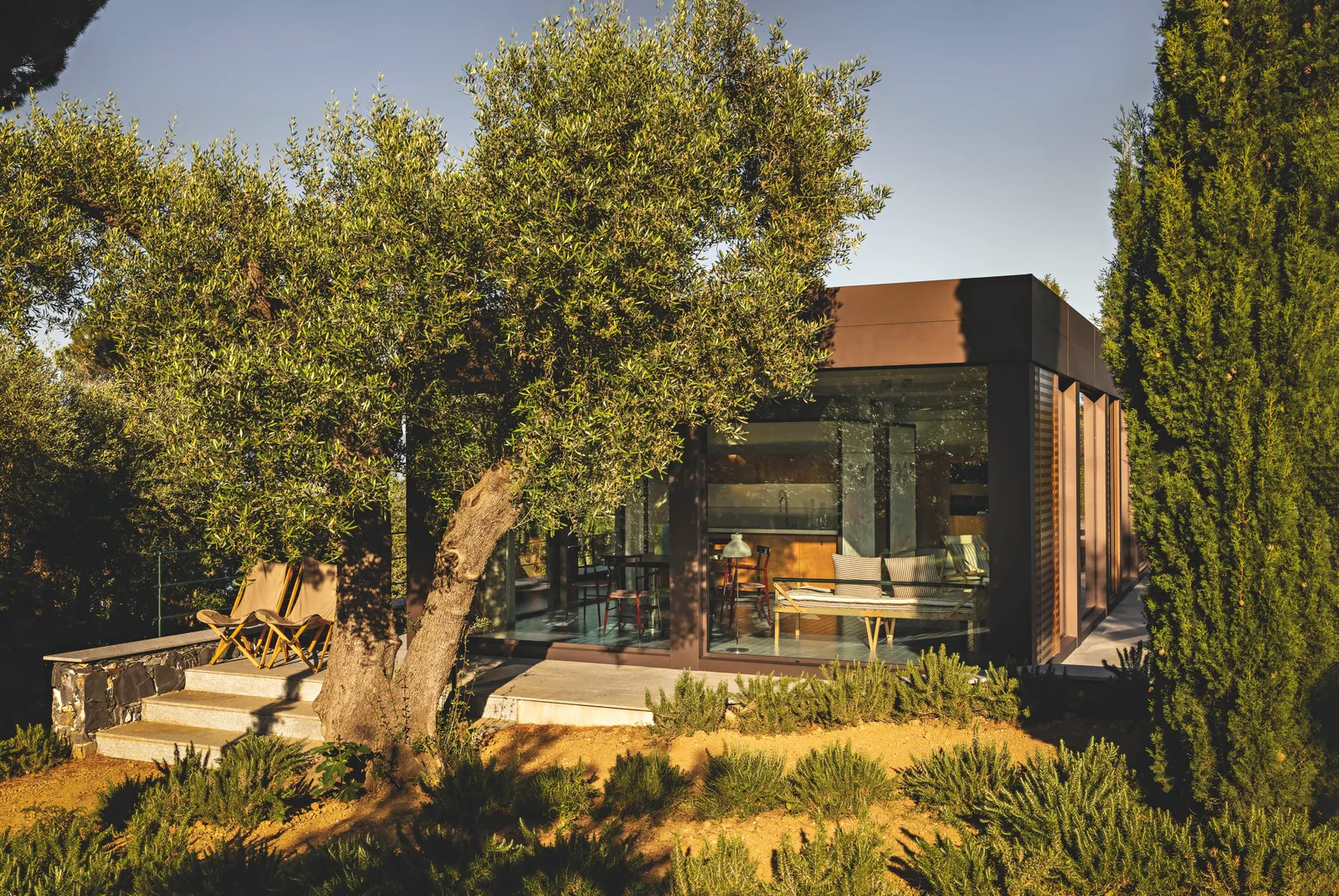
Set within the pine forest of Pineta di Arenzano, the Glass House by Eligo Studio reimagines Prouvé’s architectural principles in a newly built, self-sufficient residence. Conceived in close dialogue with the Ligurian landscape and its modernist heritage, the house draws on the region’s materials, craftsmanship and architectural language, establishing a subtle continuity between built form and nature.
The project reflects Eligo Studio’s holistic approach to design, in which architecture, interiors and furniture are considered as parts of a single composition. Research, functionality and an attentive treatment of detail shape a design language that is less concerned with a signature style than with bringing references, materials and forms into a coherent relationship with their setting.
The Legacy of Jean Prouvé
An avant-garde glass house rises where an old garden tool shed once stood. Jean Prouvé’s prefabricated structures were conceived as lightweight, industrial and temporary housing solutions for workers in the post-war years. In Arenzano, Eligo Studio, founded by Alberto Nespoli and Domenico Rocca, revisits this legacy through a contemporary architectural intervention, translating its underlying principles into a sustainable villa shaped by today’s needs.
The result is a considered dialogue between modernist ideals and the genius loci of the Ligurian coast, where the work of masters such as Caccia Dominioni, Zanuso, Gardella, Ponti and Magistretti has long informed the architectural identity of the area.
“The municipality is forward-thinking and understood our project, which is in tune with the DNA of the place and the savoir-faire found in this pine forest, and granted us the necessary permits,” explains Alberto Nespoli, who founded Eligo Studio with Domenico Rocca.
From Garden Shed to Glass House
Building regulations ultimately led the architects beyond their initial idea of a prefabricated pavilion, allowing the project to take shape as a permanent architectural structure within the pine forest. Sustainability was integral to its conception. Solar panels are discreetly integrated into the roof, beneath a walkable surface finished with Mediterranean pebbles, while thermally insulated glazing ensures the house’s energy efficiency. “The house is energy self-sufficient,” Nespoli explains.
The dialogue with the surrounding landscape continues through the exterior details. Moss-green railings, terraces and dry-stone walls draw on the vernacular architecture of Liguria, recalling, among other references, the setting of Lord Byron’s Grotto in Portovenere.
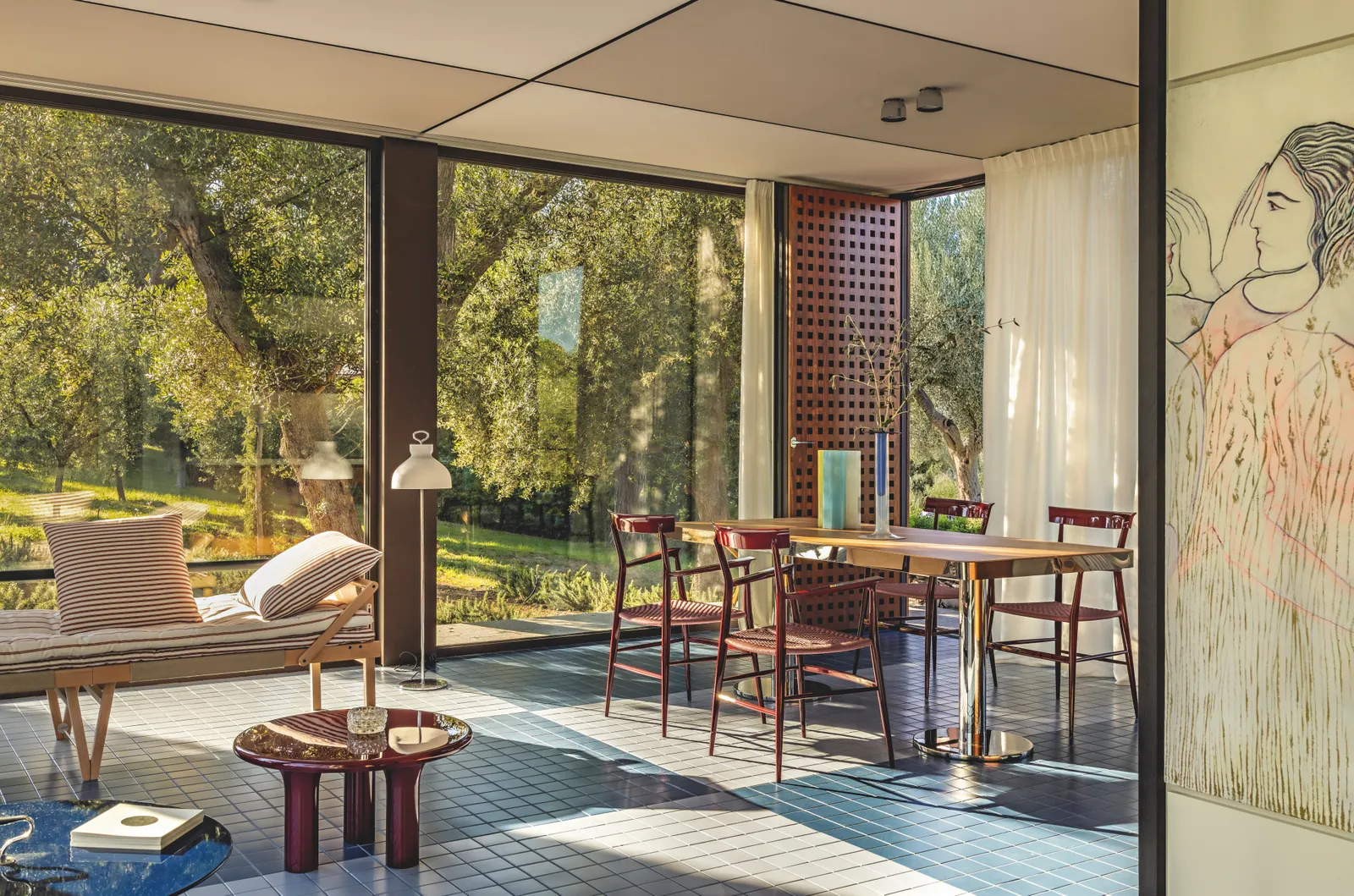
Inside, a perforated iroko-clad door introduces a nautical sensibility that runs throughout the house. Porthole-inspired lights, combinations of steel and wood, carefully considered handles and precisely integrated built-in elements reinforce this connection, bringing together industrial rigour, maritime references and a quietly refined material palette.
Rather than reproducing a modernist language, Eligo Studio distils its essential principles into a house that belongs to its own time and place—one in which architecture, landscape and the memory of local craftsmanship remain in balance.
A Villa in the Pineta di Arenzano, Designed Like a Boat
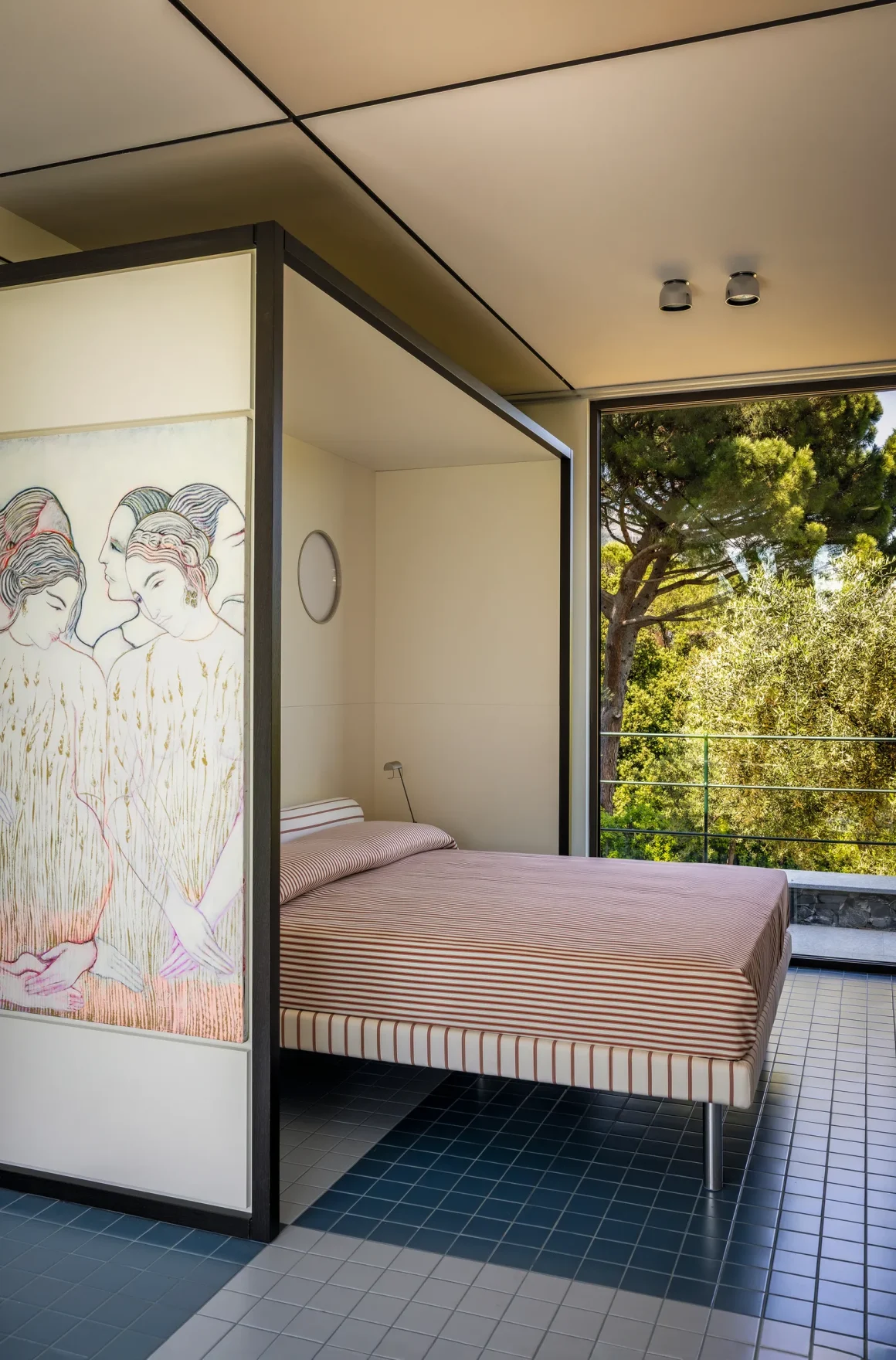
“The owner, a painter and art enthusiast, had acquired two works from Sofia Cacciapaglia’s studio, which became the starting point for the design of the entire 100-square-metre residence,” Nespoli explains. The two panels were reimagined as the walls of a pair of boxes—architectural volumes within the larger space. One houses the kitchen, while the other accommodates a bespoke alcove bed. The bathroom is the only fully enclosed room in an otherwise open, light-filled interior, where the surrounding trees and the sea breeze become part of the experience.
The furnishings bring together different eras of Italian design. A Magistretti loveseat and a Gardella side table sit alongside Eligo Studio’s contemporary interpretations of iconic forms, among them the Tripolina and Chiavarina chairs. The latter is reimagined with a seat woven from climber’s rope, introducing another subtle reference to the functional beauty of technical materials.
Simple square tiles, arranged in a two-tone pattern, define the floor like a woven rug, their palette evoking the shifting colours of the sea. Above, a geometric arrangement of panels framed in chocolate-brown steel reinforces the intimate, pared-back character of the cabanon.
“The project was originally conceived as a caretaker’s house on the owners’ estate. In the end, however, the clients fell so much in love with it that they decided to use it themselves. We therefore designed a separate residence for the caretaker.”
Photography © Helenio Barbetta
About Eligo Studio
Founded by Alberto Nespoli and Domenico Rocca, Eligo Studio is a creative practice specialising in interior design and decoration. With a distinctive sensitivity to materials, craftsmanship and detail, the studio develops bespoke projects across retail, hospitality, restaurants, private residences and set design, guided by the enduring principles of Italian style.
Its approach brings traditional Italian techniques into conversation with contemporary design, creating interiors that feel both of their time and timeless. Each project is conceived as an individual expression of the Italian way of life, shaped through what the studio describes as a “couture approach to interior design”, in which every detail is developed with precision and care.
In 2015, Eligo Studio received the prestigious Milan Design Award for Il sentiero dei nidi di ragno, a scenographic installation created for Antonio Marras.
The studio’s distinctions also include L’Empreinte de l’Année 2015, awarded in Paris by Les Talents du Luxe et de la Création; ADI Design Index – Eccellenza Lombarda 2019; Altagamma Best Design Company 2019; and inclusion in AD’s Special Interior Design Issue – TOP 100 Best Interior Designers 2019. In 2020, Eligo Studio received the BIG SEE Interior Design Award in the category “Hospitality, Architecture and Design as Experience.”