The contemporary art exhibition Nurturing Mechanisms: Interweavings at Kabones has opened at the historic Kabones olive grove in Naxos, transforming a place shaped by deep historical and familial continuity into a site for contemporary artistic creation.

Conceived and initiated by Maria Polykreti, president of the cultural organisation Polykríti Naxos, and curated by Sevastiana Konstantaki, the exhibition brings together five women artists, Phoebe Giannisi, Eirini Gonou, Sevastiana Konstantaki, Mariandri and Katerina Nakou, who present works born from their relationship with the olive grove itself. Their practices explore care as a cultural act, a creative process and a means of connecting human beings with place and time.

The starting point of the project lies within the place itself.

Kabones is a cultural and natural ecosystem where human presence, the cultivation of the land and memory have coexisted over time. Its ancient olive trees, traces of labour and the history of the family estate create an environment in which the idea of continuity acquires a tangible form. Within the exhibition, this environment is activated through contemporary art, becoming an integral part of the artistic process itself.

Nurturing Mechanisms places the notion of care at its centre: care for the land, memory, knowledge, materiality, relationships and all that is passed from one generation to the next. Through this lens, the exhibition explores the mechanisms through which a place sustains its vitality, transforms itself and continues to generate experiences and meaning.

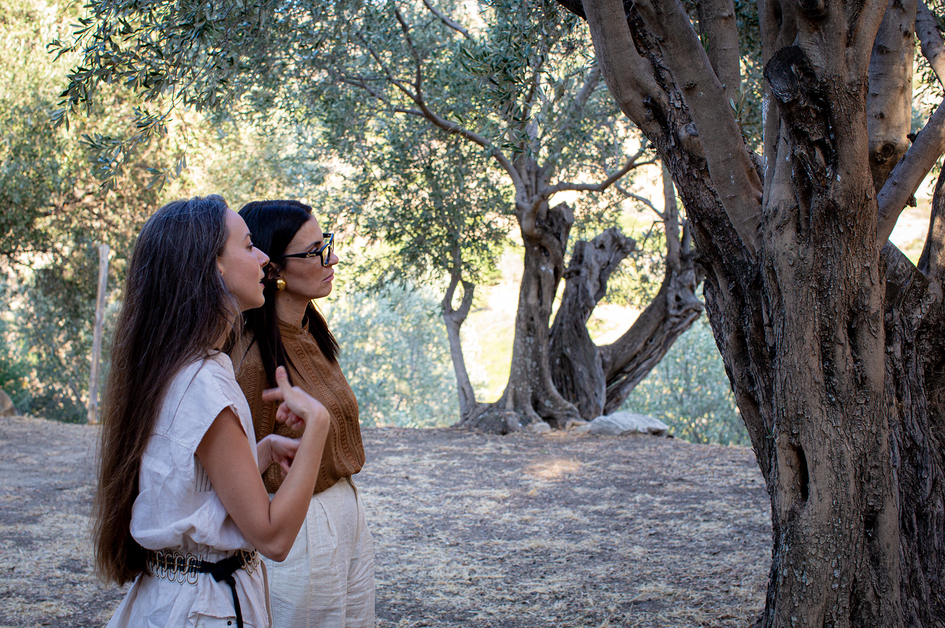
This relationship began with the very process of creating the works. The artists came to know Kabones, walking among the trees, observing the land and the forms of the olive trees, and engaging with the history of the estate before developing their interventions. As Maria Polykreti explains, the initial intention was for the works to establish a meaningful relationship with the olive grove, allowing the olive trees and the natural environment itself to become an organic part of the exhibition.

The exhibition, then, unfolds through the place and together with it.

Thread, weaving, sculpture, installation, performance and sound encounter the trunk, the leaf, the fruit, the wind and the earth. The materiality of the works enters into dialogue with that of the olive grove, creating a polyphonic narrative around time, ecology, embodied knowledge and collective experience.

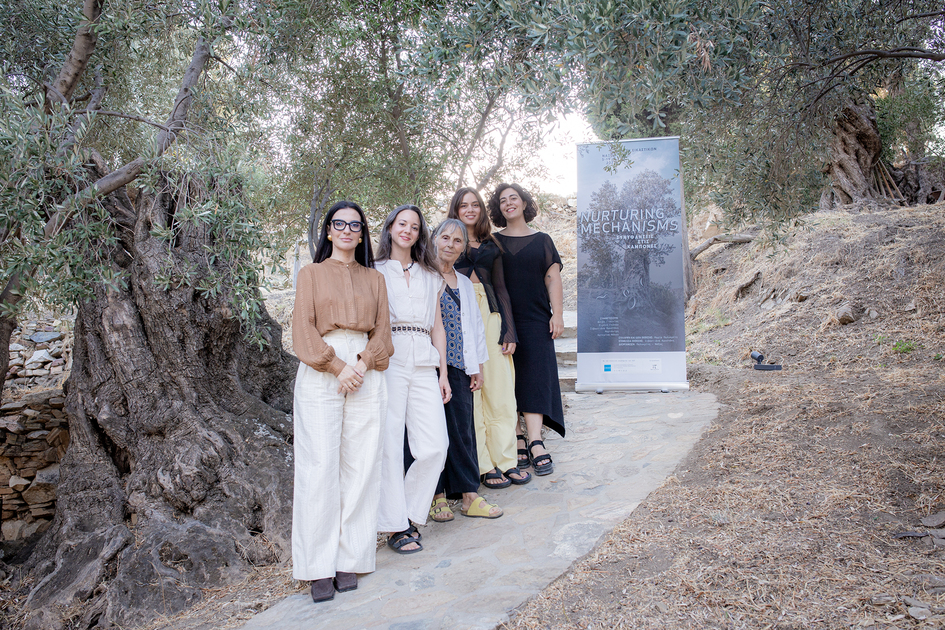
Maria Polykreti, Katerina Nakou, Eirini Gonou, Mariandri and Sevastiana Konstantaki
Eirini Gonou
Sevastiana Konstantaki
Katerina Nakou

Five Artistic Approaches, One Common Point of Departure

Phoebe Giannisi presents Temenos, 2026, a performance and installation that connects the land and the olive tree with ideas of community, political identity and belonging. Drawing on the ancient olive grove of Kabones and the historical and symbolic significance of the olive in the Mediterranean world, the work develops a narrative in which the tree becomes intertwined with place, survival and collective memory.

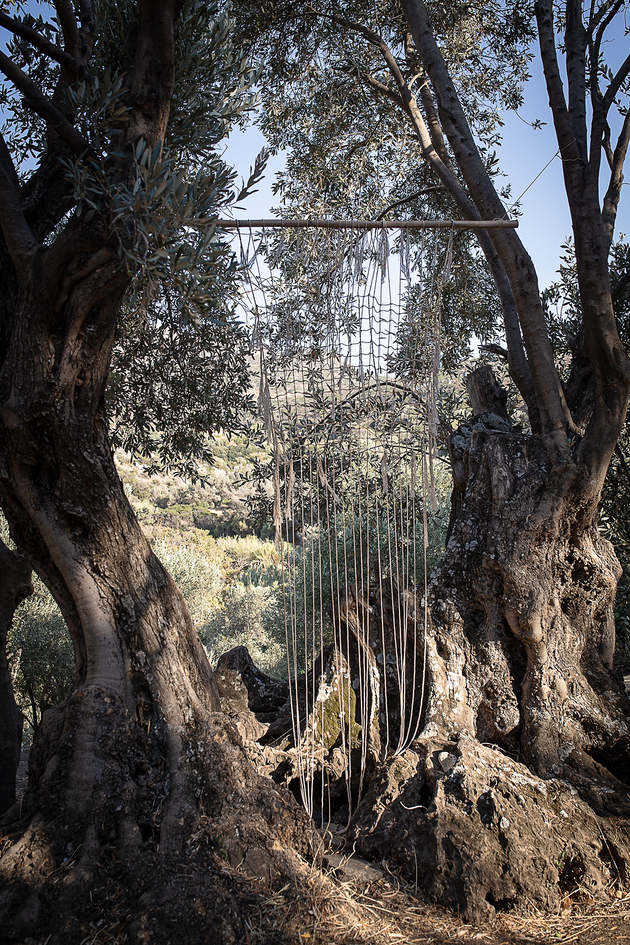
With The Breath of the Olive Tree, 2026, Eirini Gonou creates a form suspended within an ancient olive trunk. Cotton thread dyed with olive leaves, rush, gourds, seeds and three idiophones come together in a work that moves with the wind and breathes alongside the tree. The work emerged from the artist’s embodied relationship with the thousand-year-old olive tree, conveying an experience of profound coexistence between the human and natural worlds.

In Exoskeleton Tales in a Grove, 2026, Sevastiana Konstantaki presents an installation of five sculptures made from cotton cord, recycled thread, gold and plaster. Drawing on the sculptural bodies of the ancient olive trees, she captures selected knots and junctions where branches meet, transforming their casts through thread into exoskeletons. Suspended between organic trace, protective structure and potentially wearable object, the forms translate an embodied moment of a tree into a new sculptural condition.

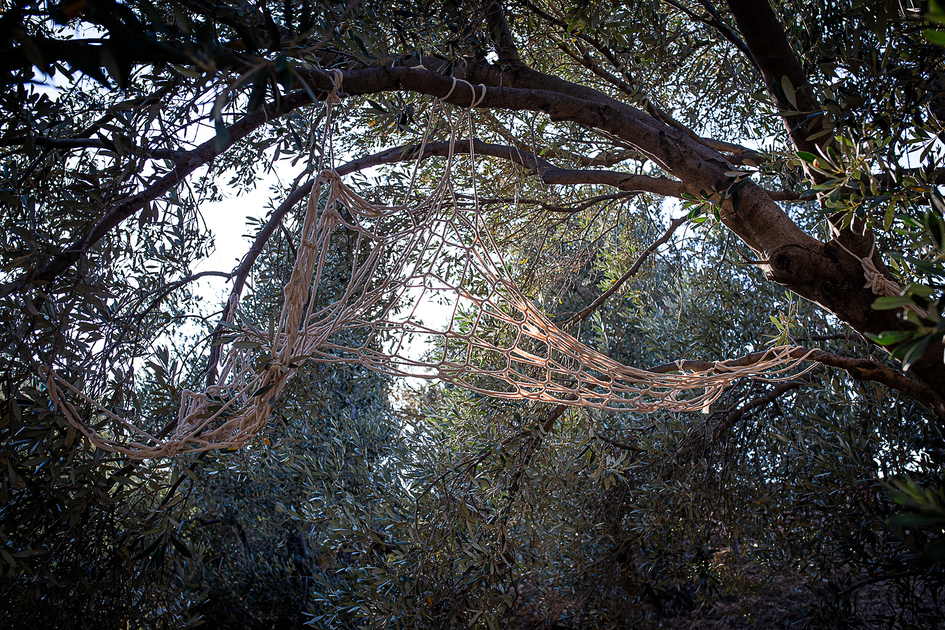
With To Nurture Is to Set Free, 2026, Mariandri approaches the resilience of olive trees through the continuity of weaving and the transmission of knowledge from one generation to the next. She uses olive branches and fruits as improvised knitting needles, adapting her gesture and body to the form of the tree. The process brings the practice of weaving into direct relation with the natural environment, approaching tradition as living knowledge—something that is passed on, evolves and takes on new forms with each generation.

Katerina Nakou presents Elaia, 2026, a handmade textile work in wool, silk, linen, metallic threads and gold thread. For its creation, she draws on a historic compound weave, a variation of samitum known as proto-lampas, translating the form of the olive tree into a new material expression. The work reactivates a historic textile tradition and completes its journey by returning to the olive grove that served as the starting point for its creation.

From Heritage to Contemporary Creation

Behind Nurturing Mechanisms lies a broader understanding of how a historic place can participate actively in contemporary cultural production.

For Maria Polykreti, Kabones is intertwined with family, childhood memories, nature and her own personal journey. This relationship has evolved into a sense of responsibility towards what one receives from a place and what one can give back to it through care and creation.

Polykríti itself was born from the desire to create a space where cultural heritage could meet the present. Memory, knowledge and tradition are treated as active materials that can inspire new ideas, create connections between generations and open up new possibilities for cultural expression.

As Maria Polykreti notes:

“Naxos is the starting point of this conversation, not its boundary.”

The phrase encapsulates one of the central directions of the project. Our relationship with nature, memory, care, the choices we make about what to carry forward from what we have inherited, and our responsibility towards future generations are questions with both timeless and universal resonance.

Culture with Naxos as Its Point of Departure

The exhibition also forms part of a broader conversation about the potential of island communities to become active sites of contemporary cultural production.

The cultural activity at Kabones begins with the distinctive characteristics of Naxos and gains the potential to engage with a wider audience. Through encounters between artists, different fields of knowledge and creative practices, Polykríti is gradually shaping a cultural identity grounded in consistency, quality, knowledge and a meaningful connection to place.

Particular emphasis is placed on giving younger generations access to contemporary culture and on enabling the islands themselves to become places where ideas, works and new cultural experiences are born. Maria Polykreti places this perspective at the heart of Polykríti’s development, pursuing collaborations in Greece and internationally, and envisioning an organic evolution of Kabones as a place for art, culture and thought.

Nurturing Mechanisms: Interweavings at Kabones marks a first significant chapter in this direction. Within the historic olive grove, contemporary art encounters lived history, the artistic gesture meets embodied knowledge, and cultural heritage is activated as a field of creation.

Kabones thus becomes a place where memory nourishes the present, and the present creates the conditions for continuity.

Nurturing Mechanisms: Interweavings at Kabones is presented from September 5 to 19, 2026, at the historic Kabones olive grove in Naxos.


Photo Credits:©️Christina Kalligianni

Phoebe Giannisi
Μariandri
Sevastiana Konstantaki
Katerina Nakou & Maria Polykreti

Author