How did your creative path begin, tell us about your life story
My parents took us to museums, theatre and concerts on a regular basis, so there was always plenty of room for art and culture. At the same time, there was a lot of freedom. My father was a general practitioner and almost always working, so we were expected to keep ourselves occupied. Somehow, that suited me perfectly.
How did your love for design begin, and how has it evolved to visual art?
Our house was filled with beautiful furniture, books and objects, and the house itself was anything but ordinary. My mother also had a great fondness for Belgian fashion, and the way she dressed made a huge impression. It always felt as if almost anything was possible if you were willing to commit to it. Looking back, the transition from design to art doesn’t feel like a big change. I’m still interested in the same things; only the questions have become broader.
What was the first thing you created and how far is it from your today’s work?
On my bookshelf there are two handmade cigarette packs my brother and I made when we were seven or eight. One is Marlboro and the other Camel. The latter was made by my older brother, who’s two years older than me, so it’s clearly the better-crafted one. That fascination with the seductive power of images has never really left me. It’s still what I’m working on today.
In what way does your country influence you and your art?
Belgium has an incredibly rich surrealist and conceptual tradition. We’re also spoiled with museums, institutions and public and private collections, making it almost impossible to run out of things to discover.
Where does your inspiration come from?
I can lose myself in almost anything. I enjoy reading about subjects I know almost nothing about because sooner or later they always reappear in another form. “Inspiration” sounds a little too grand to me. I believe more in serendipity: accidentally finding something valuable while looking for something else. But that only works if you remain curious enough to notice it.
What makes your art so exceptional and stand out? What unique qualities define it?
Uniqueness isn’t something that keeps me awake at night. I’d rather develop a recognisable way of looking than a recognisable style. Curiosity is the only thing I consciously try to be consistent about. The work usually tells me what it needs, so every project finds its own form. That doesn’t always make life easy for galleries or collectors, but it keeps the work alive and me interested.
How do you use colour in your work? Do you follow your heart?
The work, its context and its underlying ideas determine the outcome. Nothing is fixed beforehand. As a project develops, an internal logic slowly emerges until it becomes obvious why something has to be blue rather than red. I trust that logic more than my own preferences.
Tell us about this new exhibition on view now. What kind of stories are there?
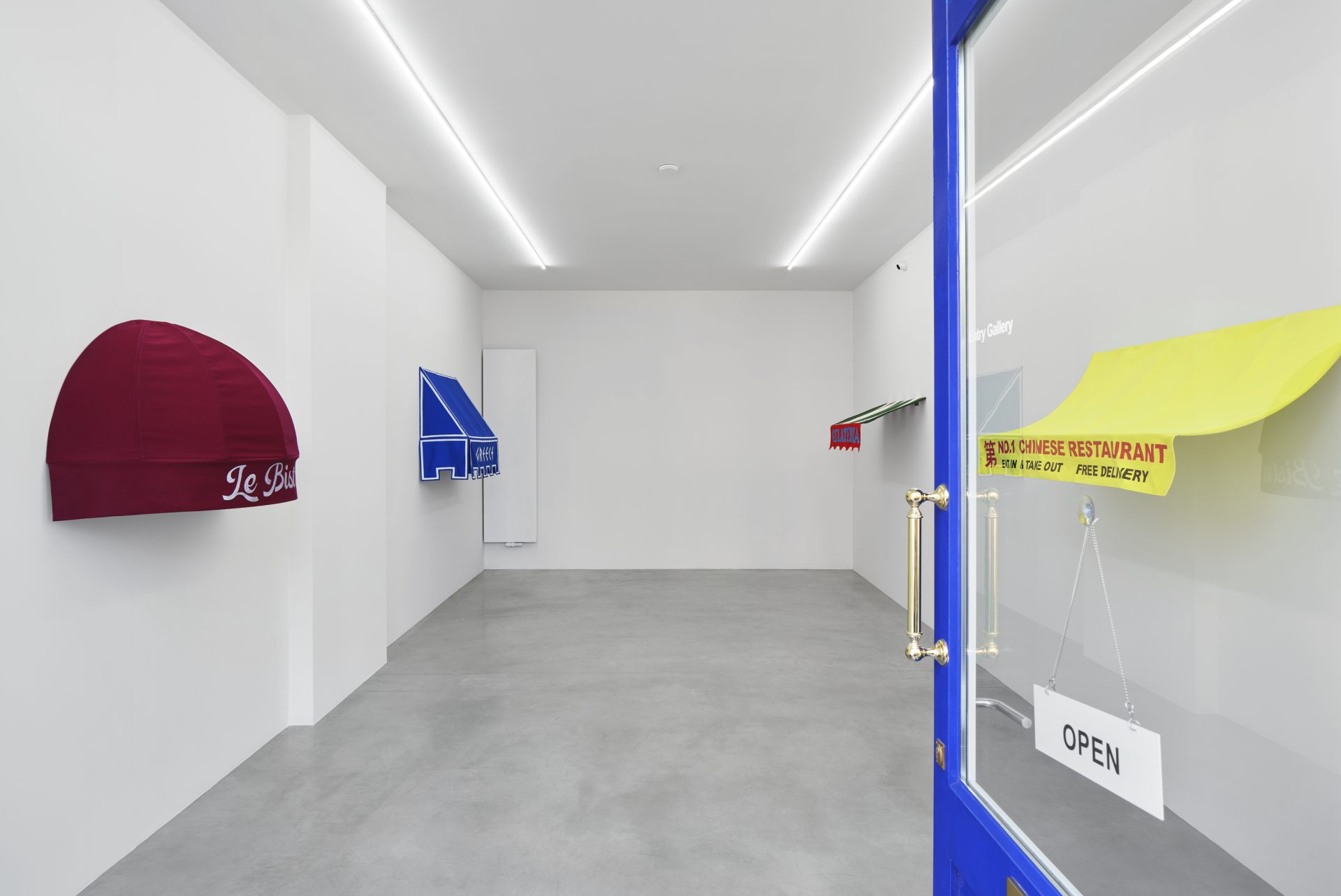
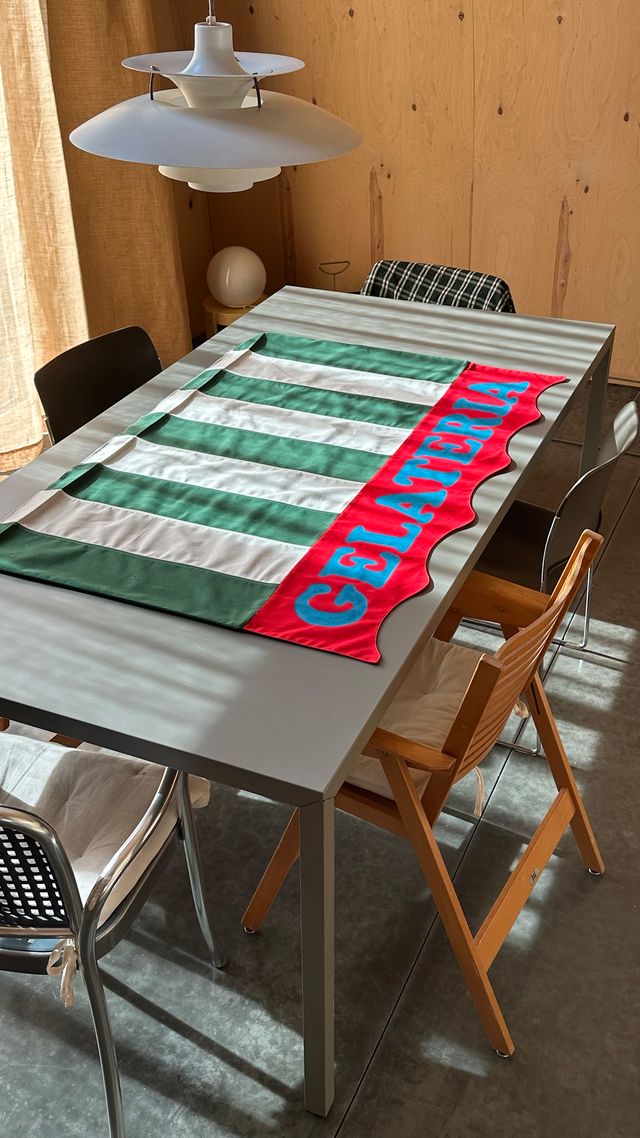
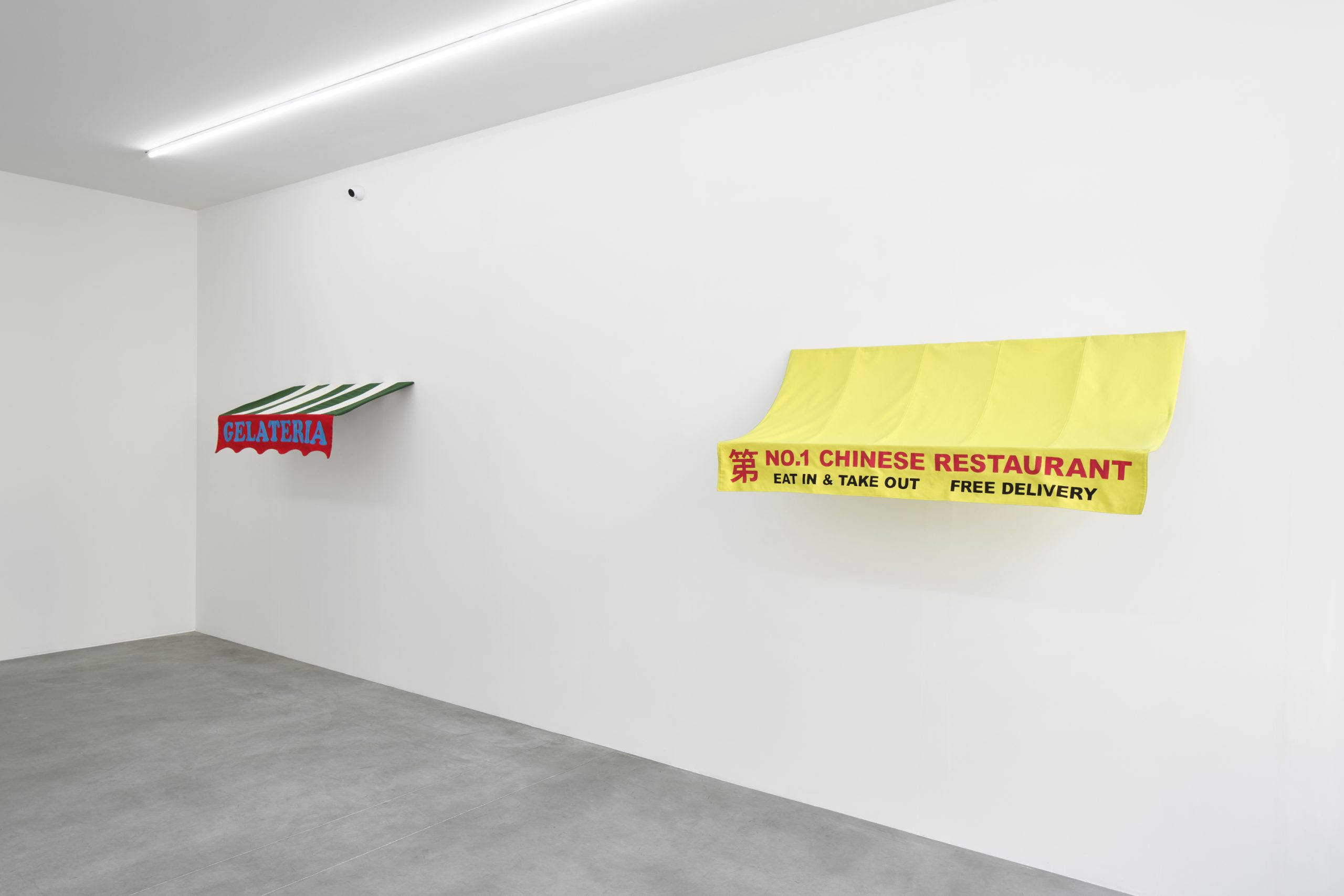
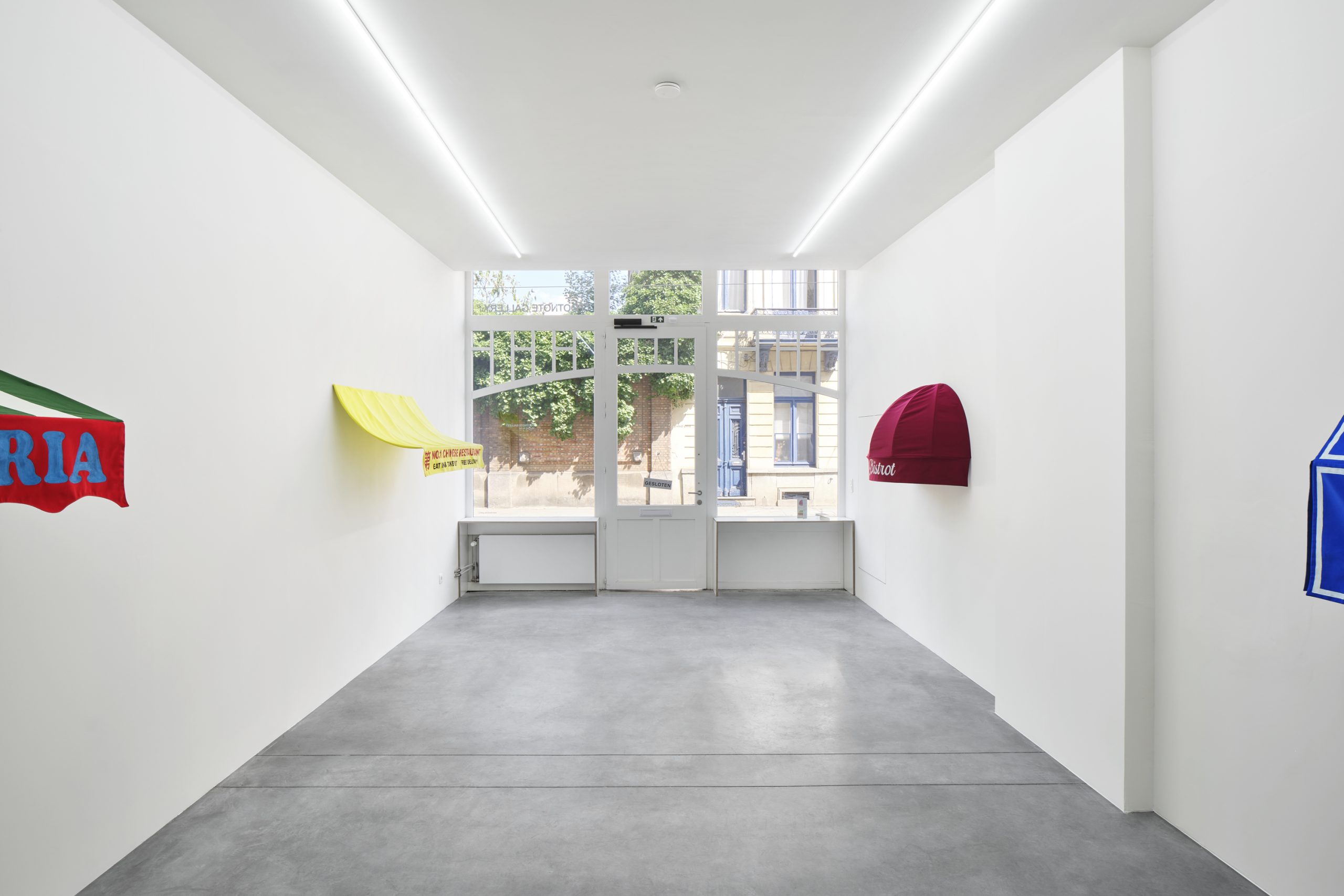
When I first visited Footnote Gallery, I was struck by the Turkish restaurants with their colourful awnings lining the street. They don’t just provide shelter; they give rhythm, colour and character to the neighbourhood. I’ve always been fascinated by advertising, and awnings are among its most generous inventions.
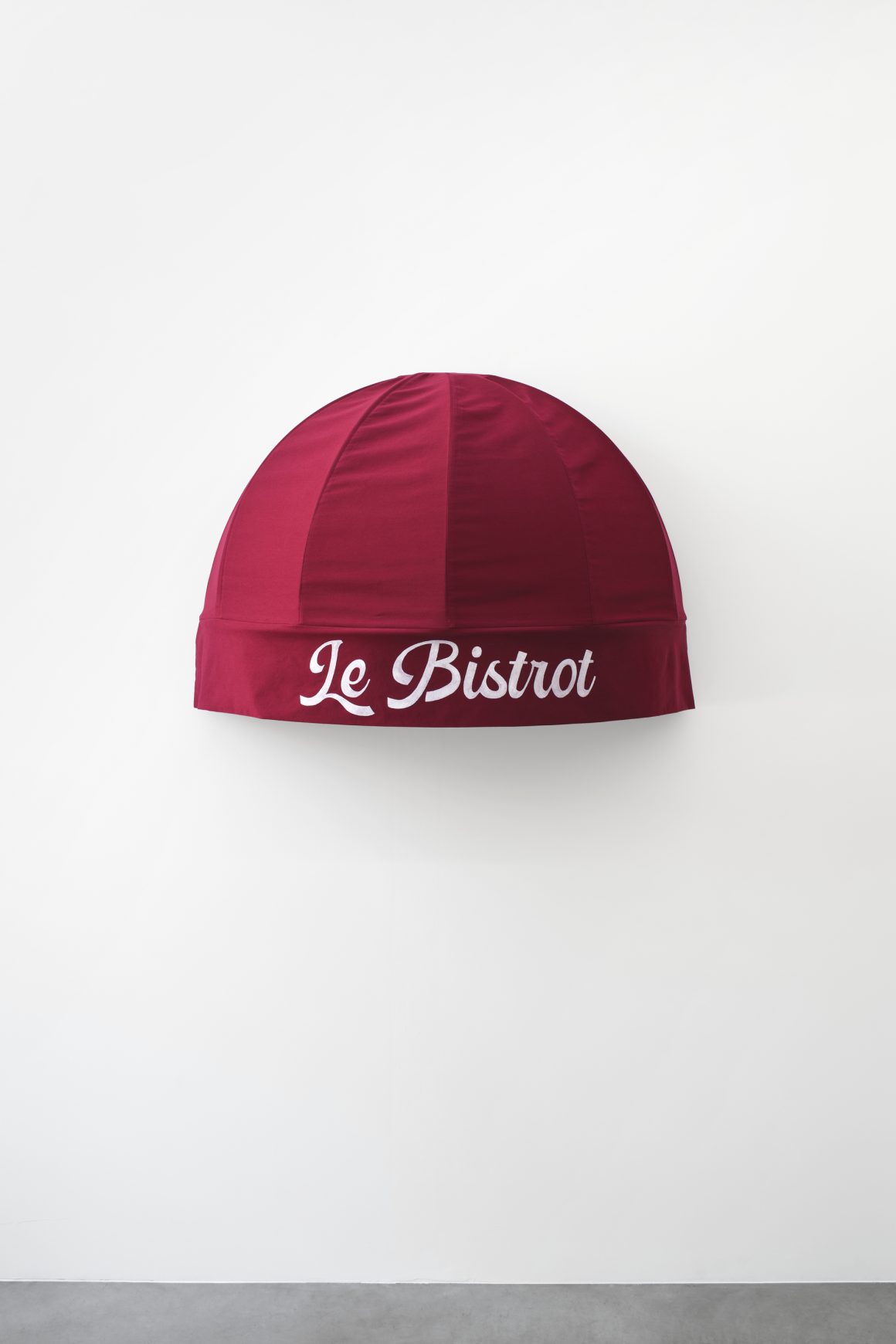
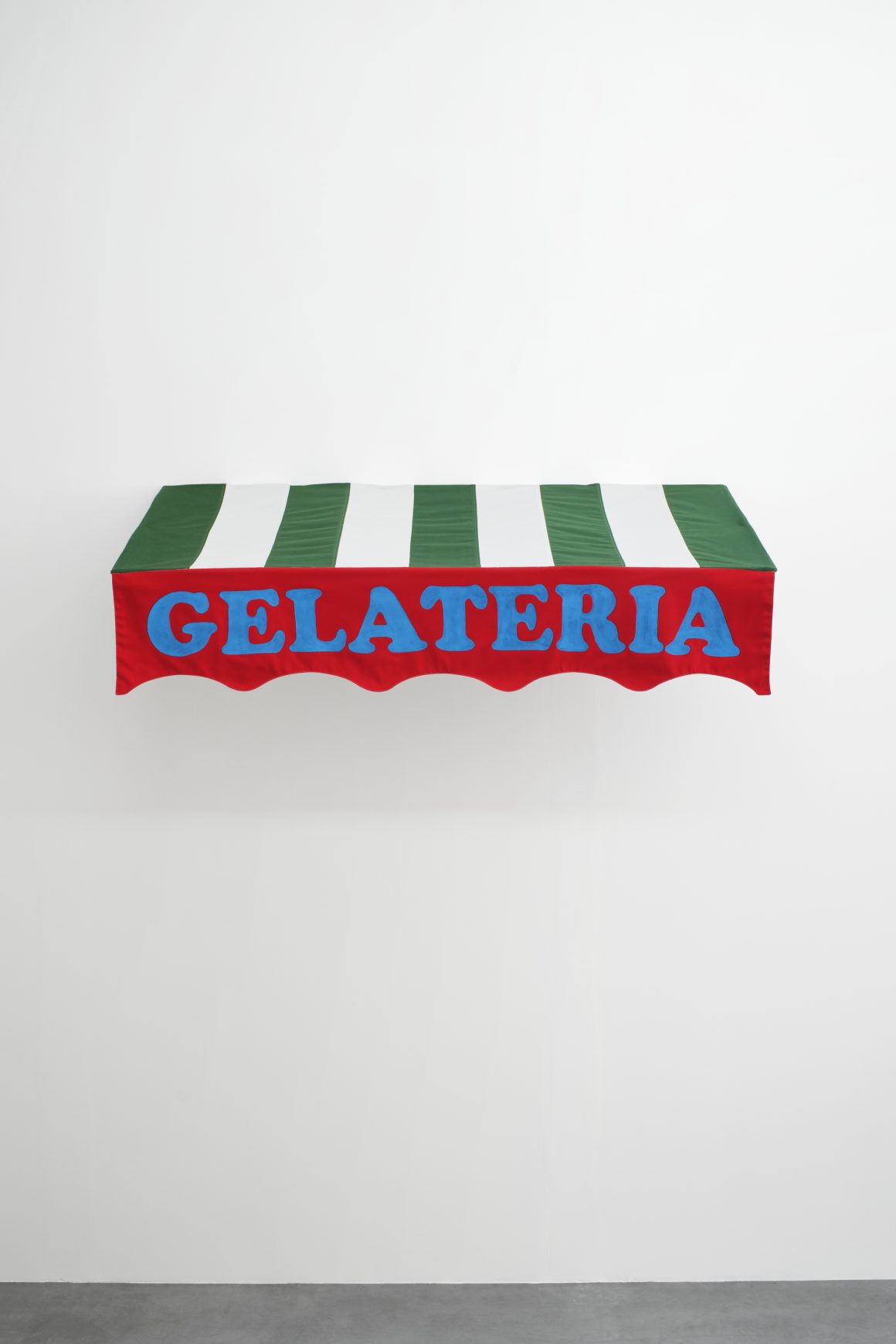
What interests me is the moment when a functional object stops being purely functional and starts becoming an image. Awnings sit somewhere between architecture, advertising and sculpture, and that’s exactly where I wanted this exhibition to exist.
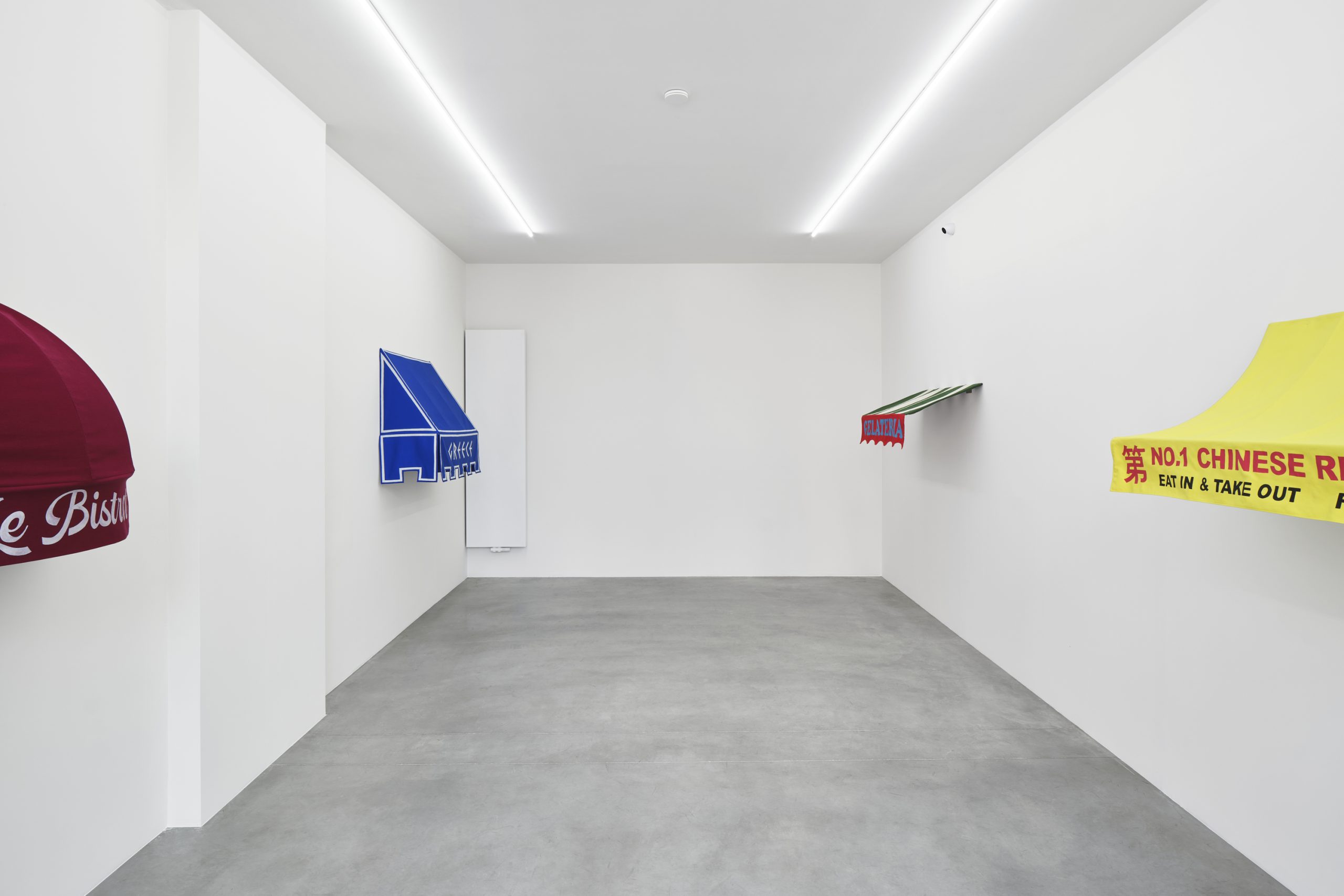
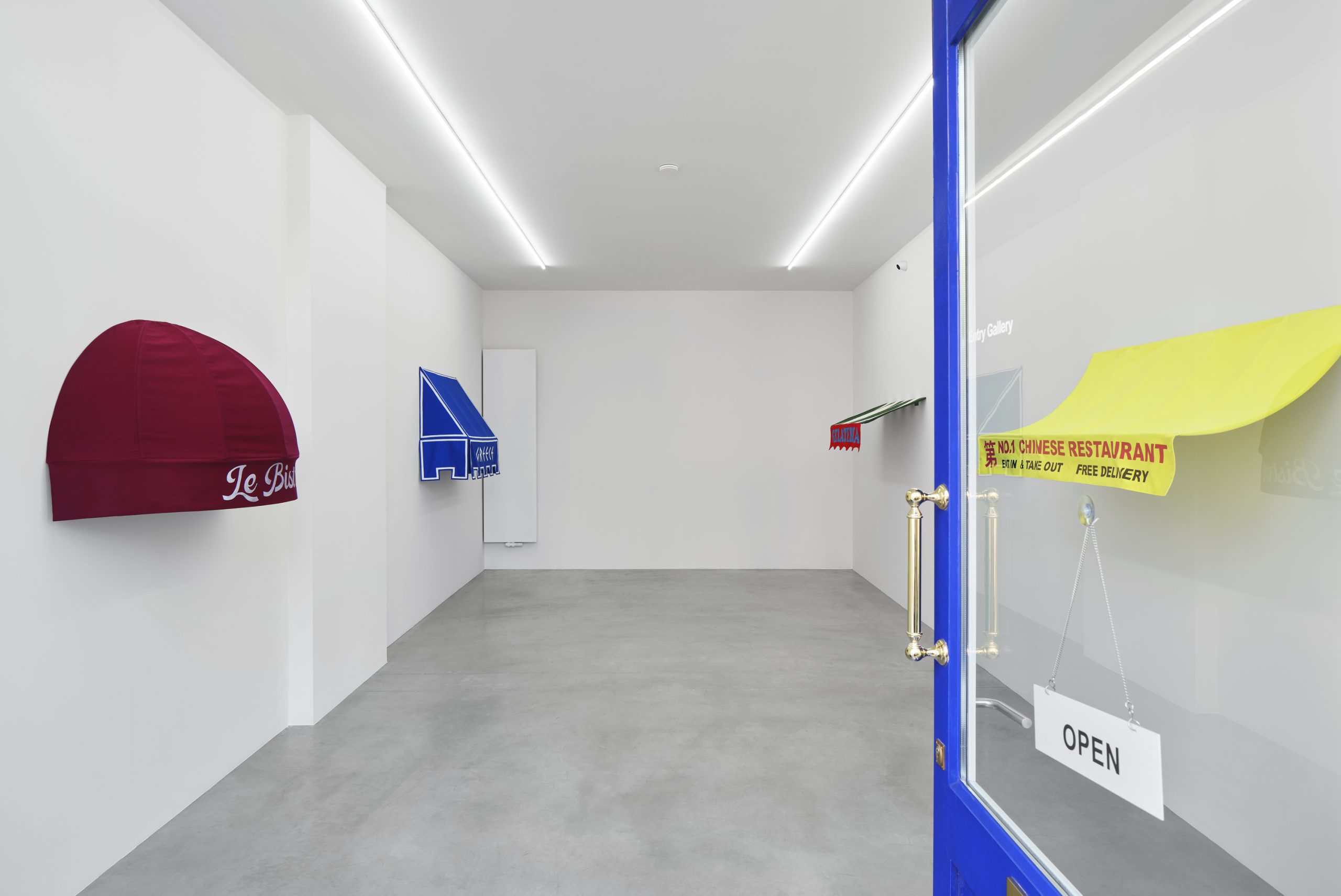
Instead of inviting visitors somewhere else, the awnings became the destination themselves. We built two plastered walls and closed off the back of the gallery so there was nothing left to enter or discover beyond them.
Somewhere in the back of my mind was also Jacques Tati’s Playtime, where a glowing question mark turns into an arrow and accidentally leads someone inside. I love that combination of humour, architecture and gentle misdirection.
Do you have any connection with Greece and how the Greek artwork came out?
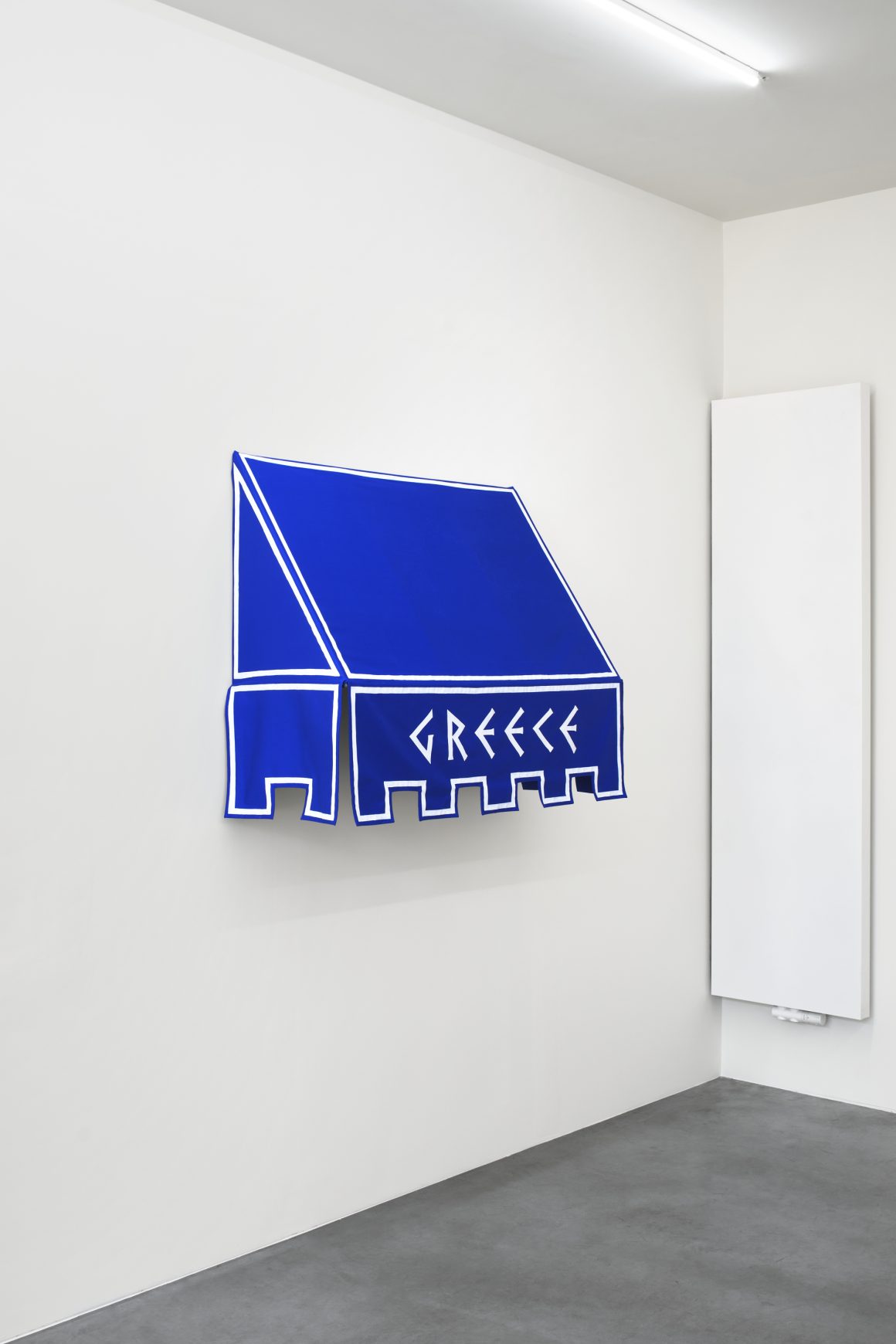
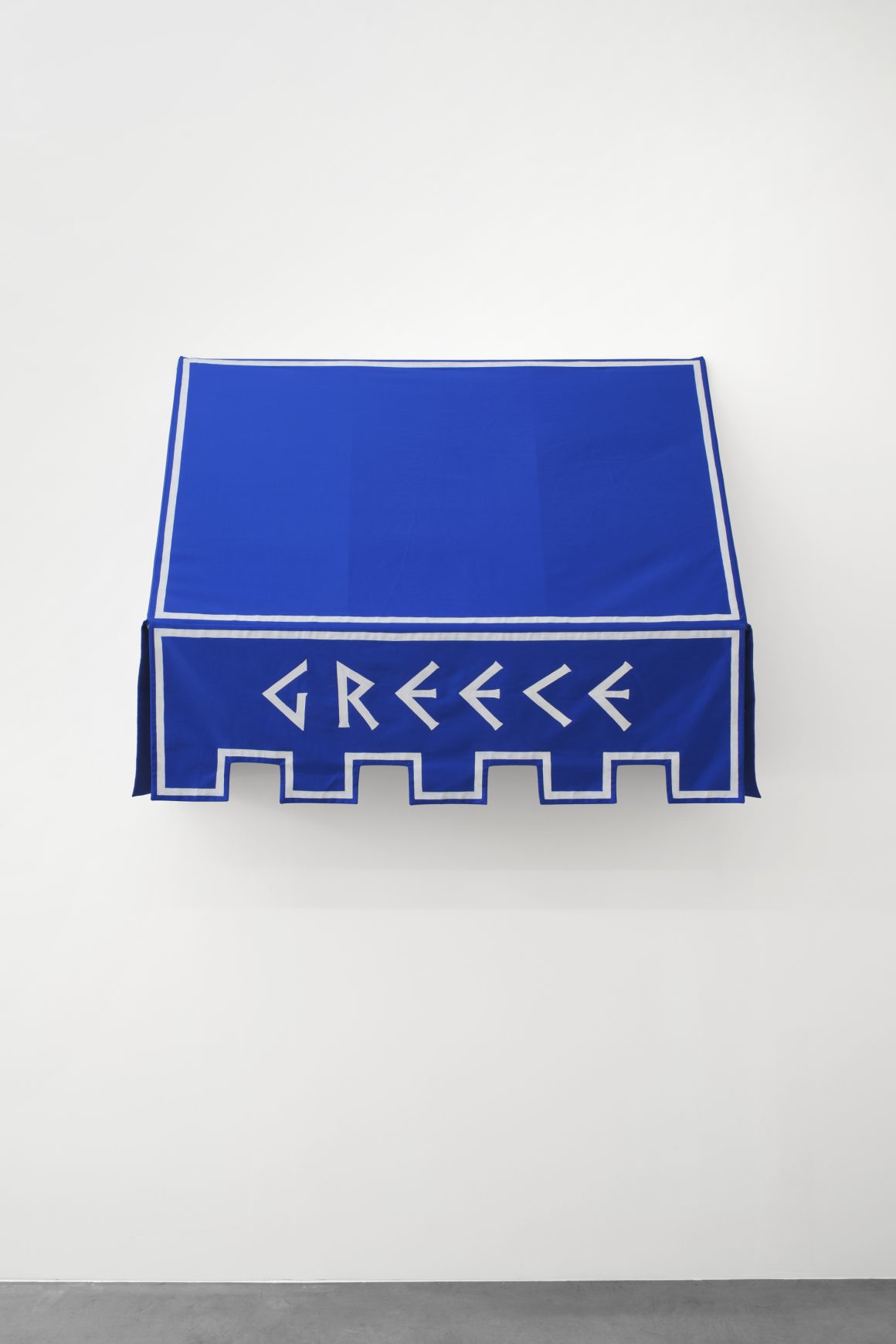
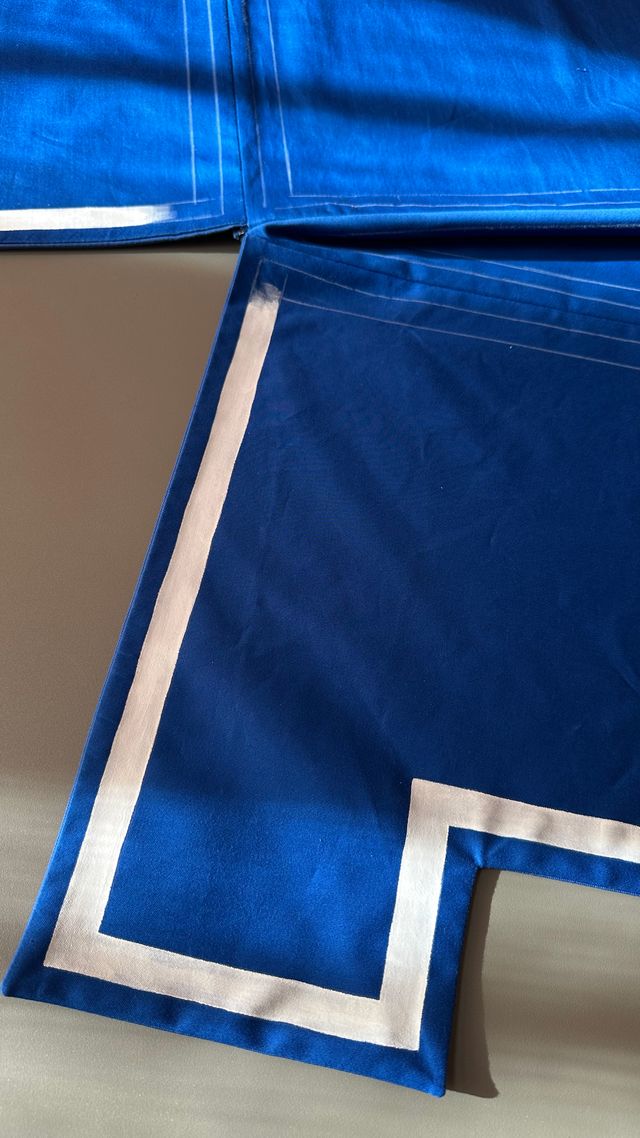
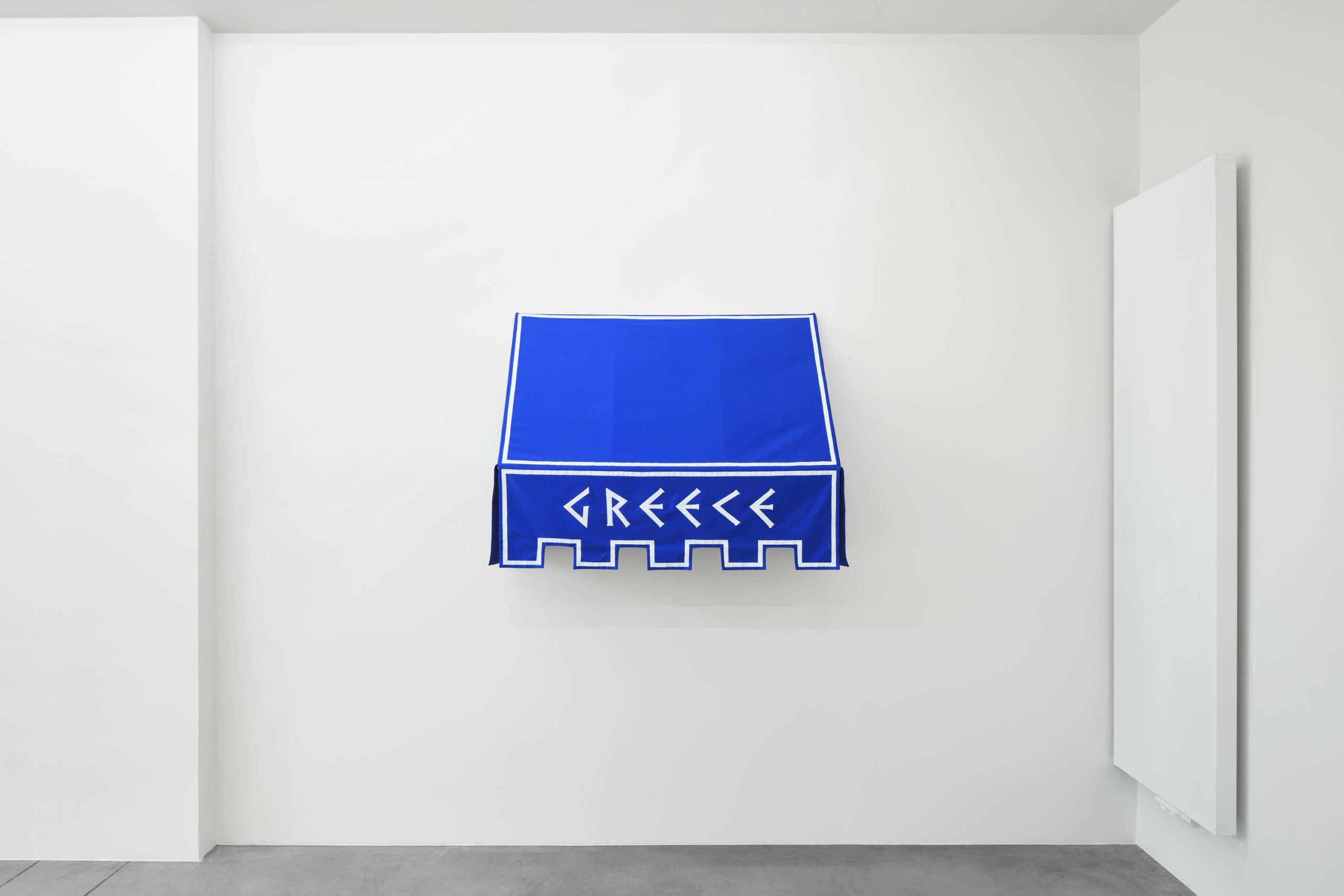
The gallery space was larger than the budget, so I could only make a limited number of works. That meant choosing the most iconic awnings while also creating variation in colour and shape to make the exhibition feel lively. There was never any doubt that Greece had to be included. The notched edge and the Hellenistic typography are the kind of details I never get tired of looking at.
Which is your best ever creation?
In 2018 I made Who Else?, a work in which George Clooney appears thirteen times, each printed in a different Nespresso coffee blend. For me it remains one of those works where image culture, mythology and playful critique blend into the perfect aroma.
What would you consider the main highlights of your career?
I’ve been fortunate enough to work on wonderful projects, from solo exhibitions to a 3D animation or a book shaped like a piece of cheese. Each project has its own possibilities, and right now I’m far more interested in the next one than the previous.
What goals are you pursuing now?
I hope to build lasting relationships with the people and institutions I work with. Mutual trust creates the freedom to grow, experiment, occasionally fail and simply begin again. If I can build a practice around that, I’ll consider myself very fortunate.
In what ways does your art elevate your aesthetics to a new level?
I don’t think the role of art is to make the world more beautiful. I think its real value lies in helping us look more carefully. Everything else follows from that.
Which collaborations have been the highlights of your artistic journey?
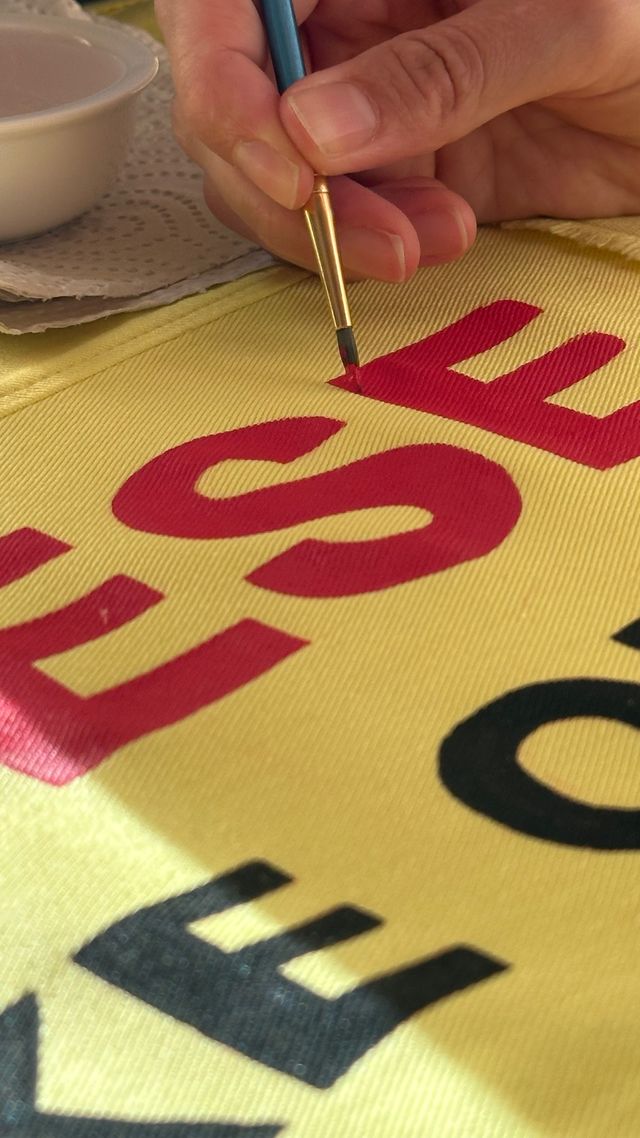
I owe an enormous amount to the many people who help realise my projects. Without their generosity and expertise, none of this would be possible. I often arrive with little more than half an idea and a rough sense of direction. The conversations that follow are where the work really begins.
Your philosophy for design
For me, design is a way of reading history. Objects quietly preserve ideas, values and desires long after the people who made them have disappeared. That’s what keeps me looking.
How do you see yourself in ten years?
The future is like a holiday destination: if you have too precise an idea of what it will look like, you’re often disappointed when it turns out differently. We’ll see when we get there.
Your dream project
My dream isn’t a particular project. It’s to build a self-sustaining practice that gives me the freedom to stay curious, keep experimenting and allow every new project to become genuinely different from the last.
When you enter a room what draws your attention first?
I rarely see a space as a neutral backdrop. The architecture, the street and the institution all become part of the work. At Footnote Gallery, that meant radically altering the space because the exhibition only worked once the gallery itself became part of the idea.
The designer and the artist you adore
Since I’m sitting in one of his chairs, I’d like to mention the Slovenian designer Niko Kralj. His Rex folding armchair is, to me, a perfect balance of comfort, elegance and practicality.
As for artists, Megan Francis Sullivan is someone I greatly admire. We don’t make the same work, but I recognise a similar curiosity about how images, objects and context shape the way we see things.
An exhibition you will never forget
Since 2010, Wade Guyton and Stephen Prina have exhibited together almost every year at Petzel Gallery in New York. It’s one of the most convincing examples I know of a collaboration that never asks either artist to compromise. They remain completely themselves, and that’s precisely what makes the exhibitions so memorable.
The best bit of advice you ever received and the one you gave
“Energy: Yes! Quality: No!”
I first came across that sentence in a stapled collection of writings by Thomas Hirschhorn. It happened to be the cheapest thing I could find in the museum shop of the Bonnefanten Museum, cheaper even than a postcard. I’ve quoted and paraphrased it countless times since. There are enough interesting minds in the world that I’d rather keep their ideas in circulation than insist on inventing everything myself.
The most emblematic design piece of all times
I’d probably choose a spoon. A friend of mine once photographed the makeshift photo studios reflected in the polished surface of antique spoons offered at auction. I’ve always thought that was a perfect metaphor for design. A good object helps us engage with the world while quietly changing the way we see it.
Your design motto
If I had to choose one, it would be: “Curiosity before consistency.” Everything else tends to follow from that.
The last thing you bought and loved
Probably a book or a work by a friend. Those are the purchases I rarely regret.
Your favourite work of art
I’m torn between Martin Kippenberger’s MOMAS and METRO-Net. I’ve always admired the ease with which he turned functional objects into works of fiction. Looking back, I suspect my own awnings have more in common with METRO-Net than I realised while making them. Like his metro entrances, they point towards something beyond themselves, only to become the destination instead.
Favourite guilty pleasure?
Packaging. Especially when it’s trying just a little too hard.
What’s on your reading list?
I just finished Lucassen en Ger van Elk… zogezegd by Roland Patteeuw. I’m currently reading Een schilder in Parijs by Eric Min, and next up is Flowers by Ed Atkins.
Any recent discovery?
Last weekend my wife and I visited Manifesta 16 in the Ruhr region. Every exhibition took place inside a church, making the architecture inseparable from the work. I always enjoy exhibitions where the context is as carefully considered as the artworks themselves.
What are three places you return to time after time and why?
I’d happily return to Kunsthaus Bregenz. It’s one of those museums where the architecture reshapes the way you experience the work. Museum Ludwig in Cologne is another favourite, thanks to its outstanding Pop Art collection and consistently strong programme. I’ve also been meaning to revisit the Kröller-Müller Museum for years. Between the collection, the sculpture garden and the Hoge Veluwe National Park, it always feels like a complete journey rather than just a museum visit. Ask me again tomorrow and the list will probably be different.
At your dream dinner party… And you’d invite
I’d probably invite half my bookcase. It would make for an impossible conversation, which is exactly why it sounds so appealing.
Your definition of beauty
I’ve always trusted curiosity more than beauty. It’s served me well so far.
What is Authentic for you?
Fortunately, authenticity isn’t something you get to decide. It’s something other people might recognise.
If you designed something for TheAuthentics.gr what this would be?
Earrings shaped like life buoys.
Photo credits:Exhibition views © Thomas Min
Exhibition: The Menu
From 17 July, artist Egon Van Herreweghe presents The Menu at Footnote Gallery in Ghent. For this exhibition, he has developed an entirely new series of sculptures, created specifically for the gallery and its surroundings.A menu sets expectations about what lies ahead. So does an awning. Before you even enter a building, it gives the façade a face and suggests the kind of experience waiting behind it. This idea forms the starting point for The Menu.The gallery is located on Sint-Salvatorstraat, a street known for its many Turkish restaurants. Striking façades, colorful awnings, and illuminated signs define the streetscape. They capture attention, create expectations, and give each establishment its own distinct identity.
An awning is an invitation. Before you step inside a building, it already tells you something about what you expect to find. I wanted to detach that moment of anticipation from the architecture and make it visible as sculpture. Although the gallery itself has no awning, that absence became the starting point for the exhibition. Van Herreweghe has brought four sculptural awnings into the exhibition space. Removed from theiroriginal function, they become objects that feel both familiar and strange. They offer no shelter, yet invite visitors to come closer.
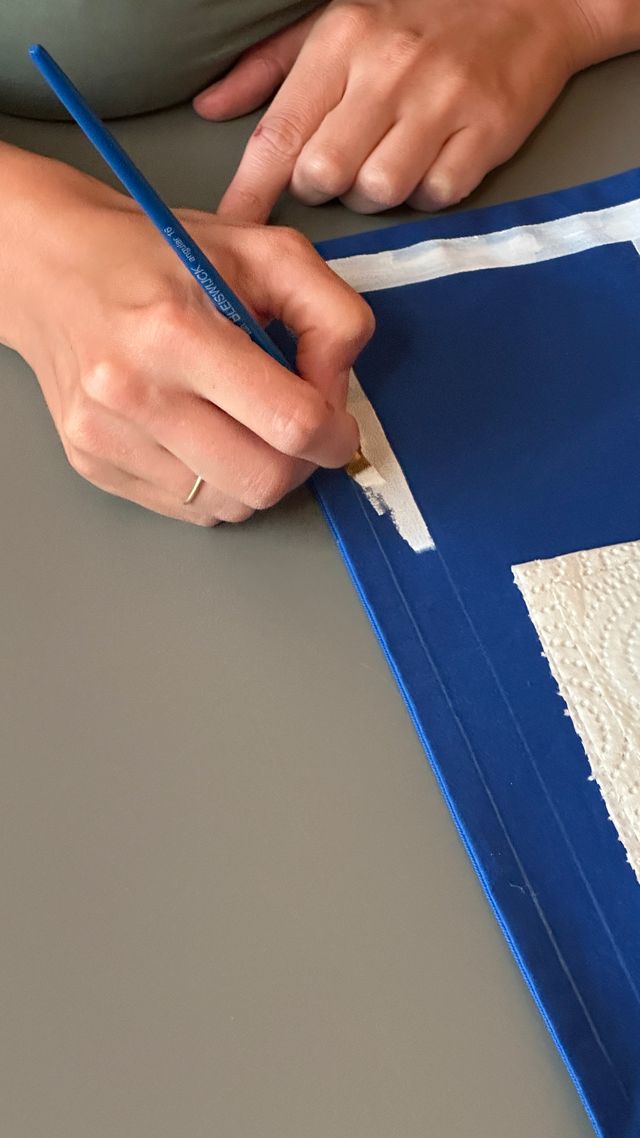
The sculptures reveal how seemingly simple architectural elements guide our perception and shape the way we experience a place. In a street where restaurant façades evoke atmosphere and cultural identity, the awnings become carriers of expectation and recognition.In his practice, Egon Van Herreweghe draws on everyday objects and the visual language of shops, brands, and commercial environments. By having these objects meticulously fabricated and placing them in a new context, he shifts their meaning. His work invites viewers to reconsider ideas of authenticity, value, and authorship.
Footnote Gallery, Sint-Salvatorstraat 125, 9000 Ghent, Belgium
Until 29 August 2026