Few objects sit at the crossroads of design, craftsmanship and everyday life quite like the chair. In The Only True Protest is Beauty, chairs become a thread that reveals how contemporary makers reinterpret function, memory and material.

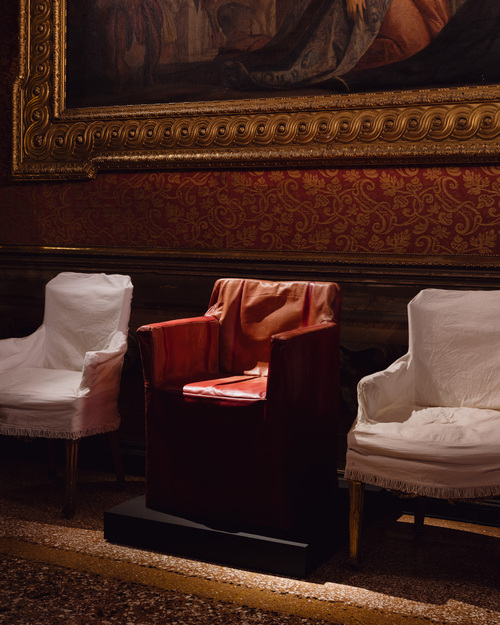
The journey begins with Moreno Schweikle‘s ‘Ageism’, which asks why the marks of age enrich an antique while diminishing an everyday object. By reworking the worn leather of a Le Corbusier LC2 armchair into a slipcover for a standard conference chair, he transfers history, patina and emotional value onto an anonymous object, reversing the logic of preservation.

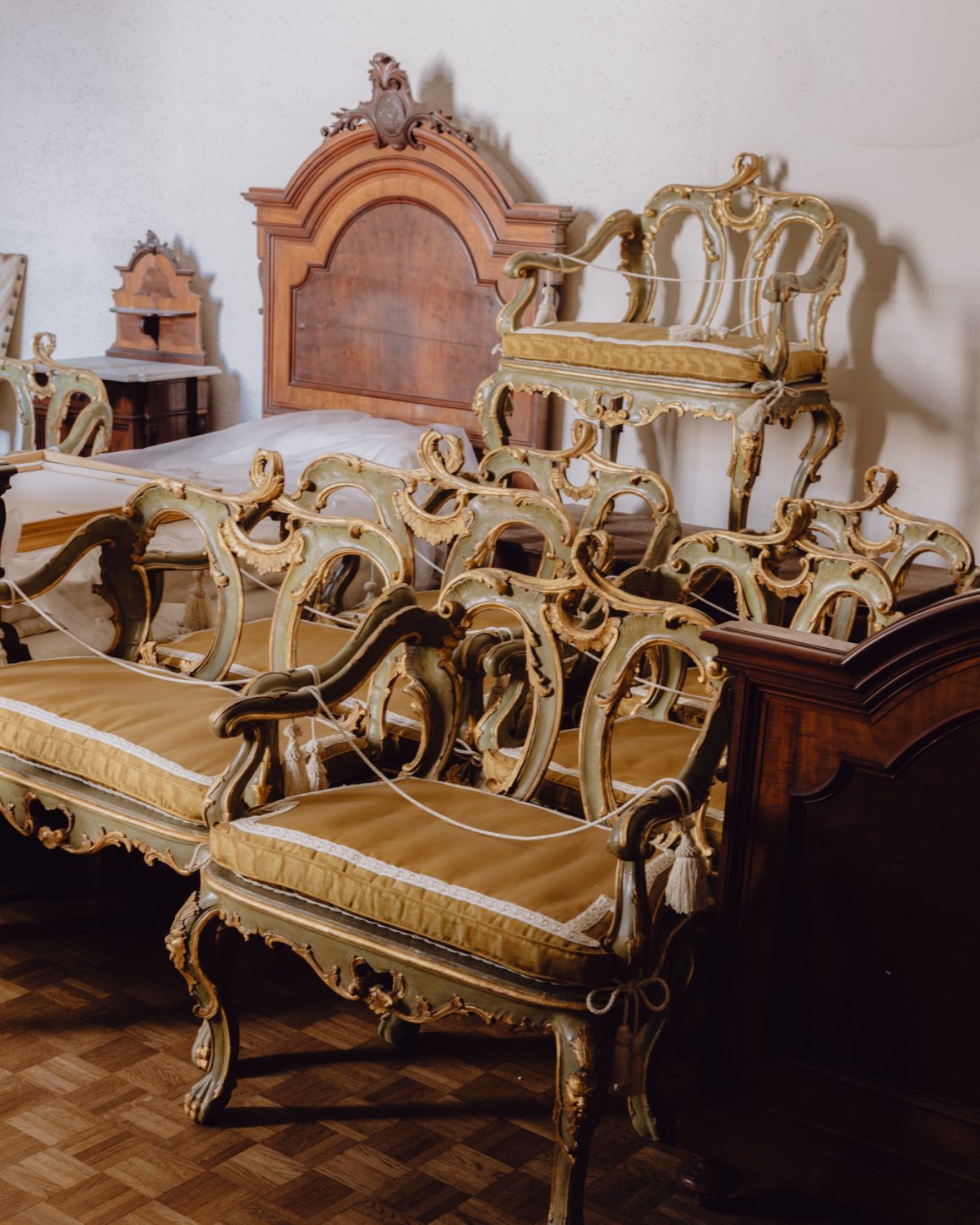
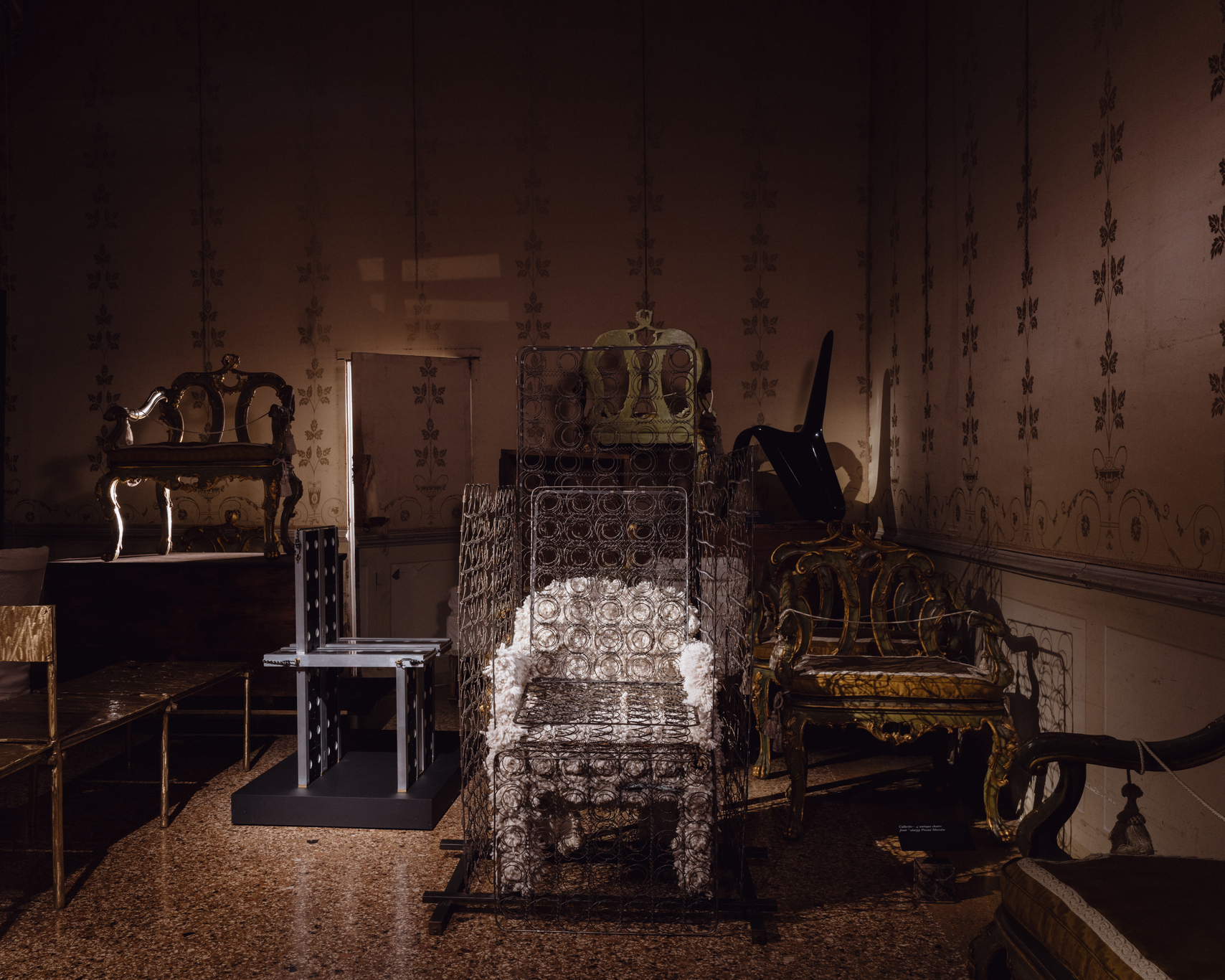
The conversation continues in what was once Palazzo Pisani Moretta’s storage room. Contemporary chairs are presented here alongside the palace’s own eighteenth-century seating: French in style, crafted by Venetian artisans around 1730, and originally commissioned for specific rooms within the Palazzo. Too fragile to be used today, these historic pieces become a fitting backdrop for a new generation of designers exploring transformation through making.

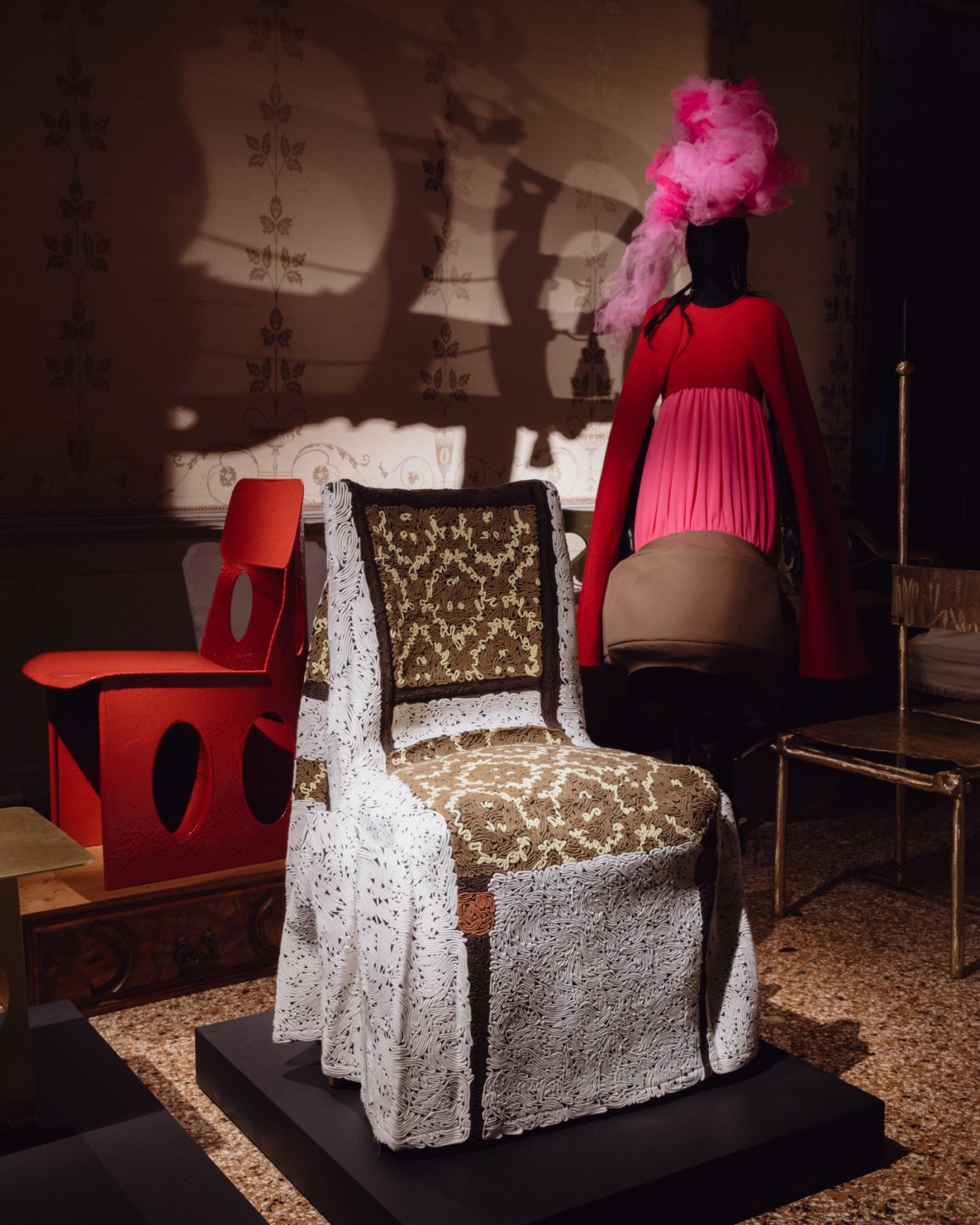
Wendy Andreu’s Empire Ghost Chair begins with a traditional Empire chair, which is used as a mould to create a new structural core. Wrapped in ropes that recreate the decorative pattern of the original upholstery, the chair hovers between presence and absence: familiar in silhouette, yet entirely reimagined in material and construction.

Chris Fusaro’s Model 3468 takes the opposite approach. Made from moulded fibreglass, its continuous form exaggerates the structural language of mass-produced plastic furniture – curved surfaces, softened edges and transitions – distilling them into a single sculptural volume.
Lionel Jadot approaches the chair as an act of reinvention, assembling obsolete objects and personal memories into unexpected forms. His works transform discarded VHS players and a family heirloom into contemporary seating, demonstrating how existing objects can acquire entirely new identities. Nifemi Marcus-Bello‘s The Daybed, inspired by the Agadaze traditional Tuareg bed, is cast entirely in bronze, merging seating, architecture and ritual into a single form.

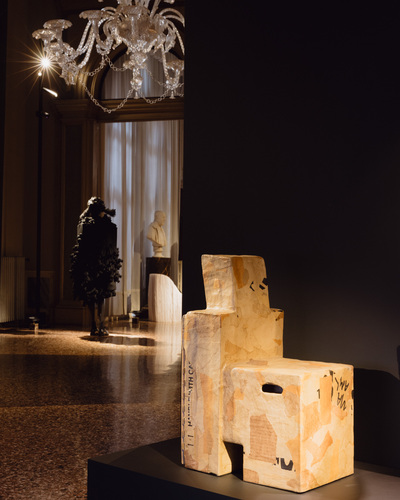
Elsewhere, Seongil Choi transforms wire mesh through successive layers of polyurethane rubber until it becomes self-supporting, balancing fragility and strength. Lastly, Max Lamb works from discarded cardboard, compressing and reconstructing packaging into the (2.10) BOX Chair, a dense papier-mâché structure that elevates waste into form.

All these exquisite experimentations reveal that craftsmanship is not defined by a single material or technique. It exists equally in restoration and reinvention, in digital fabrication and hand assembly, in bronze casting, fibreglass moulding, weaving and stitching. Across the Presentation, the chair becomes the perfect medium through which to explore the many ways beauty is made.


Until October 4, 2026
 
Fondazione Dries Van Noten 
Palazzo Pisani Moretta 
San Polo 2766, Venezia

Author