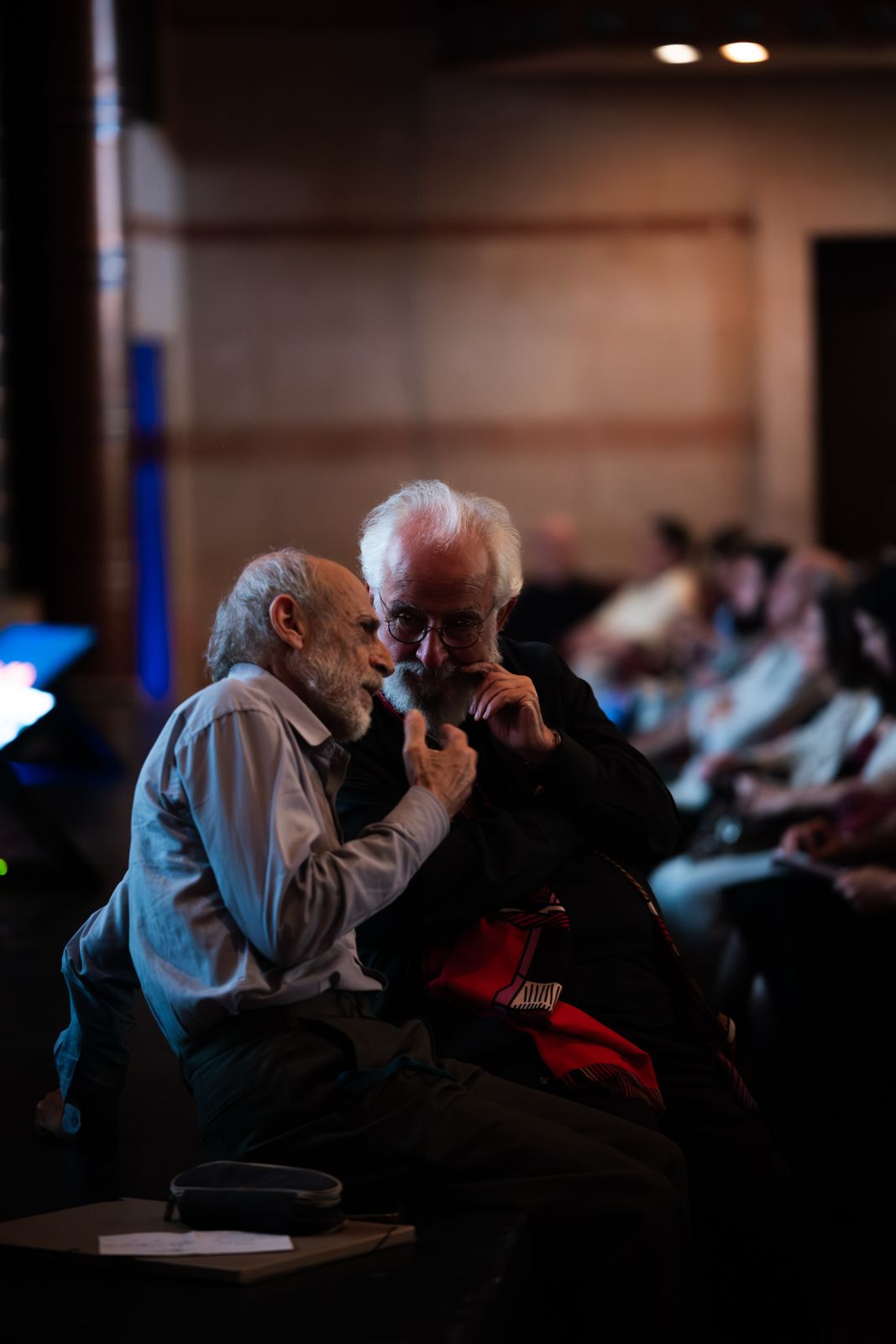
The ESO 2026 conference concluded with great success on Wednesday, May 13, at the Alexandra Trianti Hall, reaffirming once again its role as one of the most important events for architecture and contemporary creative thinking and production in Greece. Centered around the theme “Negotiation, Not Compromise. Design as a Dialogue Between Earth, Technology and Humanity,” this year’s edition highlighted architecture as a dynamic process shaped through the continuous interaction and feedback between people, technology, and the environment. The content was created by Archisearch, with production direction and artistic curation by Design Ambassador.

The audience had the opportunity to attend nine presentations by distinguished figures from the Greek and international architectural scene, all leading voices in orchestrating the future experience of architectural design.

The conference opened with a roundtable discussion dedicated to the 100th anniversary of the birth of Takis Ch. Zenetos, featuring architect and researcher Dora Theodoropoulou, visual artist Elina Theodoropoulou, architect and curator Giorgos Tzirtzilakis, and Elina Zenetou, daughter of the architect.

The discussion was inspired by an audiovisual work — a creative exploration by Dora and Elina Theodoropoulou — described by Elina as “a work within a work.” Through the speakers’ reflections, Zenetos’ pioneering vision emerged: an architect who understood architecture as an open field where technology, the city, and human experience coexist, long before the rise of today’s digital era.

The creator’s way of life, his relationships and personal conflicts, alongside his talent and vulnerability, helped sketch the portrait of a visionary who moved “beyond the limits” and made “the stars dance,” as Giorgos Tzirtzilakis characteristically noted.

The issue of materials and construction methods was brought into focus during the discussion between Danae Makri and Christoforos Voulgaris, Concrete Business Unit Director at Interbeton. Referring to the 21st century, Voulgaris spoke about the urban landscape, the structure of cities, construction, and the mechanisms behind their production. Concrete, although an old material, still remains — according to him — a material full of possibilities, capable of being modified, adapted, and even self-repaired.

“Material alone, however, is not enough. We also need the architectural narrative,” noted Voulgaris.

The talk by Ourania Pikramenou, architect and co-founder of dePlot Architects, followed. Through the presentation of the studio’s projects, she addressed the need to create “buildings capable of transforming over time” and to understand sustainability as the very possibility of inhabitation. “What is sustainable is what is inhabitable,” she characteristically stated.

“We do not compose from nothing; we interpret what already exists.”

Starting from this statement, Eleni Tsigarida, architect and founder of Etsi Architects, spoke about “projects that negotiate a new way of designing that allows continuity.” Her presentation revolved around three projects — an olive mill, a stone-paved path, and a public square in Mani — all of which approached “architectural design as a story of evolution, a living archive.”

The presentation by Loukas Bobotis, architect and co-founder of Bobotis+Bobotis Architects, highlighted the “edge effect” as a creative approach linked to the search for balance between negotiation and compromise.

Through personal stories and observations, Bobotis explored the contradictions and conflicts that shape our worlds, while speaking about how design must seek connection and encounter between different forces and fields.

Caroline Bos, architect and founding member of UNStudio, presented the studio’s international experience through projects related to the transformation and regeneration of urban landscapes and building structures. In Bos’ approach, architectural production emerged as a negotiation between people and places, between past, present, and future, as well as between local identity and international systems.

As she characteristically noted, “an architectural project only carries real value if it attracts people to use it.”

As part of ESO 2026, the eighth edition of the Archisearch Lifetime Achievement Awards also took place, honoring three distinguished figures of Greek creative thought. The awards were presented by Panagiotis Pangalos, architect and professor at the University of West Attica and the Hellenic Open University, who introduced and welcomed the honorees to the ESO stage.

Engineer and inventor Dimitris Korres was honored for his significant contribution to engineering, particularly through the construction of pioneering vehicles and the transportation of historic monuments, combining technical ingenuity, practical expertise, and innovative construction solutions.

Architect and academic Andreas Kourkoulas received an award for a groundbreaking body of built architectural work that connected theoretical thought with construction and the collective experience of public space.

Describing herself as a “dyed-in-the-wool anti-consumerist,” Leda Papaconstantinou, one of the first Greek performance artists, was recognized for her radical contribution to contemporary Greek art through deeply experiential work created in direct connection with the audience.

Following a short break, Maria Deda, architect and founder of Deda & Architects, invited the audience on an architectural promenade along the waterfronts of Thessaloniki and Athens through the presentation of the studio’s projects. The principles shaping the studio’s architectural and compositional decisions revolve around timelessness, integration, sustainability, and comfort.

Beat Huesler, architect and Director Europe at Oppenheim Architecture, presented the studio’s practice in his lecture titled Spirit of Place. Through projects of varying typologies, he explored the fusion between natural landscapes and architecture. By developing construction innovations and experimenting with new materials and techniques, Oppenheim Architecture realizes architectural ideas of complex forms.

“We choose to build with the earth, not on the earth,” he emphasized.

The conference concluded with a lecture by Winy Maas, architect and founding member of MVRDV. Positioned between research and design, the global and the local, the human and the non-human, the individual and the collective, the creator and the team, Winy Maas’ consistently pioneering thinking presents architecture as a tool for imagining future scenarios and new ways of living. Architectural manifestos, contemporary expressions of urban life, experimental forms, and social critique come together in the work of a creator who expanded the limits and possibilities of contemporary architectural practice.

With more than 1,400 participants, ESO 2026 concluded by reaffirming the importance of collaboration, research, and creative negotiation as essential tools for the future of architectural design.

Event Details
Conference Title: ESO 2026 – “Negotiation, Not Compromise. Design as a Dialogue Between Earth, Technology and Humanity”
Format: Conference & Architecture and Design Symposium
Location: Alexandra Trianti Hall
Date: Wednesday, May 13, 2026

Content Creation & Media Sponsor: Archisearch.gr
Production Direction & Artistic Curation: Design Ambassador

Photography: Houlaki Studio for Design Ambassador

Author