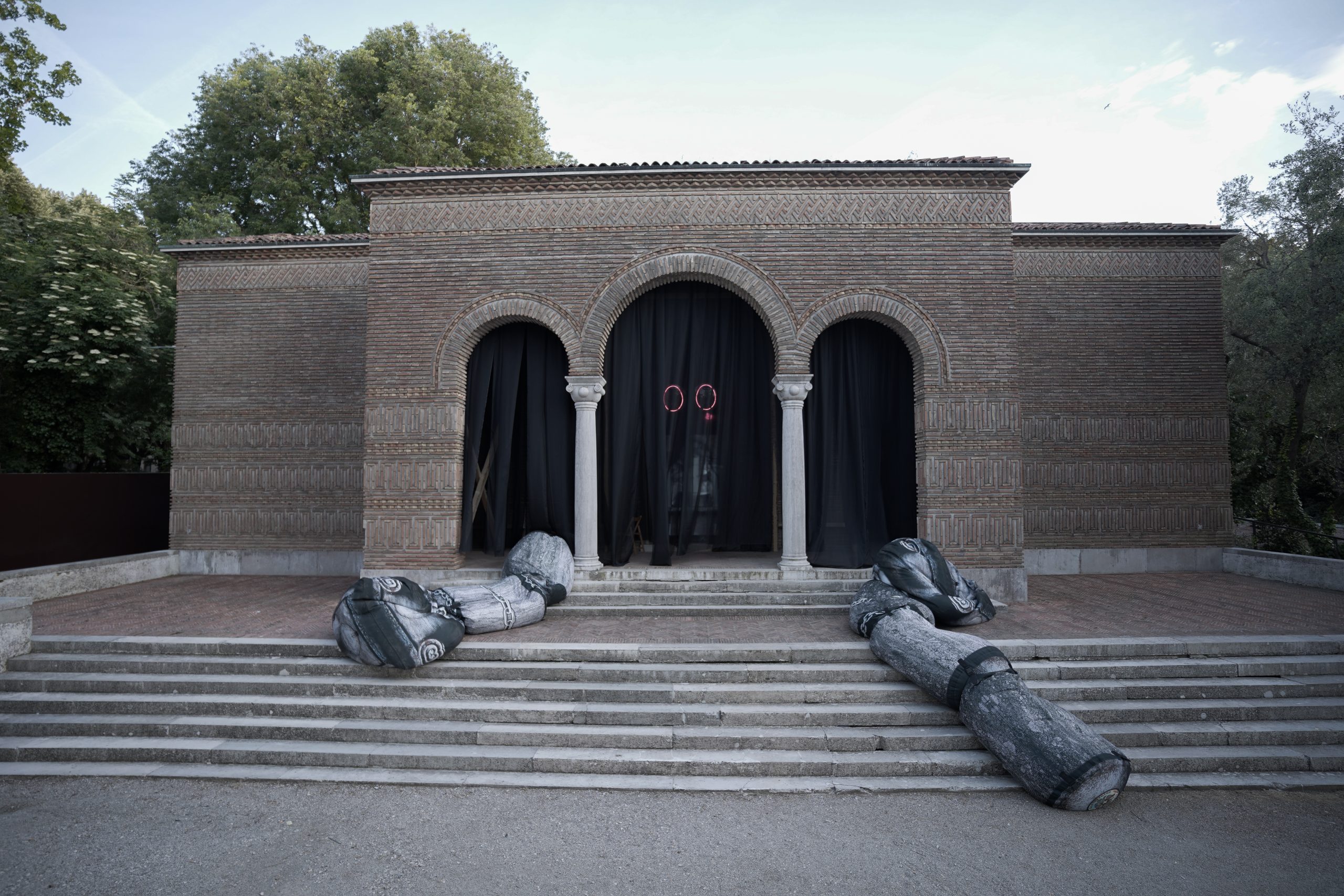
The Greek Pavilion at the 61st La Biennale di Venezia has opened to the international public with “Escape Room”, an installation by internationally acclaimed artist and architect Andreas Angelidakis, curated by Giorgos Bekiaris and commissioned by MOMus – Metropolitan Organisation of Museums of Visual Arts of Thessaloniki. The official opening took place on the evening of Thursday, May 7, 2026, while the exhibition will remain on view until November 22, 2026.
“The national pavilion is divided in two: the National and the Pavilion. Both operate like the mechanisms described by Plato in the Symposium,” Andreas Angelidakis stated, having transformed the space into a labyrinth of images, objects, architectural fragments, videos, and “souvenirs” of Greek history and identity. The installation unfolds as a contemporary Platonic cave, where history, ideology, and national narratives are simultaneously produced, repeated, and deconstructed.
At the centre of the installation, an imprisoned surveillance camera continuously films itself. Scattered throughout the space are dozens of objects and references that function as small “lectures” or fragments of collective memory: the year of the Greek Civil War, when Greece did not participate in the Biennale and Peggy Guggenheim rented the Greek Pavilion to present works by Cubist and Surrealist artists that were then considered images of anti-fascist art; a small memorial to Vasso Katraki at the pavilion entrance; and references to Yannis Tsarouchis, Zak Kostopoulos, and Maria Beikou.
“I will certainly not speak to you about the artistic work itself, as there are others far more qualified than me to do so. Besides, I believe this work is so striking and so powerfully constructed that it speaks for itself — it speaks to everyone,” stated Deputy Minister of Culture for Contemporary Culture, Iason Fotilas, during the opening of the Greek Pavilion. “What I would like to focus on instead is what remains unseen: the work carried out at the Greek Pavilion by our national commissioner, MOMus – Metropolitan Organisation of Museums of Visual Arts of Thessaloniki. The work behind the interventions, the security systems, the constructions, and the infrastructure, so that this installation could be presented in its complete form and without limitations. Organisational work is successful when it is invisible — when it allows the artwork and the artist to speak freely, when it allows the work to stand on its own. The Ministry of Culture, Minister Lina Mendoni, and I personally have always been and continue to be at the disposal of the commissioner, the artist, and his team, in order to present an important proposal that I am certain will spark meaningful dialogue. I would also like to thank the strategic supporter of the Greek participation, the Onassis Foundation, as well as all supporters of the Greek presence.”
Epameinondas Christofilopoulos, President of MOMus – Metropolitan Organisation of Museums of Visual Arts of Thessaloniki, stated: “A few months ago, we undertook with enthusiasm and a sense of responsibility the role of national commissioner — an appointment that gave us the opportunity to support a particularly ambitious undertaking and contribute meaningfully to Greece’s presence in Venice through Andreas Angelidakis’ ‘Escape Room’. With the unwavering support of the Ministry of Culture, we implemented an extensive and demanding project within an exceptionally limited timeframe. Today, we stand before the result with the conviction that visitors to the Greek Pavilion will experience something truly meaningful.”
A special publication accompanying the installation “Escape Room” was also released, in which curator Giorgos Bekiaris writes, among other things: “‘Escape Room’ presents to the viewer an analogy of life under the shadow of capitalism. The traces are everywhere. The game from which we must escape is not a room, but a deep dark cave, fortified by the buzzing of millions of images circulating across our screens. Real and surreal realities collide on platforms that drain our attention while simultaneously serving national agendas and commercial interests. In this work, Andreas Angelidakis reverses spatial hierarchies, creating the paradox of an inhabitable ruin within the digital panopticon. Ultimately, he discreetly offers the audience clues that they may either gather or simply overlook. In essence, it is the viewer who is invited to decide how to exercise their agency and where to direct their attention. After all, it is only a game.”
Andreas Angelidakis’ Escape Room is presented at the Greek Pavilion of the 61st International Art Exhibition – La Biennale di Venezia with the support of the Hellenic Ministry of Culture. The national commissioner is MOMus – Metropolitan Organisation of Museums of Visual Arts of Thessaloniki.
Strategic supporter: Onassis Culture.
About
Andreas Angelidakis
Andreas Angelidakis (b. 1968, Athens) is a Greek-Norwegian architect and artist based in Athens. He studied architecture at the Southern California Institute of Architecture in Los Angeles and later at Columbia University in New York. His artistic practice unfolds through a wide range of interdisciplinary interests spanning architecture, publishing, writing, design, and curating. His works often begin as digital simulations and explore the transformations the internet has brought to perception and user behaviour.
His work is characterised by the use of architectural signifiers and the creation of environments through which he renegotiates the relationship between viewer and artwork, foregrounding the interplay between power, space, and infrastructure. In his practice, architecture becomes a vehicle for investigating identity, while the city of Athens and the notion of the ruin — ancient, contemporary, or digital — reappear as central motifs. Both his installations and writings construct narrative environments that reconsider the boundaries between the real and the virtual, historical memory and fiction, sincerity and humour.
His work has been presented internationally at major institutions including the National Museum of Contemporary Art Athens (EMST), the Onassis Foundation, documenta 14 (Athens and Kassel), the Museum of Contemporary Art Chicago, the Hayward Gallery, ETH Zurich, and the Louisiana Museum of Modern Art. His works are included in major public and private collections worldwide, including EMST, the Onassis Foundation, the Art Institute of Chicago, and the Nasjonalmuseet.
Giorgos Bekiaris
Giorgos Bekiaris lives and works in Athens. He studied Museology and Exhibition Design before pursuing postgraduate studies in Cultural and Film Studies at the National and Kapodistrian University of Athens. Since 2012, he has realised projects with the support of institutions such as the Hellenic Ministry of Culture, NEON Organization for Culture and Development, Onassis Stegi, and Eleusis European Capital of Culture 2023. Alongside his curatorial practice, he regularly collaborates with artists on new productions and with artistic platforms including P.E.T. Projects, ΎΛΗ [matter]HYLE, Souzy Tros, and T.A.M.A.
His texts have appeared in publications including Thanasis Totsikas’ solo exhibition With Minerals and Track Threads at Sylvia Kouvali Gallery (2025) and the catalogue for Ephemeral Party at Carco Parking in Athens (2025). He is the curator of the Greek participation at the 61st International Art Exhibition – La Biennale di Venezia featuring Andreas Angelidakis.
Recent curatorial projects include Institute of Post-Epicurean Garden (Drosia, Attica, 2020–present), Heather stays at 505 at Perianth Hotel (2021), Prizing Eccentric Talents I–III at P.E.T. Projects (2021–2024), Performative Encounters at ΎΛΗ [matter]HYLE (2021), Oikonomia at The Breeder Gallery (2023), Mystery 110 Orpheus for Eleusis European Capital of Culture (2024), and ROOM505: LORE at Perianth Hotel (2025). His curatorial work has been featured in international publications including Artforum, Art in America, ArtReview, NERO Editions, and Artsy.
Photo: Vladimiros Nikolouzos