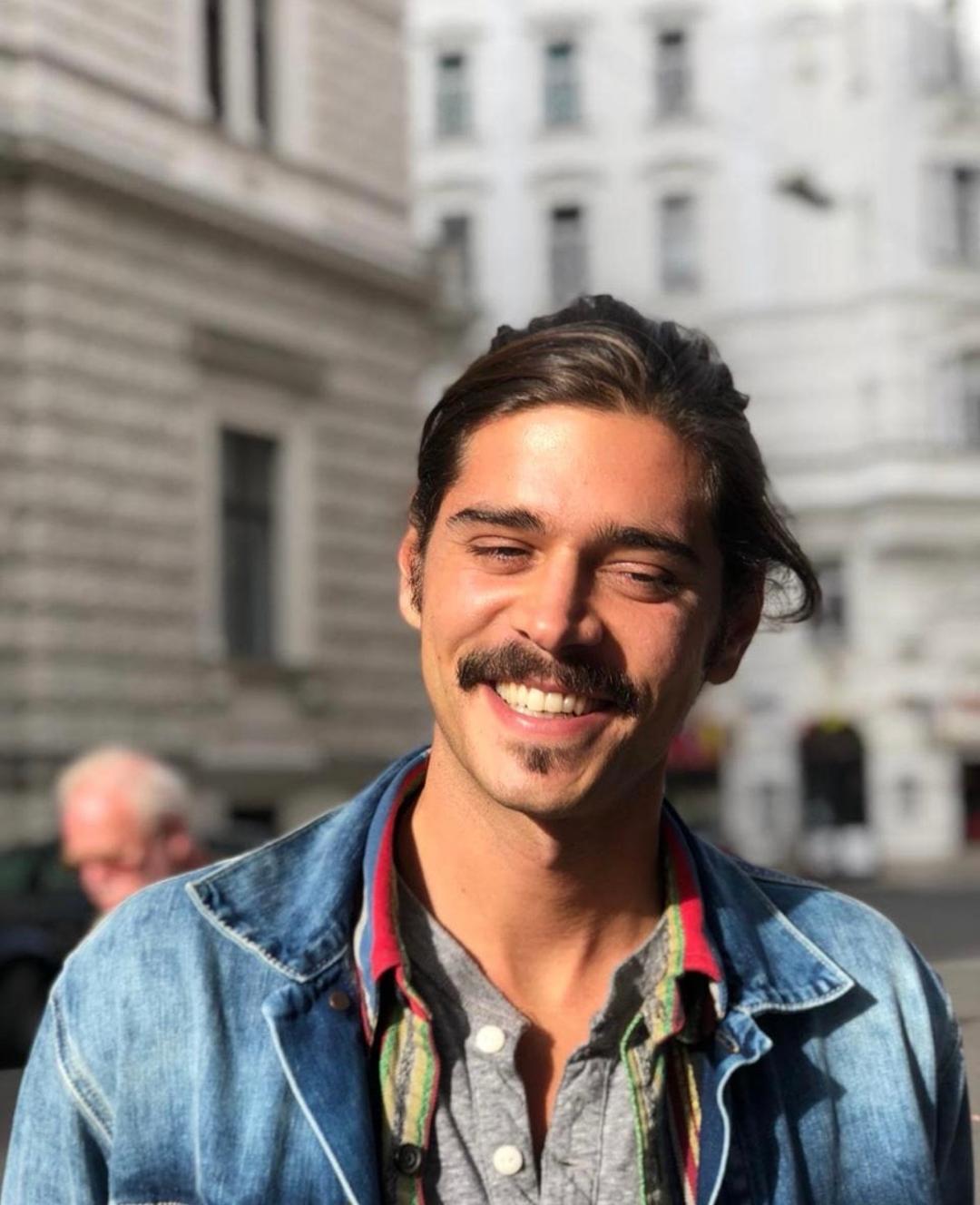
With architecture as your main field, what shaped your path and what would you consider its highlights?
If I had to single out the highlights of my journey, I would say the first defining moment was moving abroad, to Munich, where I completed my studies in architecture. This was followed by a period in Spain, with a year spent between Madrid and Seville—experiences that shaped me profoundly, both personally and professionally.
The travels, encounters, and collaborations that emerged during those years became the foundation on which my path was built. I’m not someone who operates with a strict plan; on the contrary, as a rather impulsive person, I allowed things to unfold more intuitively, driven by instinct and a curiosity for the new.
After gaining professional experience in various architectural offices, I gradually moved toward independence. First with Phormin, a visualization studio, then as co-founder of Meer Architekten in Munich, and later with the establishment of my own practice, Kalemis Architektur und Raum.
Returning to Greece with my wife and children after nearly 20 years now feels like a kind of completion of that early internal search—a circle closing while simultaneously opening a new one.
In Thessaloniki, this translated into the creation of the architectural office Takkt, as well as my involvement in Soulfood—the company behind the Thessaloniki Street Food Festival and Beer Festival Thessaloniki—and the co-founding of 45M2, a cultural space on Ernestou Embrar Street aimed at promoting emerging artists in the city.
How did architecture enter your life, and what is the story behind discovering a creative perspective through your work? How did it begin and evolve over time?
Architecture entered my life much like most of the decisions I’ve made—almost effortlessly. I sort of drifted toward it; it wasn’t a childhood dream or an obvious calling. My family supported my choice without pressure, more with the mindset of “try it and see.”
My first real connection came at university. That’s when it truly drew me in: endless hours of work, models, presentations—a kind of intensity that, for me, felt almost addictive. At the same time, creativity began to take shape, curiosity deepened, and knowledge kept opening new paths.
At some point—without realizing exactly when—it becomes part of you. It’s no longer just a profession, but a way of seeing and understanding the world. You become part of this “small sect” of people who touch facades to feel the texture of stone, concrete, or plaster, who overanalyze proportions and spaces while others look on in confusion.
It’s an incredibly multidimensional and deeply creative field—provided you engage with it meaningfully and continue to evolve it in your own way over time.
How do you think your aesthetic evolves?
Primarily through lived experience. Experientially, through continuous discovery—traveling, visiting spaces, observing and analyzing everything around me. It’s an open, almost daily process, fueled by images, materiality, and experiences.
At the same time, it evolves through practice itself: through trial and error, through critique, and through tangible outcomes. In architecture, design doesn’t remain theoretical—it reveals itself in what is built. That’s where your decisions are truly tested.
You compare, reassess, experiment—and through this process, you evolve. Perhaps that’s why no architect is ever fully satisfied with something they’ve just completed—because they already see what could be done differently in the next iteration.
What do you consider your most important achievements?
On a personal level, without a second thought, my greatest achievements are my children.
Professionally, I don’t feel I’ve yet reached a point where I would define something as an “achievement.” Perhaps because I see the journey as an ongoing process of evolution. If I felt I had already arrived somewhere, it would lose its meaning—the motivation to search, improve, and create.
I’m more interested in the process than in a final destination. Continuing to evolve, to test, and to discover is what keeps the energy and curiosity alive for what comes next.
What and who are the people around you that help you move forward?
Certain people have played a decisive role in helping me move forward.
First and foremost, my mother, who instilled in me a sense of confidence and encouraged me to claim what I want—to see happiness not as something accidental, but as something I’m entitled to.
And of course, my wife, Christina, who—despite having to live with someone who is internally restless, work-driven, and often demanding—remains steadily by my side. She supports me in a meaningful way, celebrates my successes, and shares in my disappointments. She is someone who brings balance and meaning to this entire journey.
What materials do you love, and how do you experiment with them?
I try not to focus on a single material, as I believe each one has its own reason for being and its own way it should be used. For me, architecture is not about favoring specific materials, but about understanding their nature and handling them appropriately.
Perhaps, due to my experience in Germany, I’ve explored timber construction more deeply, moving away from the conventional dominance of concrete and brick. What’s interesting about wood is that it exists in time: it changes appearance and texture, it ages, it “comes alive,” and evolves alongside the user and the space. It’s a more ecological, more immediate material, with an almost organic presence.
For me, experimentation happens through practice—through testing different combinations, details, and applications. It’s about how one material meets another, how it wears, how it responds to light and use. It’s an ongoing process of exploration, where each project becomes a kind of small laboratory for development.
Tell us about your transition from Munich to Thessaloniki. How different are things in Greece, and what keeps you here?
The transition from Munich to Thessaloniki was relatively smooth. I still maintain my office in Munich alongside the one in Thessaloniki, which means I travel frequently and stay actively connected to both cities.
Coming back, I essentially knew what I was returning to. There were already constants—family, friends, familiar places—that helped create a sense of balance in everyday life. This dual presence allows me, in a way, to bridge the two environments and draw from the positives of both.
The differences are clear, but I wouldn’t say one is “better” than the other. There are challenges everywhere—some we already know, others we discover along the way. What matters to me is that I’ve found a balance that allows me to work creatively and feel that I belong to both places.
What kind of creative outlets have you developed in the city?
Beyond the framework of traditional architecture, I’ve sought out other creative outlets within the city—ones that function in a more open and collective way.
I’m part of the creative team behind the Thessaloniki Street Food Festival and the Beer Festival Thessaloniki—two events that activate public space and bring together gastronomy, culture, and the social life of the city.
At the same time, I run 45M2, a space on Ernestou Embrar Street that operates as a platform for emerging artists, in a more informal and immediate way.
These axes—architecture, design, gastronomy, and art—form the core pillars of my interests and shape my creative expression within the urban fabric.
That said, my most essential outlet is always outside the city, in nature. That’s where balance is restored and the mind clears in a way no urban activity can replace.
Is your architectural thinking the same wherever you are, and how does it adapt to different conditions?
There is certainly a personal design language that evolves over time. However, for me, architecture is inseparably connected to the environment it inhabits, so approaches can’t be fixed or standardized.
Each project emerges from the specific parameters that define it. A new building is always in dialogue with its surroundings—whether that’s a natural landscape or a dense urban fabric. Understanding and “translating” these conditions leads to a different outcome each time.
In this process, the client’s vision also plays a crucial role and must be interpreted and integrated in a way that genuinely meets their needs, without compromising the coherence of the architectural proposal.
For this reason, I don’t believe there is a distinct approach that changes from country to country, such as Greece versus Germany. Each project is a new condition, a new equation—and the answer emerges from the process itself.
Do you follow your instinct, or are there techniques that guide you? Is architecture a matter of the heart, or something that can be learned?
I believe architecture begins with an inner drive—you have to love it early on in order to truly develop it. It’s not a profession that can be fully “learned” in the way something more technical might be.
What you can learn are its individual aspects: managing an office, believing in the value of your work, communicating with people and clients, and understanding construction. All of these develop and improve over time.
Creative thinking, however—imagination—is not taught in the same way. It exists in everyone, but in some people it’s constrained or held back by circumstances, fears, or environments.
For me, it’s a combination. There’s instinct, which guides you and gives direction, but also experience and knowledge, which allow you to translate that instinct into something tangible. In the end, architecture is both a matter of the heart and an ongoing process of learning—one that is never fully complete.
Have you experimented with other forms of art? What else shapes your field of exploration?
I wouldn’t say I’ve experimented with other art forms in the traditional sense, like music or painting. My interests revolve more around the nature of materials themselves. I’m particularly drawn to extending the lifecycle of materials and to the idea of circular design.
Reuse—especially through temporary structures—is something I’ve been exploring for years. That’s where I find a different kind of creativity—not necessarily “art” in the conventional sense, but a process of transformation.
The idea that a material can gain a second life, shift function, and be reintroduced into a new context is, for me, a deeply meaningful creative pursuit. In this space, architecture intersects with environmental awareness and design freedom.
What has extroversion offered you, and how does it affect your work?
Extroversion certainly helps in promoting my work. In architecture, in order to create, you first have to convince the client that you’re capable—that you can deliver. It’s a field that doesn’t easily forgive mistakes, especially when they directly affect others.
That said, extroversion alone doesn’t open doors. Self-promotion without substance isn’t enough. It’s the combination of extroversion with professionalism, consistency, and reliability that ultimately makes the difference.
When these elements come together, it becomes easier to build trust, form relationships, and establish your place on the map. And that, in turn, influences the work itself—because it gives you the opportunity to realize ideas that might otherwise remain theoretical.
What do you love—and what don’t you love—about Thessaloniki?
What I love about Thessaloniki is its strong contrasts: the sea set against the mountains, a Byzantine monument next to a 1960s apartment block, the coexistence of a laid-back atmosphere with the city’s intensity. All of this creates a unique identity.
On the other hand, I miss green spaces—parks. I miss proper cycling infrastructure. I miss cleanliness. It’s one of those cases where you can clearly see what the city could be—and that makes what it actually is feel frustrating.
What disappoints me most is its unrealized potential. There’s a dynamic that remains inactive, a perspective that hasn’t yet been translated into action.
How would you like its architecture to evolve, and which parts of the city do you prefer?
The city’s architecture should place much greater emphasis on public space—especially on how people perceive and respect it. Public space is not just the void between buildings; it is the primary stage where collective urban life unfolds.
Unfortunately, at least for now, much of the work produced by architects in the city is limited to interior architecture. As a result, there’s a lack of comprehensive approaches that address the city as a whole. There is a noticeable absence of projects with strong aesthetic and sustainable qualities, as well as a coherent overall vision of the urban experience.
It would be interesting to see more interventions that not only improve the quality of individual buildings but also strengthen the relationship between old and new through meaningful dialogue, rather than simple contrast.
As for my favorite spots in the city: definitely the waterfront—especially the steps that lead down to the water along the outer edge—the narrow streets of Ano Poli, Olympou Street with its small square near the Church of the Twelve Apostles, and finally a hidden, often overlooked place: the outdoor amphitheater of the Macedonian Museum of Contemporary Art.
What’s the most extravagant thing you’ve ever done?
Perhaps the most “extravagant” thing I’ve done was walking one of the Camino de Santiago routes—the Portuguese Camino, one of the historic pilgrimage paths. I walked περίπου 300 kilometers over ten days, starting from Lisbon and reaching the cathedral of Santiago de Compostela in Spain.
It was one of the few times I truly gave myself the space to disconnect from everyday life and confront deeper thoughts and experiences. A physical journey, but also an intensely internal one—a path that brings you closer to what you usually overlook.
Which architects and designers do you admire most, and why?
There are several architects who have influenced me in meaningful ways, each for different reasons.
Alejandro Aravena, founder of Elemental, for his work in social architecture. His approach to social housing, with open and accessible construction strategies, shows how architecture can function as a tool for social change.
Aires Mateus, for their minimalism and the clarity of their volumetric compositions. Their work carries a sense of calm and strength that emerges through simplicity.
Valerio Olgiati, for the consistency of his thinking, his recurring motifs, and his self-explanatory concepts. There’s a clarity and rigor in his work that makes it immediately legible, yet deeply architectural.
And Atelier Fala, a group of young Portuguese architects, who, for me, bring one of the most playful approaches to design. They experiment with textures, materials, and geometries in a fresh and liberated way, introducing a different energy into the contemporary architectural scene.
Are we defined by the choices we make?
Our choices shape us, guide us, and help us evolve.
“Wrong” choices don’t define us as wrong people. They are part of the process. They are allowed—and often necessary. Through them, we come to understand ourselves better, redefine our path, and gain depth.
Ultimately, it’s not individual choices that define us, but how we process them and how we move forward afterward.
Is art and creation a path toward becoming better people?
Art and creation can be a path toward becoming better people—but not automatically.
If what you create has a positive impact on those around you, then yes. If the act of creating doesn’t turn into a constant inner unrest that consumes you, then yes. If it offers you a sense of calm and fulfillment, then yes.
Creation has a dual nature—it can elevate you, but it can also exhaust you. The challenge, perhaps, is to find the balance where it works in your favor rather than against you.
What does true happiness mean to you?
For me, happiness is not fixed—it changes with the stages of life.
There was a time when happiness meant travel, friends, and the freedom of discovery. Today, it has taken on a more essential and quiet form. It’s family. It’s the moment I open the door and hear my daughters calling “dad.”
How would you define beauty?
I believe in objective aesthetics—in beauty as something that is not purely subjective or simply a matter of personal expression. There are relationships that work and others that don’t: colors that clash, scales and proportions that fail. It’s no coincidence that concepts like the golden ratio reappear across time.
I believe aesthetic awareness should be cultivated from an early age—not to impose rules of taste, but to sharpen observation and sensitivity toward space and the relationships that define it.
For me, beauty is not accidental. It is the result of balance, proportion, and underlying principles that, when aligned, produce something almost universally recognizable.
What else would you like to design?
Through competitions, I’ve had the opportunity to design a wide range of projects—from museums to fire stations, as well as more conceptual proposals that don’t necessarily relate to built reality. It’s a process that expands thinking and allows for experimentation.
In my everyday practice, however—through which I make a living—I mainly focus on small- to medium-scale residential projects, with an emphasis on luxury living.
What would particularly interest me is working on projects with a stronger social impact, such as social housing or schools. Using simple architectural strategies and low construction costs to create sustainable spaces of high aesthetic quality.
I believe that designing within such constraints and goals is far more demanding and meaningful than a luxury private commission. That’s where architectural thinking is truly tested.
What feels authentic today?
It lies in what doesn’t try to prove its value. In what simply exists—steadily and meaningfully. Because what is truly authentic doesn’t need an audience to be real.